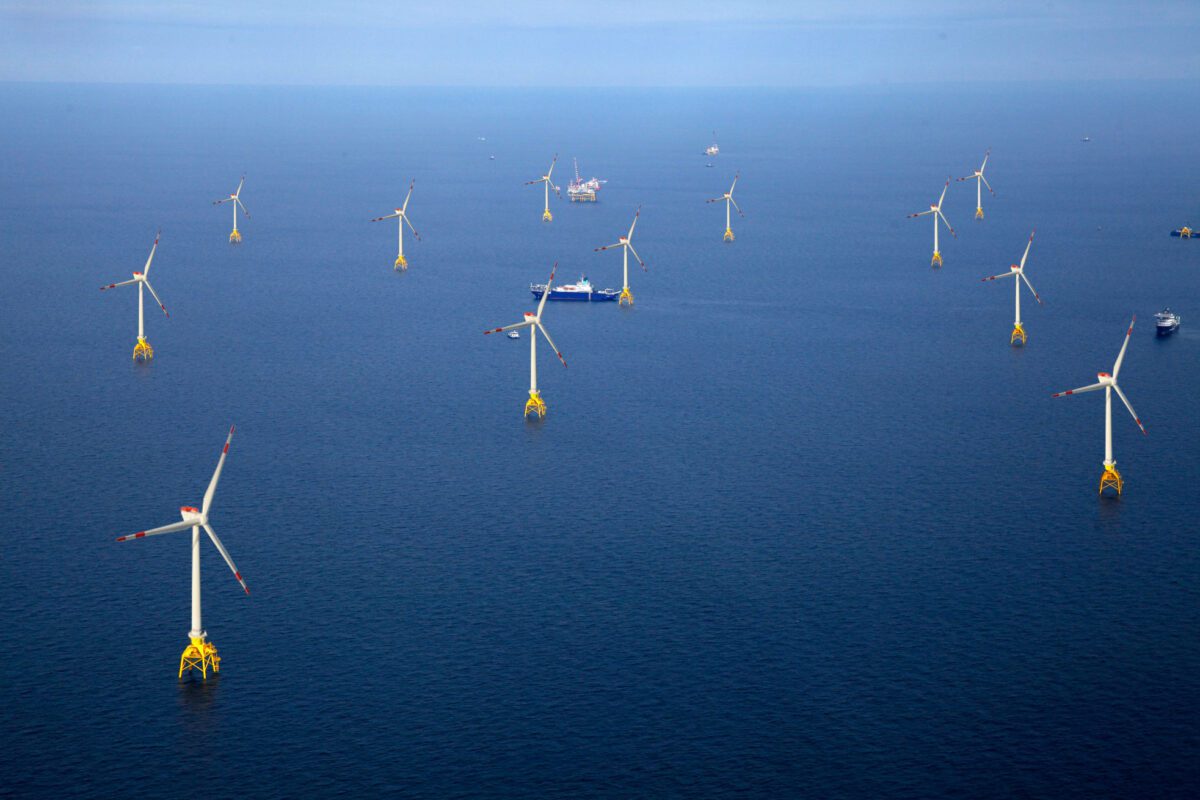
The Australian business subsidiary of Spain’s Iberdrola has obtained regulatory approval to conduct ocean studies for its huge Aurora wind project proposed for a site off the coast of Victoria, signifying a huge milestone in the project’s development.
Iberdrola says it has received the green light from the Offshore Infrastructure Regulator (ORI), which means it can now commence important metocean and wind studies in the area earmarked for the wind farm.
Although commencement of the recently approved studies are dependent on weather conditions, Iberdrola hopes to kick off its investigations sometime later this month.
In order to gain a greater understanding of the proposed project area, Iberdrola plans to deploy three types of equipment: floating LiDAR buoys, wave buoys and sea frames.
The developer will use these to collect a whole host of wind, waves, currents, water levels, meteorological and oceanographic data which it will then use to guide the final design of its wind farm.
Located between 25-50km off Victoria’s shoreline, the project is expected to comprise 150 turbines with a cumulative capacity of 3GW at final buildout.
The first 1GW of the project is expected to be operational by 2032, however, this timeline is subject to additional permitting approvals.
Offshore auction
This recent news follows on from Iberdrola recently receiving a feasibility licence from Victoria’s Labor Allen Government, allowing the developer to assess the suitability of its Aurora project through various environmental assessments for up to seven years.
The Aurora project is one of 11 projects to have obtained one of these licences so far which are all located off the coast of Victoria’s Gippsland region.
In an attempt to meet its target of having 9GW of offshore wind capacity by the end of 2040, the State Government recently announced plans to launch Australia’s first ever offshore wind auction.
After asking licence holders to register their interest in such a scheme during May of this year, the auction is expected to launch in September, with contracts handed out before next October.
Although the specifics of the scheme have yet to be revealed, it’s expected that developers will receive guaranteed payments via contracts for difference (CfD) agreements.
Under a scheme such as this, developers are paid a fixed price for electricity, known as the strike price, no matter the cost of wholesale electricity. In the event the strike price falls below the wholesale price, developers are paid the difference.
Conversely, if the strike price falls below wholesale, developers are required to pay back the difference.
With the holders of CfDs essentially shielded from volatile wholesale electricity markets, developers are able to plan ahead with more certainty, leading to the increased likelihood of third-party investment.
These schemes have proved very popular with global grid operators wanting to boost renewable energy deployment – particularly for offshore wind, with its added construction complexity and lengthy lead times.
The UK’s CfD scheme made major headlines earlier this year, after Orsted shelved plans for one of the world’s largest offshore wind projects, after previously obtaining one of these Government-backed agreements.
The Danish developer blamed the decision on “adverse macroeconomic developments, continued supply chain challenges, and increased execution, market and operational risks.”