A massive 10-hour battery has just landed in the federal green queue, but is facing a second review in its home state after being bombarded by objections.
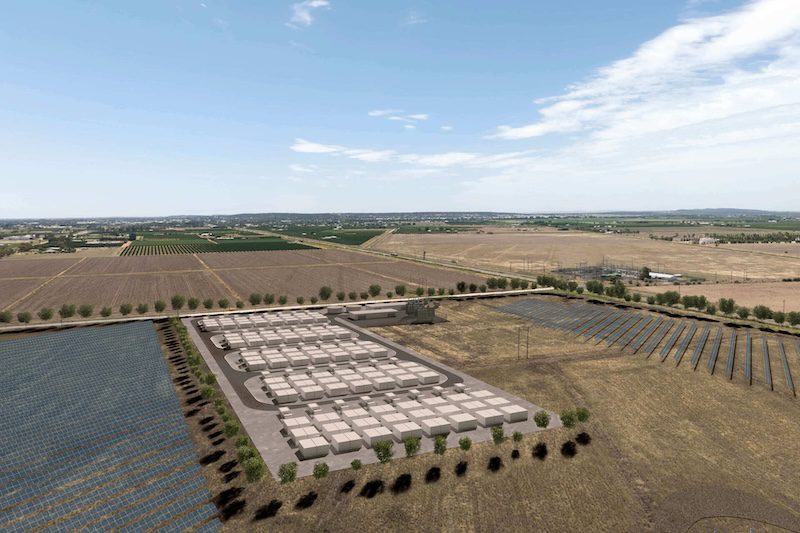
Eku Energy’s Griffth battery, a 100 megawatt (MW), 1000 megawatt-hour (MWh) project proposal, will sit in amongst one already operating solar farm and another under development, just outside the New South Wales (NSW) town of Griffith.
In its original 800 MWh form, it was one of the first eight-hour batteries to win an underwriting agreement through the NSW government’s Electricity Infrastructure Roadmap in 2023. The first of those eight-hour batteries, at Limondale, is now up and running.
The NSW planning application is for 10-hours of storage, possibly to build in added redundancy, or more flexibility, and it turns out that some people who live in Queensland, Tasmania, Victoria and hundreds of kilometres away in other parts of NSW are annoyed.
The project attracted 74 objections, of which just one was truly local, a man who lives 650m down the road from the battery and solar projects developments and was worried about road use, and noise and air quality.
As is now common, most of the objections to the project were anonymous and, apart from the local man’s worries, repeated the same stale, and occasionally unhinged comments that are regularly copy-pasted into the submissions process.
These include concerns about foreign ownership, that “ruin-abulls” (sic) create a fire risk that could release toxic chemicals, and of Chinese Communist Party control of the energy sector.
A group called Save Our Surroundings Redbank Plains, a suburb outside Brisbane, objected on the grounds that it is an “evil, poisonous and treacherous plan that’s designed to rip off Australian people, contaminate our land/water /biodiversity/the public and enable our greatest enemy to control and harm us.”
The project is expected to be referred to the NSW Independent Planning Commission because of the volume of objections.
According to the separate EPBC referral, the project itself will take up about 7.5 hectares of land including the road reserve needed to connect the battery to TransGrid’s 132 kilovolt (kV) substation.
It will be tucked inside the under-development 15 MW Yoogali solar project. A paddock away is the 36 MW Griffth solar farm and even closer is the pre-construction 40 MW Riverina solar project, notes the scoping report lodged with the NSW planning department.
While batteries have tended to fly through the federal green queue without needing any oversight, developers have been taking the cautious approach and putting almost all storage projects into the EPBC process.
Sitting as it will in a paddock, surrounded by industrial farmland, energy projects, and the towns of Yoogali and Griffith, the Griffth battery may too find the EPBC path fairly simple.
The area is at moderate risk of bushfire and while there are old irrigation canals running through the site, it has not seen any recent flood events nor fires, the EPPBC referral says.
“The broader Griffith region is well known for its strong agricultural character, with agriculture, forestry and fishing the region’s second largest industry. The land surrounding the Project Area is primarily used for electricity infrastructure, and agricultural uses,” the referral says.
In fact, an environmental survey couldn’t find any threatened species or habitats on the site, and a handful of weeping Myall acacia trees on the other side of the road couldn’t count as an ecological community, even though the trees are listed with the EPBC.
If you would like to join more than 29,000 others and get the latest clean energy news delivered straight to your inbox, for free, please click here to subscribe to our free daily newsletter.