South Australia (SA) could benefit from pumped hydro energy storage (PHES) as it tracks towards 100% average solar & wind in 2027. SA has dozens of PHES sites close to roads, water, cities and transmission that offer competitive, large (15-50 GWh) 100-year-lifetime energy storage
For comparison, Snowy 2.0 has 350 GWh of storage and a big battery stores around 1 GWh. PHES provides a large energy sink by soaking up excess solar and wind on sunny and windy days and exporting it to the eastern states days later at much higher prices.
This stored energy also reduces local gas generation and electricity imports during calm and cloudy periods. A large energy buffer also reduces the need for standby gas generators should transmission lines fail.
The table shows potential PHES sites in SA including links for visualisation. The parameters are explained in this article. Indicative construction cost per GWh is $90-100 million for Leigh Creek (Class A), $120-170 million for Class B sites, $350-400 million for big batteries (GenCost) and $34 million for Snowy 2.0 (Class AA).
Land requirements are small: around 10 kWh per m2 compared with 15 kWh/m2 and 4 kWh/m2 for the 0.45 GWh Victorian Big Battery and an EV respectively.
Water (about 1 Gigalitre per GWh) is a small component of system cost and a small fraction of agricultural water. The same water cycles between the reservoirs for 100 years, and effective evaporation suppressors are available.

Leigh Creek
Interesting 50-500 GWh Class A PHES sites are available near Leigh Creek, 300 km north of Port Augusta, where solar and wind is often available when it is cloudy and calm in the southeast. Leigh Creek could be connected to Sydney-Melbourne transmission with a 900km long powerline via Broken Hill.
Leigh Creek can store days or weeks of solar and wind generation, allowing its powerlines to operate at full load for most hours of the year rather than only when sun and wind are available. For example, 5 GW of solar plus 2 GW of wind could deliver 2 GW of 24/7 power to Sydney, Melbourne and Adelaide. Average demand in SA is 1.6 GW.

Hybrids
PHES and batteries work well together as a hybrid. PHES is cheap for energy storage (GWh) because adding more storage merely requires scooping more rock from the bed of the reservoirs to make the dam walls a few metres higher. Batteries excel for rapid high power (GW) applications.
Hybrids harvest high prices when generating and are recharged with cheap electricity. For example, a 50 GWh PHES system with 0.5 GW pump/turbine has a duration of 100 hours (Snowy 2.0 has 160 hours). It can be matched with 1 GW of 4-hour batteries to form a 54 GWh, 1.5 GW, 36-hour hybrid.
From 8am to 4pm on sunny days the PHES and batteries soak up excess low-priced electricity with power up to 1.5 GW. For the next 16 hours, the batteries trickle-recharge the PHES with power up to 0.5 GW. They can do this for a week before the PHES is full. In a calm and cloudy week, the batteries meet the morning and evening peaks and are trickle-recharged by the PHES at other times.
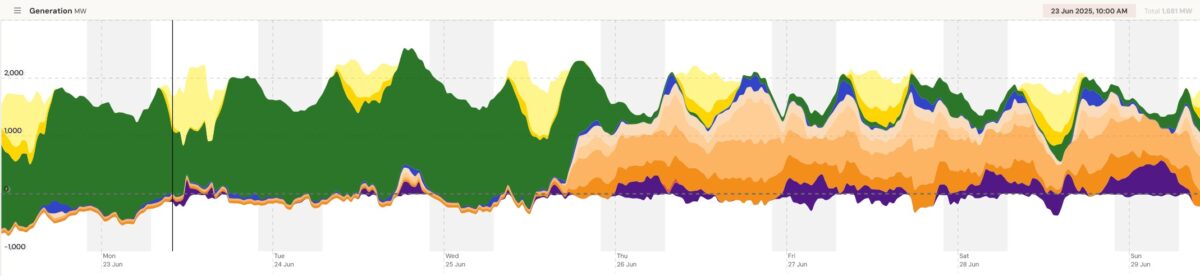
The figure from OpenElectricity illustrates a week in late June and shows how PHES could be recharged from wind (green) and solar (yellow) with low-negative prices (left half), and then make a lot of money by displacing gas (orange) and imports (purple) in the following week of calm weather (right half) when high prices prevail, up to $15 million per GWh.