There are a few moments in adult life when you realise you’ve crossed some invisible threshold. Having regular discussions about interest rates. Having strong opinions about insulation. And now, apparently, getting excited about standing at the front of your house at 8am watching three people unload what looks like the contents of a small data centre.
What’s happening at my place is far from unique. Australia now has hundreds of thousands of homes with solar and battery systems, and the rate of adoption has accelerated sharply, particularly since the federal battery rebate came in to effect in 2025. An estimated 200,000 households have added storage with the rebate, with hundreds of thousands more in consideration.
Households are effectively becoming small power stations that can generate, store and, if needed, feed energy back into the broader grid. This shift isn’t just about reducing bills, it also reflects a transition in the relationship between consumers and the electricity network. Where once energy flowed one way, now homes like mine will be able to push power upstream during the day and draw only when absolutely necessary.
A couple of months ago, Sungrow and Aiko approached me to record this process of installing residential storage and solar. Sungrow provided a 25kWH battery, a 10kW hybrid inverter, and their EV charger. AIKO provided 21 of their Neostar 475W solar panels, I paid an extra surcharge to beef it up to 28 panels, totalling 13.3kW in total.
This article focuses on the installation itself. Over the coming weeks and months, I’ll be collecting data and reporting back on what living with solar and battery storage actually looks like for a fairly typical house in Sydney.
The rise of home batteries isn’t just about panels on roofs and shiny screens in apps. It’s about a shift in energy behaviour and expectations.
A decade ago, solar was largely about reducing daytime grid imports. Batteries were niche. EVs were still niche. Today, all three are converging. The average Australian household that installs solar and batteries now often couples that with an EV charger, a trifecta that makes the home more self-reliant than ever.
It’s one thing to generate energy during the day; it’s another to store it for night-time use and to power a vehicle. That’s a form of electrification that has implications for households and the grid.
Policy makers have taken notice. Governments and network planners are increasingly tasked with designing tariffs, rebates and incentives that reflect this new reality, and not the old one where everyone passively consumed power from the network.
There’s obvious environmental benefit to this trend. But there’s an equally important economic and behavioural dimension: homes with storage and EV charging participate in the energy system in a way they never did before.
The first thing that goes on the roof isn’t solar panels. It’s racking. Aluminium rails get fixed into the roof structure, and everything else attaches to that. It’s not glamorous, but it’s arguably the most important part of the entire system. Once it’s in, the panels aren’t just sitting on the roof, they’re tied into the bones of the house.

Next, solar panels get lifted, aligned, and clamped into place. These aren’t things you throw up in a hurry. 28 of these AIKO Neostar 475-watt units come with with modern cell technology designed to extract every last bit of energy from the sun.
They look nice on the roof, and they’re doing the work that will ultimately keep the lights on for years. Watching the installers handle them, you realise this isn’t a hobbyist operation. It’s professional work that requires professional attention to detail, and made it clear the importance of finding a properly trained and qualified installer when undertaking a project like this.
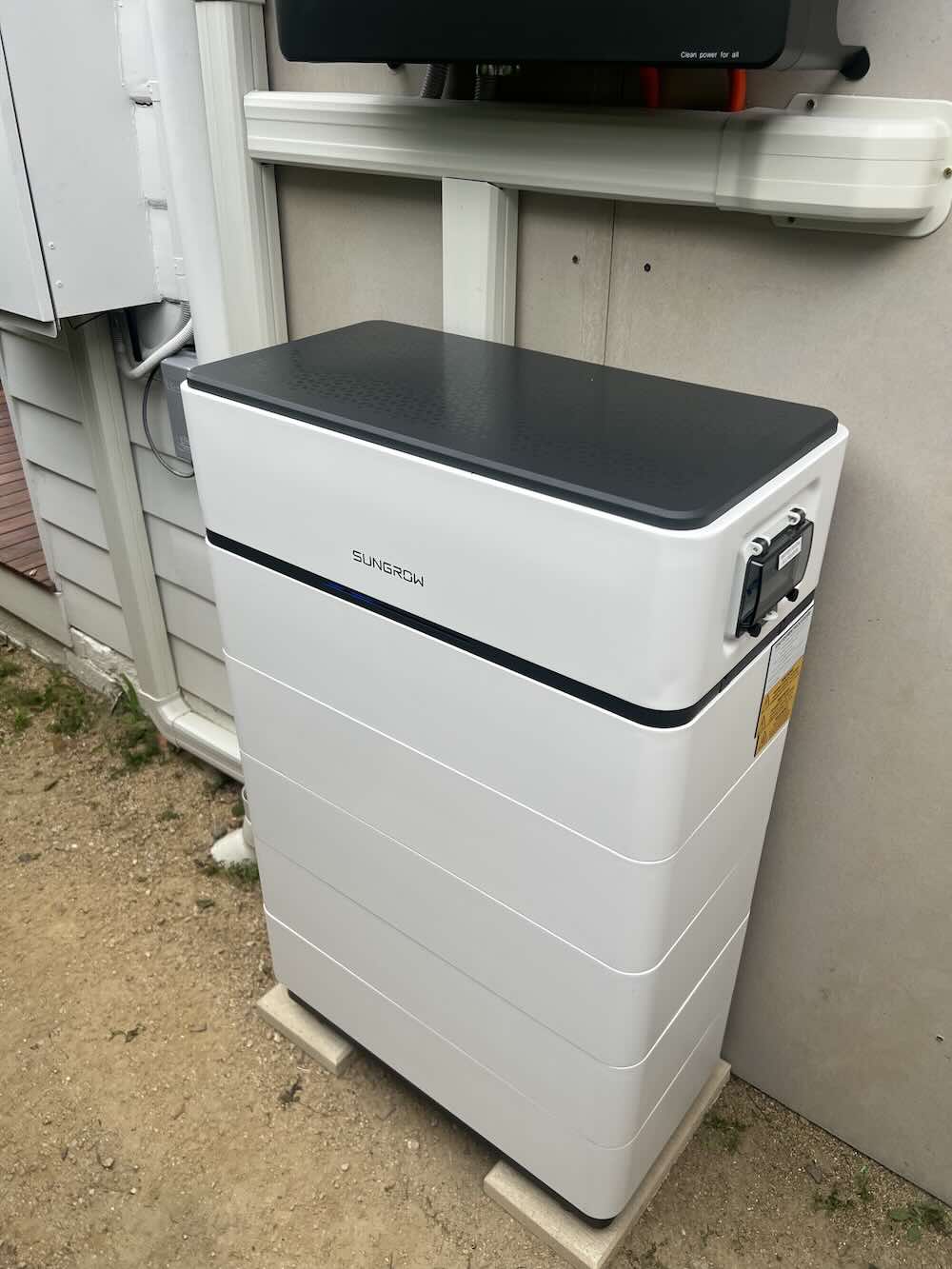
The Sungrow SBH250 battery system is modular, with 5kWh modules stacked to make 25 kilowatt-hours in total. That’s substantial storage by household standards, and it reflects a wider trend. Two or three years ago, most residential battery installs were more modest; today they’re becoming bolder and larger as prices continue to fall and homeowners see the value in storing their own solar and find ways to export with a more reasonable feed-in tariff (FiT).
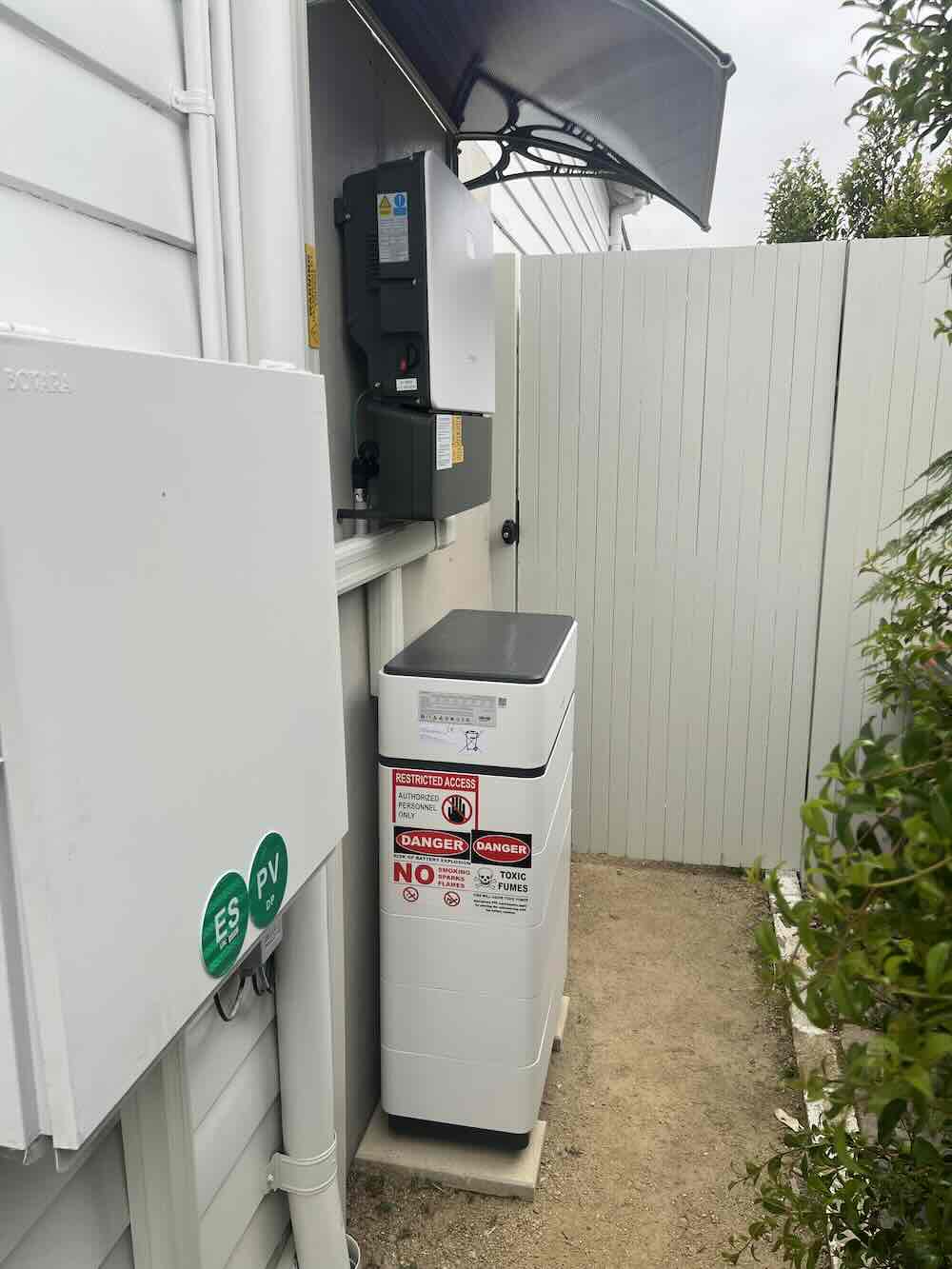
The work continues with the installation of a 10kw Sungrow hybrid inverter, heavy cabling, safety sheeting, communication modules, and the Sungrow AC-22 EV charger. There’s a pleasing amount of precision to it all. It feels like something modern but sensible, like having a very technical appliance rather than a futuristic gadget.
It’s worth noting that not every house is equally suited to this transition. Roof orientation, shading, local network constraints and the structure of electricity tariffs all play a role in whether a solar + battery + EV system is worthwhile. For some households, the economics are obvious. For others, the payback is still a long slog. But for many, there’s an intangible benefit in energy independence. It’s a feeling that in an age of rising prices and uncertain energy markets, you have some control over your own energy destiny.
After less than two days, I realise my house has quietly joined the distributed energy system. It doesn’t hum or glow. It just quietly shifts energy from sun to battery to appliance to car to grid, all coordinated by software you can check on your phone. I’ve now gone from being a consumer to a prosumer. My home will no longer just consume energy, I will now be able to generate, store, schedule and export it. A reversal of a century-old relationship. Electricity was once something people simply used. Now it’s something people can manage, optimise, and increasingly control.
With the installation complete, I have started the process of watching generation and consumption, tweaking behaviour, learning real-world performance, and finding out whether the ROI on what is (despite the current rebates) a substantial financial investment for most households. I’ll be checking back in after a month to report on all these things. If you have anything in particular you would like me to cover in my findings, drop a comment!
This article is part of a 3-part series capturing the real-world process of installing and living with residential household and battery storage, sponsored by Sungrow and AIKO.
Installed equipment:
AIKO Neostar 2P+ 475w Solar Panels (13.3kW total)