The number of home batteries installed through the federal rebate has now passed 430,000, as new rules start to rein in what has been stratospheric uptake of residential energy storage – and to dial down the average system size being installed.
Carl Binning, executive general manager of the scheme operations division at the Clean Energy Regulator, has given a fresh update on the progress of federal Labor’s enormously successful Cheaper Home Batteries scheme, just over a month after new settings were introduced.
“We’re just about to hit 12.5 gigawatt-hours of installed battery capacity, and we’ve just breached 430,000 households,” Binning told Australian Energy Week 2026 in Melbourne on Thursday.
“The little kink in the curve there that you can see at the top [of the chart, below] is when the incentive, particularly for larger batteries, was recalibrated on the first of May, but in interacting with the industry, I see sustained demand for battery installations in the coming period.”
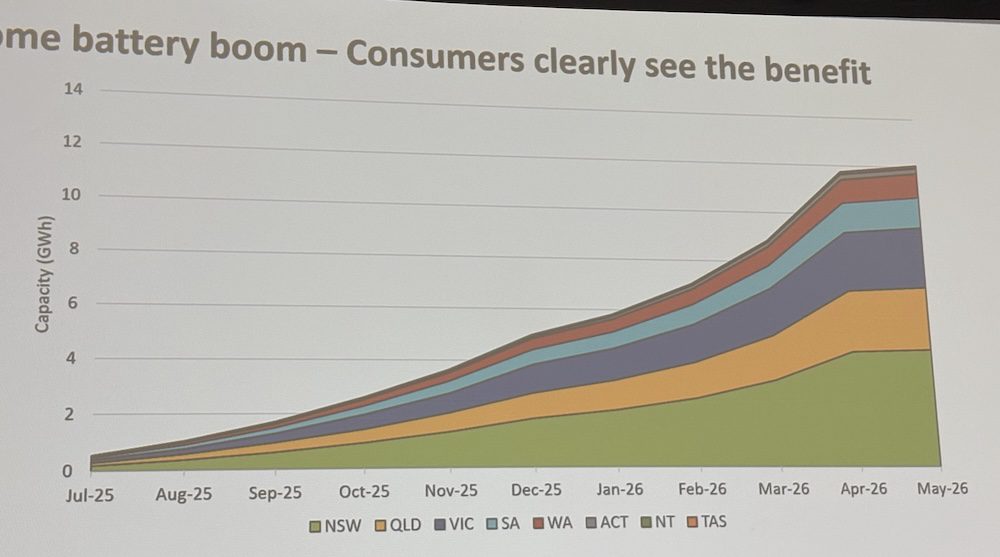
Chart: Clean Energy Regulator
Binning says the new settings of the rebate – which ratchets down the discount for storage capacity above 14 kWh and then again above 28 kWh – have also led to a decrease in the average battery size being installed, which had hovered between 40-50 kWh at the height of the boom.
“Household demand will be recalibrated, probably between 20-30 kilowatt-hours (kWh), rather than beyond 30 kilowatt-hours,” Binning told the conference. And he says a decent chunk of installations are for return rooftop solar customers.
“We’re seeing about 25 per cent of installations associated with replacement systems; so that’s small, below five kilowatt systems that probably had a generous feed-in tariff, reached the end of the contract … installing a 10 to 15 kilowatt system with a 20 to 30 kilowatt-hour battery.”
Binning says rooftop solar is booming too, with a record “790-odd MW” of new small-scale solar capacity installed over the first three months of the year, so far.
“That’s] the biggest quarter on record. And in April, alone, there was 441 MW of domestic solar installed. … I can easily see 4 GW of installed domestic solar per annum in the outviews, which is a significant uplift.”
Earlier in the week, AEMO boss Daniel Westerman said home batteries were clearly delivering benefits to the grid – in terms of energy reliability and security – and to consumers (in terms of lower prices), even without being part of a virtual power plant.
If you would like to join more than 29,000 others and get the latest clean energy news delivered straight to your inbox, for free, please click here to subscribe to our free daily newsletter.