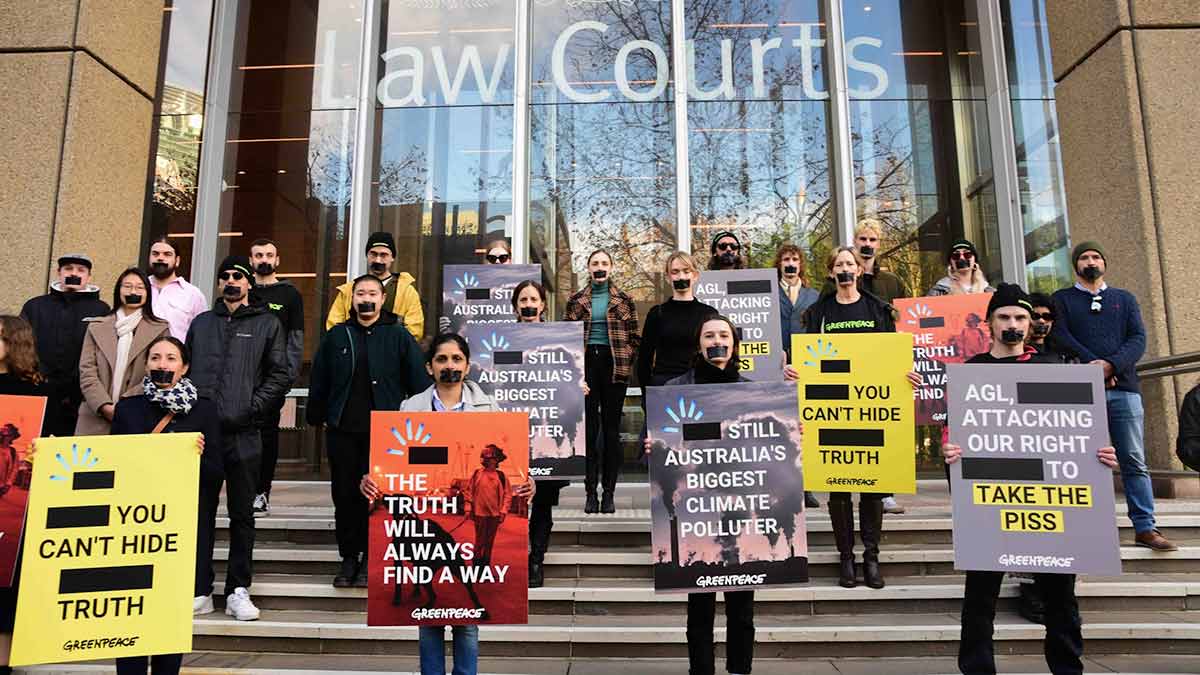
Greenpeace Australia has claimed a legal victory after the Federal Court ruled that the environment group could use the logo and branding of AGL Energy in activist campaigns, finding that they protected forms of parody and satire.
AGL had commenced the proceedings in the Federal Court in an attempt to prevent Greenpeace from using the company’s logo and branding style in an advertising campaign that labelled AGL as “Australia’s Greatest Liability” and which sought to highlight AGL’s position as Australia’s single largest greenhouse gas emitter.
In a judgement delivered on Thursday afternoon, Federal Court judge Stephen Burley said Greenpeace had successfully argued that their campaign targeting AGL could be considered ‘parody’ material and was allowable under the ‘fair dealing’ provisions of copyright legislation.
The judgement raises the prospect that other companies could become the target of similar “brand jamming” campaigns, where company logos are used by campaign and activist groups to draw attention to their environmental impact.
“Today’s legal victory is good news for charities, advocacy organisations, satirists and anyone else who seeks to rely on the “fair dealing” freedom of speech safeguard in the Copyright Act to criticise, review, satirise or parody powerful corporations,” Greenpeace Australia general counsel Katrina Bullock said.
Greenhouse gas emissions data published by the Clean Energy Regulator show that AGL Energy is by far Australia’s single largest greenhouse gas emitter.
In 2019-20, AGL produced 42.2 million tonnes of carbon dioxide equivalent emissions, more than two-and-a-half times more than the next largest company. AGL operates the Loy Yang A and Bayswater power stations, which rank as Australia’s top two power stations in terms of greenhouse gas emissions.
The court ruled that campaign materials that had been ‘transformed’ by Greenpeace, through the use of additional imagery or wording, could amount to a parody of AGL’s branding and so did not fall afoul of the copyright laws.
The judgement found that it was not the use of AGL’s logo that may be damaging to the company’s brand, but it was rather the impact of the information included with it, including that AGL was a significant greenhouse gas emitter.
“It is not the use of the AGL logo in the campaign that causes damage, but rather the informational message that is communicated in the campaign, in particular by referring viewers to the Exposing AGL report about the corporate entity,” the judgement says.
However, AGL was partly successful in seeking an injunction against the use of campaign materials that involved a more straightforward use of the company’s branding and where Greenpeace had failed to show that it had produced a parody work.
An alternate argument, that Greenpeace had breached AGL’s trademark protections, was rejected by the court as AGL could not establish that Greenpeace was using AGL’s logos to promote a business or service.
The court has ordered that both AGL and Greenpeace meet to discuss and suggest the next steps and how they propose to implement the decision of the court.
AGL Energy said that it welcomed the judgement and the injunctions that the Federal Court awarded with respect to parts of Greenpeace’s campaign. AGL said that it had never intended to stymie debate about its greenhouse emissions footprint but only sought to protect its logo and branding.
“As we’ve always made clear, this legal action was about the integrity of how our brand is used,” an AGL spokesperson said. “We regularly engage with Greenpeace to discuss their concerns and acknowledge the important role activist organisations play in holding organisations and governments to account.”
“We look forward to our continued engagement with Greenpeace on these important issues and welcome the opportunity to be part of the public debate in relation to climate and how we can work together to deliver Australia’s energy transition.”
“AGL understands its role as Australia’s largest integrated energy generator to lead the energy transition while continuing to deliver reliable and affordable energy,” the spokesperson added.
Greenpeace Australia campaigner, Glenn Walker, said that he welcomed the decision but that he hoped the campaign would ultimately work to convince AGL to address its significant greenhouse gas footprint.
“Today’s ruling in favour of Greenpeace is an affirmation that the law is on the side of freedom of expression. But this is just the first victory,” Walker said. “Our campaign to expose AGL as Australia’s single biggest corporate contributor to climate pollution and to pressure it to close its coal-burning power stations will continue for as long as it takes to win. This is much bigger than a court case over a logo – it’s a fight for the future.”