Tasmania’s first renewable hydrogen production plant has been launched north of Hobart, where it will produce 262kg of the green fuel a day – enough to run the equivalent of two fuel cell powered passenger ferries.
The launch of the Blue Economy CRC’s Hydrogen Production and Research Facility marks the first time green hydrogen will be produced in Tasmania, and delivers a welcome bit of progress for the sector when many much more ambitious projects are being dialled down, dumped or delayed.
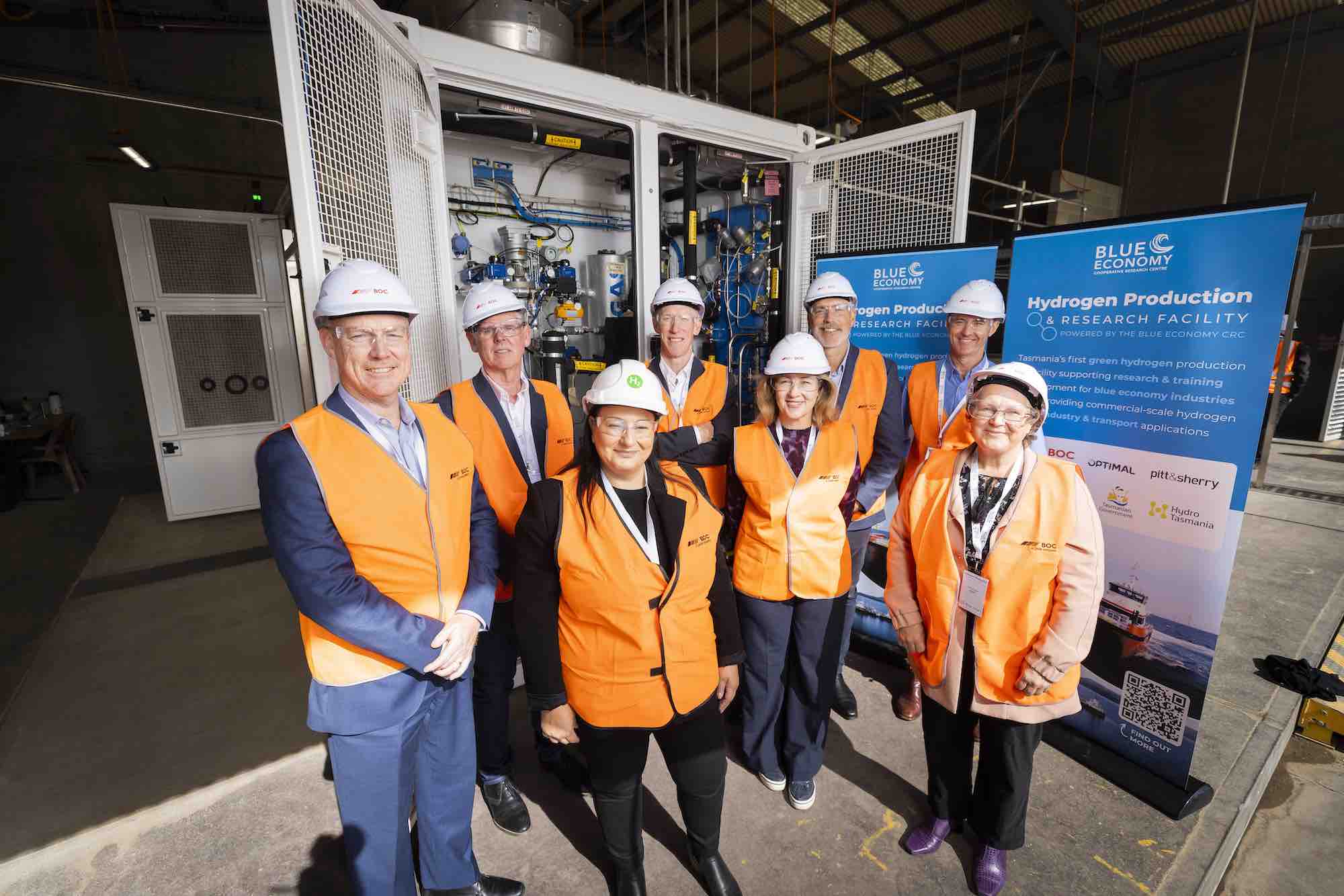
The commercial-scale facility is the end product of research led by the Blue Economy Cooperative Research Centre and its project partners, including BOC, the University of Tasmania, Griffith University and Hydro Tasmania. The Tasmanian and Australian governments have also backed the project.
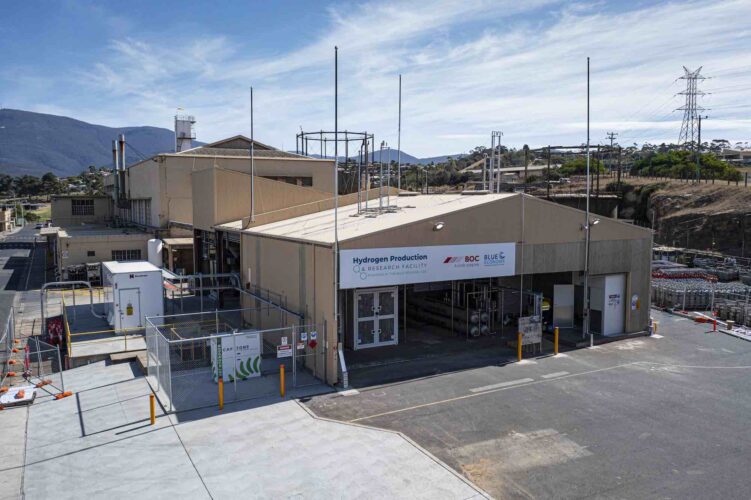
Located at the site of BOC Australia in Lutana, the plant features one of Australia’s largest operational electrolysers – a 700 kW Proton Exchange Membrane (PEM) electrolyser delivered by Optimal Group and installed and commissioned by pitt&sherry.
Attached to a microgrid system which can generate up to 100% renewable hydrogen, the ITM Power electrolyser is the first of its kind in Tasmania to draw on 100% verified renewable electricity from the state’s mostly hydro-powered grid.
The sophisticated DC hydrogen microgrid system can recreate the inputs from renewable energy such as wind, solar or ocean energy, and mirror loads from industry to simulate real-life applications.

Blue Economy CRC CEO John Whittington says the launch of the facility marks a pivotal moment for clean energy in Tasmania, and the beginning of a “journey of discovery” for the largely renewable powered state.
“The production of green hydrogen begins at commercial scale, but what we’re really looking to produce is answers to some of our most important questions around hydrogen and its uses,” Whittington said on Friday.
“This is a research facility and as we ramp up commercial production, we will also better understand the role hydrogen can play in our system and how it can support Australia’s blue economy.”
Tasmania’s energy minister, Nick Duigan, said the project highlights what can be achieved when industry, research and government join forces to drive innovation.
“Our Government has a goal to reach 200 per cent renewable electricity generation by 2040, and this facility is the start of building a sustainable green hydrogen sector to power our state for generations to come,” Duigan said on Friday.
“The commencement of this project is also an important step forward in the application of hydrogen as a green fuel, helping to decarbonise our transport sector.”
BOC Australia head and managing director of Linde South Pacific, Theo Martin, says Boc is well suited to host the project, having been safely producing, storing and transporting hydrogen in Australia for more than 80 years.

“For BOC, this was a perfect opportunity to bring our knowledge and skills to an important project that will lay the foundation for renewable hydrogen research and its application in this state,” Martin said.
“Like other projects we are involved in across Australia, this facility further demonstrates our commitment to supporting renewable hydrogen and the role it can play in decarbonising hard-to- abate industries.”
Blue Economy CRC research director Professor Irene Penesis says that, as a research and training facility, the project will advance technologies to produce, store, and distribute hydrogen efficiently and cost-effectively.
“This means opportunity for a wider adoption of this clean energy source, while building a skilled workforce capable of implementing and maintaining these new systems across the hydrogen value chain,” Penesis said.