Something significant just happened in London at the United Nations maritime peak body, the International Maritime Organisation (IMO).
Nations had gathered to adopt the Net-Zero Framework, a package of measures designed to accelerate maritime decarbonisation.

Image: Andrew Dickson
When the Net-Zero Framework was agreed upon at the IMO in April 2025 it was a positive step forward, but it was arguably more of a victory for multilateralism than for the environment.
It fell well short of aligning with the IMO’s 2023 GHG Strategy, which set the vision for net-zero greenhouse gas emission from the shipping sector “by or around 2050,” plus indicative checkpoints to cut total annual GHGs by at least 20% (striving 30%) by 2030 and at least 70% (striving 80%) by 2040.
The storm
From 14-17 October 2025, when the Net-Zero Framework measures were due to be adopted, a storm blew into the IMO and swept it off course.
Intense lobbying and filibustering from petrostate Saudi Arabia and blatant threats from the United States created chaos and confusion. Ultimately a decision was made to defer the decision by 12 months by adjourning the meeting.
This was a bitter disappointment to the many stakeholders who have worked hard to make shipping one of the only hard-to-abate sectors with a global decarbonisation target, together with realistic measures to practically achieve it.
Overview of the shipping sector
For context, the global shipping sector is the backbone of international commerce, and yet it is largely out of sight and out of mind for most people.
It is a sector which has transformed dramatically in the last century, in terms of the size and number of ships it employs, the volume of goods it transports, the technologies it uses to standardise cargo handling and to facilitate inter-modal transfer of this cargo, the energy it uses for ship propulsion, the technologies it has adopted to increase safety for mariners, and the connection of bodies of water via canals to reduce shipping distances and timeframes.
Ships transport 80-90% of international trade (but only 11% of the economy’s material footprint).
The global merchant fleet surpassed 2.40 billion deadweight tonnes (DWT) in 2023–24, comprising more than 106,000 merchant ships over 100 Gross Tons (GT) and almost 70,000 ships over 300 GT.
Shipping fuels are cheap but are highly polluting. They are essentially the thick sludge at the bottom of the barrel of the oil refining process. The shipping sector consumes around 300 million tonnes of fuel annually, which emits around 1 billion tonnes of CO2 per year (well-to-wake).
If the shipping sector was a country, it would emit more than Germany and more than double that of Australia. And on a business-as-usual trajectory, shipping emissions are projected by the IMO to rise by as much as 40% by 2050.
Notably, almost 40% of all shipping (by volume) is involved with transporting energy commodities in the form of crude oil, refined petroleum products, liquefied natural gas (LNG), liquefied petroleum gas (LPG), and coal.
This makes energy the largest single category in global seaborne trade, ahead of bulk agricultural goods or containerised cargo.
The dominance of fossil-energy transport means that shipping is deeply intertwined with the fossil fuel economy, both as an enabler and as a consumer.
Decarbonising shipping thus means tackling both the fuel used by ships, and fuels transported by ships. Even if ships become carbon-free, the sector’s role as the carrier of fossil energy will continue to link it to global emissions until energy trade patterns shift.
No wonder the petrostates unleashed a storm upon the IMO.
Decarbonisation pathways
How to decarbonise such a sector? Much of the effort has focussed on alternative fuels like methanol, hydrogen, ammonia, LNG and biofuels.
None of these is the silver bullet: hydrogen and ammonia will be very expensive initially, particularly if produced using renewables rather than steam methane reforming, which is highly emitting.
Combustion of LNG emits less than shipping fuels, but methane leaks in the production, transport and storage of LNG limit its decarbonisation outcomes. And methanol and biofuels are hard to scale due to feedstock limitations.
Other initiatives use operational measures such as slower steaming, improved ship routing and port scheduling, and better use of shore power to switch off onboard generators whilst in port. All of these help, but pale in comparison to the emissions from burning dirty fuels.
Are there other things which can have quick impact at scale? Well yes, actually there are. They’re blowing in the wind.
Wind assisted ship propulsion
I have just returned from a Churchill Fellowship to investigate the potential for wind assisted ship propulsion (WASP) for commercial shipping. I visited leading innovators in Singapore, the UK, France, the Netherlands, Germany, Denmark and the Marshall Islands.
I was pleasantly surprised by what I learned:
Currently, 77 large merchant ships have been installed with wind propulsion systems and a further seven are “wind-ready”: awaiting or undergoing WASP installation. (WASP vessel tracker).
This corresponds to over 4.3 million deadweight tonnes (DWT) of shipping. More than 130 ship installations of WASP systems are on order, most for delivery in 2025/26. By the end of 2025, there should be 100 ships installed. The number of ships installed with WASP roughly doubles each year.
It feels like the early days of solar PV, 20 years ago, before installed capacity skyrocketed.
Innovators have been quietly bubbling away for the last 10-15 years developing new WASP technologies or refining old ones with modern materials and computerised controls.
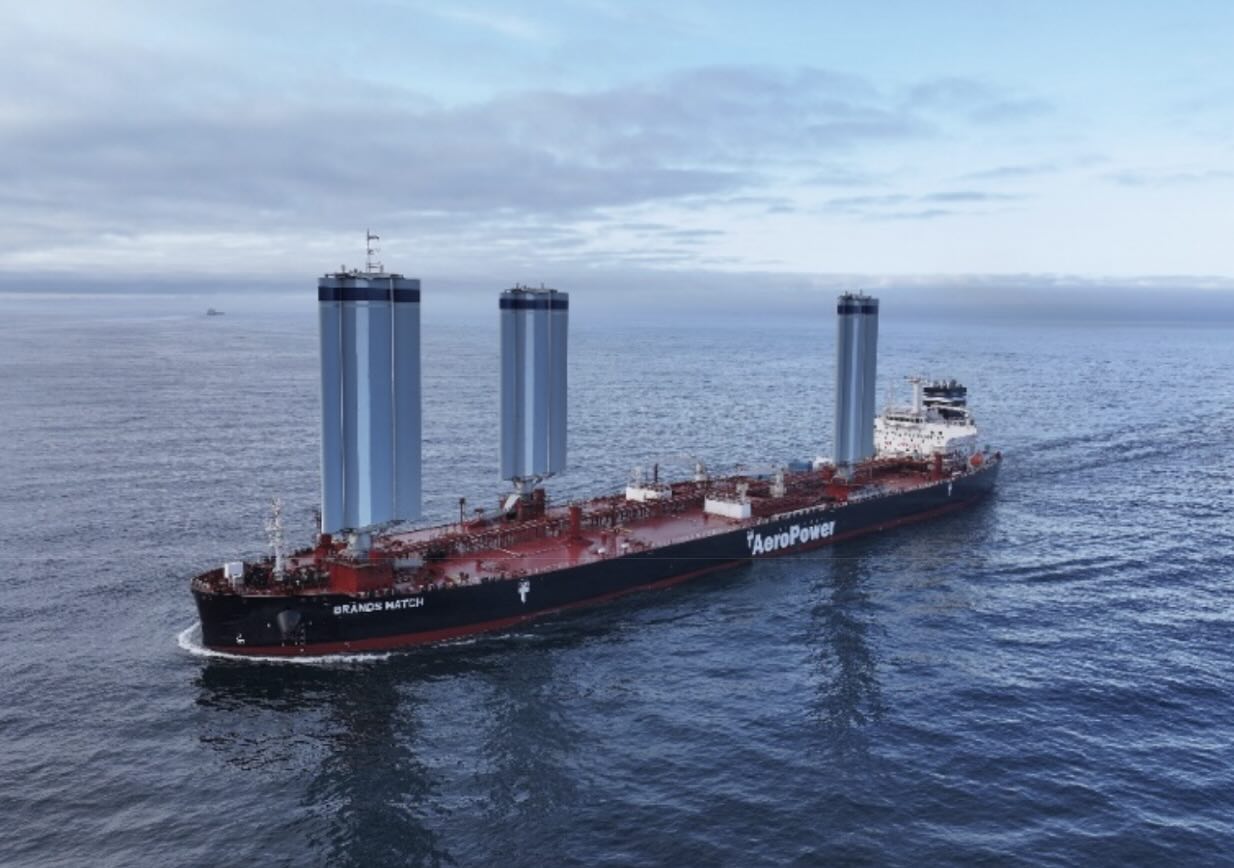
British company BAR Techologies has used experience from Formula 1 car racing and America’s Cup yacht racing to develop WindWings, a 37.5m tall, rectangular wing sail which looks like a vertical aircraft wing with its flaps extended for landing.
Two to four powerful WindWings can be fitted to tankers and bulk carriers, either as retrofits or on newbuilds. On average, each wing sail saves one and a half tonnes tonnes of fuel / four and a half tonnes of carbon dioxide per day.

Image: Andrew Dickson
Union Maritime’s newbuild tanker fitted with WindWings, Brands Hatch, had a stunning maiden voyage in which her three WindWings sails avoided 12.8 tonnes of fuel use / 38t of CO₂ in just 24 hours. Sustained peak performance of over 18 tonnes of avoided fuel per day was seen for a full six hours.
This was achieved whilst fully laden and whilst maintaining strong sailing speeds in challenging weather. In favourable conditions, the vessel achieved more than a third of its propulsion from wind power alone, proving the ability of the WindWings to deliver not only impressive peak results but also reliable efficiency over extended periods.

Image: Andrew Dickson
Tens of thousands of vessels could be fitted with solid wing sails, or with Flettner rotors like those supplied by Anemoi Marine Technologies (UK), Norsepower (Finland), Eco Flettner (Germany), Dealfeng (China) and others.

Image: Andrew Dickson
French company Neoline just commenced commercial operations with a newbuild, 136m, roll-on roll-off ship with a cargo capacity of 6,300 tons, capable of carrying up to 321 cars, 265 x 20-foot containers, or 125 x 40-foot containers.
It will be powered by two huge SolidSails from another impressive French company, shipbuilder Chantiers de l’Atlantique (https://chantiers-atlantique.com/en/). Three of these SolidSails have also been fitted to the new luxury cruise liner Orient Express Corinthian, which, when commissioned, will be the largest sailing yacht in the world.
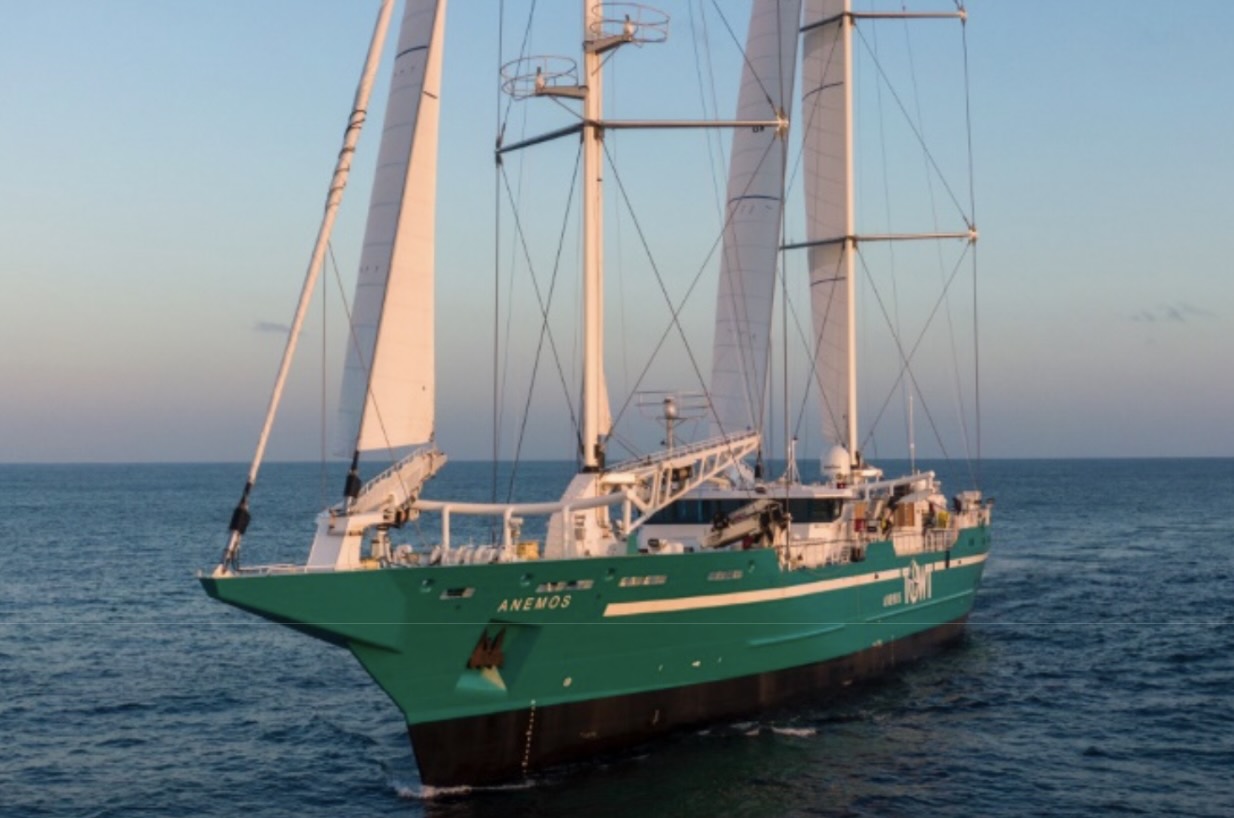
Image: Andrew Dickson
At a smaller scale, French company TOWT operates two 81m wind powered vessels (Anemos and Artemis) which transport products all over the Atlantic with carbon emissions that are less than 1/10th those of regular ships. TOWT is expanding rapidly, with six more wind-powered ships currently under construction in Vietnam.
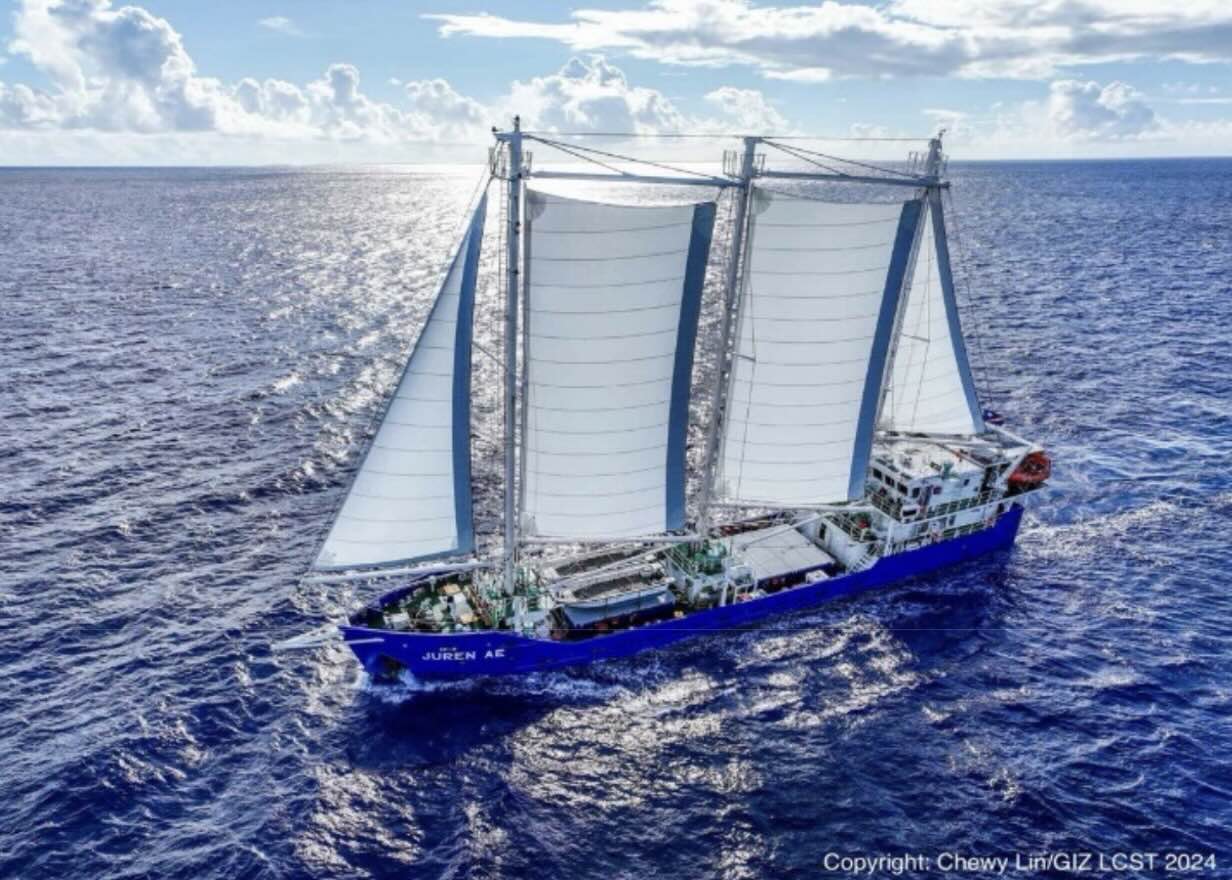
Image: Andrew Dickson
And in our backyard in the Pacific, the wind-powered cargo ship the SV Juren Ae was commissioned by the Republic of the Marshall Islands in July 2024 after several years of contribution and funding from Germany through a project called Expanding Low-Carbon Sea Transport in the Republic of the Marshall Islands (LCST).
Juren Ae uses wind power to resupply the communities living on atolls spread across its two million square kilometers of territorial waters, and reduces the need for expensive imported shipping fuels, improving RMI finances.
Low-lying islands in the Pacific are existentially threatened by rising sea levels, and wind-powered cargo ships are a tangible and practical way that Pacific nations can “walk the talk” of maritime decarbonisation.
These are just some of the many WASP innovations I learned about during my Churchill Fellowship.
So, what can Australia do?
Australia privatised its national shipping line, Australian National Line, in the late 1990s, and is now serviced largely by overseas shipping companies which operate on global routes. Not much we can influence there. But there is plenty we can do in our own region and at the IMO:
– If Australia is selected to host COP31, it will be the “Pacific COP” with a focus on Pacific priorities, especially on climate vulnerability, adaptation, finance, ocean/climate justice, loss-and-damage, and resilience. Wind-powered Pacific ships can help make COP31 into an “action COP”, not just an “agreement COP:”
- We could help raise multilateral funding for new Pacific wind-powered cargo ships, ideally alongside France and Germany, who have WASP technologies ready to deploy and existing Pacific interests and decarbonisation programs.
- We could help bring the Juren Ae to Adelaide for COP31, and potentially also one of the new TOWT vessels currently under construction in Vietnam, to show delegates first hand how their funding could deliver quick and meaningful results in the Pacific.
- We can deliver training. Pacific nations could benefit greatly from more maritime and vocational training from Australian providers including the Australian Maritime College and TAFE Queensland. The latter already delivers training for crews of the patrol boats donated by Australia through the Pacific Maritime Security Program, which is a great foundation to expand from.
– We could nurture the local innovators who are developing WASP technologies including GoSailCargo and Advanced Wing Systems and companies developing other maritime decarbonisation technologies including E Class Outboards.
– We should remain resolute supporters of the Net-Zero Framework at the IMO, to hold firm against the petrostates and to complement the national decarbonisation policies which will help Australia achieve its 2035 NDC target of 62-70%.
Wind-assisted shipping is one of the few mature, immediately deployable tools to meet the IMO’s new Net-Zero Framework. In contrast to alternative fuels, wind energy is available everywhere, is available today, is available at the point of use (so no costly and complex e-fuel supply chains are needed) and with zero fuel cost.
And best of all: the cost and energy savings from deploying WASP system on large ships will help us to afford the more expensive solutions that we’ll inevitably need, later, to decarbonise deeper.
“Sometimes the best discoveries are rediscoveries. We have a green, efficient, cost-effective solution ready to help the industry meet its goals now. We have to realise that there’s no need to reinvent the wheel. We can look back to go forwards, rediscovering the huge potential of wind. Let’s keep it simple. It’s time to set sail.” Bertrand Charrier (Source)
Andrew Dickson is a senior advisor to the Smart Energy Council. Having grown up racing sailboats, having spent 10 years in the Royal Australian Navy and over 20 years developing wind farms, he knows the power of the wind.