
Australia’s richest person, mining billionaire Gina Rinehart, has been one of the fiercest critics of the switch to wind and solar and of Australia’s climate and energy targets – net zero by 2050 and the 82 per cent renewable target for 2030.
But it turns out that a major new off-grid lithium mine operated by a company partly owned by Rinehart is showing Australia exactly how it can be done – achieving a remarkable average of 81 per cent renewables for its power supply over the last year.
The Kathleen Valley mine in Western Australia is the flagship project of the listed Liontown Resources, in which Rinehart is a major shareholder with a stake of around 18 per cent, having built a blocking stake to a bid by US-based Albermarle.
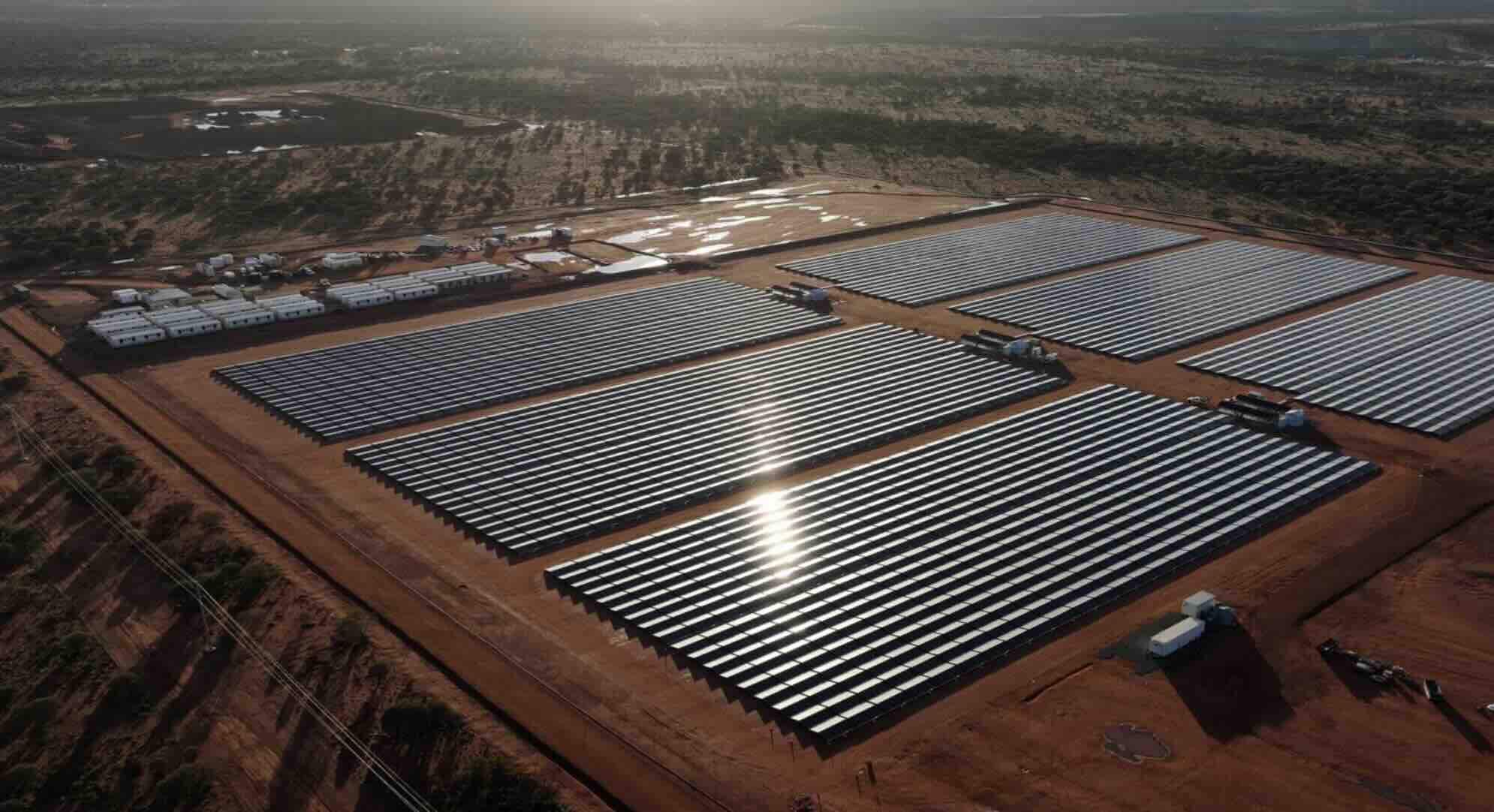
On Thursday, Liontown revealed that its hybrid power station – built by Zenith Energy and including 30 megawatts (MW) of wind capacity, 17 MW of solar and a 17 MW, 19 MWh battery, and commissioned last year – had achieved an average penetration of 81 per cent renewables over the 2025 fiscal year.

The project combines 30,000 solar panels, and five 6 MW Goldwind wind turbines, and features the 17 MW, 19 MWh lithium ion battery, 26.4 MW of gas capacity, 5 MW of diesel and three small synchronous condensers.
The results from Kathleen Valley are impressive and follow revelations that an even newer mine, the Bellevue Gold Mine also off-grid and in remove W.A., achieved 79 per cent renewables – and 84 hours “engine off” in the second full month of its operations.
See: Off-grid gold miner says 100 pct renewables is possible after running 84 hours with “engine off”
Bellevue Gold is aiming for 90 per cent renewables if it can, and the further electrification of its mining equipments, including trucks and vehicles, and changing its electricity uses – where it can – to when wind and solar are plentiful to boost its renewables share.
Liontown also says it is able to run the site – which includes a processing plant – with “engine off” at time.
“Consistently, we are delivering between 79 and 82 per cent renewable power into our operations,” CEO Tony Ottaviano told analysts in a conference call on Thursday. “There are times where we run solely on renewable power for a day or so.”
Rinehart has campaigned against renewables and longer term net zero targets, which she has described as a “magic pudding” and unobtainable. She has previously described solar panels as an “eyesore”,
“The truth hiders are not telling us, manufacturing often requires 24-hour reliable electricity, such as dairy and aluminium, steel and AI, they ignore the consequences,” she said in reports of a speech that was posted on the Hancock website.
Liontown says in its annual report that it is also looking at electric alternatives to its diesel-powered fleet to electric alternatives, and it is also looking at underground ventilation on demand, cable tethered and battery electric vehicles.
“Each study will assess energy demand, charging infrastructure, equipment performance, and lifecycle emissions,” it says.”Potential insights will guide our long-term strategy for fleet electrification and energy use reduction.”
It said it could expand the wind, solar and battery capacity at its hybrid power plant.
“We recognise the increased energy demand that will result from potential fleet electrification. As part of our strategy, we are exploring the integration of battery energy storage systems (BESS) in our own operations.
” In parallel, we will work with Zenith Energy to expand renewable energy generation and storage capacity at the hybrid power station, with expansions to support our future energy demands under the overarching PPA.
“This approach will support load balancing, enhance grid stability, and help ensure that the additional electricity demand from fleet electrification does not lead to increased Scope 2 emissions.”