HMC Capital’s newly created energy platform, chaired by former prime minister Julia Gillard, has unveiled plans for a massive long duration battery storage project in Queensland, part of plans to roll out a multi-gigawatt portfolio of assets.
HMC’s newly acquired Stor-Energy wants to build two big batteries next to each other near Columboola in the Western Downs area of southern Queensland, in the heart of a coal seam gas mining area, along the route of an existing transmission line and across the road from the Condamine gas generator.
One of the two batteries, Columboola East is sized at 150 MW and 1450 MWh, which would nominally suggest a 10-hour battery, while a separate battery, Columboola West, is sized at 400 MW and 1950 MWh, suggesting a five-hour battery, according to the application.
However, Stor-Energy later told Renew Economy that despite these specifications, the Columboola East was likely to operate as an eight-hour battery, while Columboola West would be configured as a four-hour battery for operational purposes. The extra capacity is to allow for expected degradation.
Stor-Energy’s application for approval under the EPBC Act does not give many details about the project plan, apart from saying that the the battery systems will be used to stabilise local networks and market pricing.
However, the proposed batteries are part of a trend towards longer duration battery storage, mostly to help store excess solar energy during the day and push the output into the more lucrative evening peaks. There are several solar farms already built in the area, including the Columboola, Baking Board and Bluegrass solar farms.
Battery storage costs are falling fast, and with continued reductions in solar modules, this is now emerging as the most popular investment strategy for renewable energy developers, particularly given the static if not rising costs of offshore wind, and its planning and social licence issues.
The first big batteries in Australia had around one hour of storage, because they mostly focused on markets such as frequency control. They grew to two hours as more started to make money from arbitrage, and are now expanding to four hours, often with the specific purpose of storing solar in the middle of the day and saving it for the evening peak.
The latest move is for eight-hour batteries, providing deeper storage in the absence of pumped hydro, which is proving expensive to build, and instead of more costly and emissions intensive gas generators, where turbines are proving expensive and hard to get.
Three eight hour batteries have been contracted in NSW, and others are in earlier stages of development. Andrew Forrest’s Squadron Energy has flagged a couple of 12-hour battery projects next to proposed wind farms in the south-east of NSW, but these are for the moment blocked by the lack of grid capacity.
Stor-Energy forms a key part of HMC’s new billion-dollar venture into the green energy transition, and will be merged with the Victorian assets of Neoen when that transaction is complete later this month.
HMC Capital announced a reshuffle earlier this month, appointing Stor Energy boss Gerard Dover as head of energy transition platform, and will run the merged business. Gillard is chair of energy transition platform.
Stor Energy hopes to get planning approval early next year for the Columboola batteries, and to begin construction in the second half of 2026, with completion in two years.
It will involve 536 battery enclosures for Columboola West, although that site has space for an additional 202 enclosures, while Columboola East will comprise 400 battery enclosures, with no room for more.
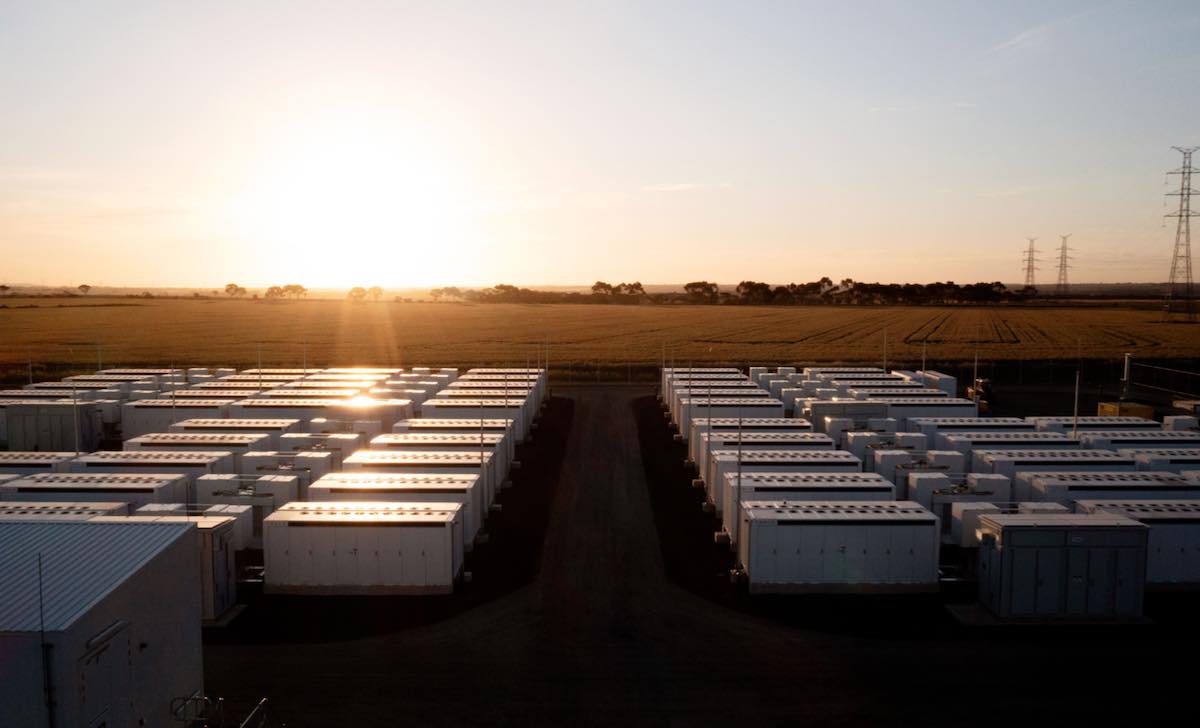
The Neoen assets in Victoria that HMC is buying include the Victoria Big Battery (pictured above), the Bulgana green energy hub, and the Numurkah solar farm, as well as the proposed Moorabool battery and the Kentbruck wind farm.
Note: This story has been updated to reflect Stor-Energy’s advice that the final battery configuration will not – as the specifications in its EPBC application suggested – be for a 10-hour battery and a five-hour battery, but would ultimately be an eight-hour and four-hour battery.