Iron ore major Fortescue Metals says it is making real progress on its “real zero” ambitions, as the cost of key decarbonisation technologies like battery storage and electric mining equipment continues to fall, pushed downwards by the “investment supercycle” currently underway in China.
Fortescue’s Real Zero Target aims to eliminate Scope 1 and 2 emissions from its Australian terrestrial iron ore operations by the end of 2030, effectively meaning it will not burn gas or diesel for power or for transport and mining operations.
The ambitious goal, spearheaded by Fortescue founder and executive chair Andrew Forrest, contrasts with the go-slow being executed by fellow Australian mining giant BHP and the complete and utter rejection of any and all action on climate by fellow iron ore magnate Gina Rinehart.
And in the background, Australian political debate around Net Zero has polarised, with federal Labor preparing to announce its interim, 2035 emissions reduction target while a bizarre, Barnaby Joyce-led campaign calls for the federal Net Zero by 2050 target to be scrapped.
Fortescue, however, remains undeterred.
Asked about the cost of Real Zero, and the impact of inflationary pressures on the economic case for emissions reduction at its annual results briefing on Tuesday, Fortescue said the mission to decarbonise is already paying dividends because costs are being balanced out by savings on diesel fuel and falling costs of technology.
“I wouldn’t be too concerned about inflationary pressures,” CEO Dino Otranto said. “I think that’s been largely offset by the reduction in cost we’re seeing in technology advances through solar, wind and battery energy.
“We announced a pretty significant deal with BYD a few months ago on battery energy storage, which really is demonstrable of an ongoing pricing reduction in technology, largely driven by the investment supercycle in China,” he said.
“Our mission to decarbonise is paying dividends, already,” newly appointed energy head Gus Pichot added. “We are finding ways to sustain … the future of existing iron or assets through decarbonisation, new technologies and green iron. And we’re also looking at what is next to keep adding value to our shareholders.”
Forrest did not attend the webinar on Tuesday, but took the opportunity to restate his views in a statement in the full results report.
“We were told the world had moved on from recognising the existential threat of climate change. That the era of investing in green energy was drawing to a close. That ambition was out of fashion,” he writes.
“But here we are, with those with courage staying the course on climate.
“I think of our innovations – in green iron, in solar energy, in batteries. They are showing that those who try to undo global progress are simply choosing to lose the global technology race. Choosing to keep burning sticks and logs while the rest of the world moves forward,” Forrest says.
“When Fortescue decarbonises its operations, which will include the installation of more than 4GWh of battery energy storage within an integrated power network, we will set an example for the rest of the world to follow.”
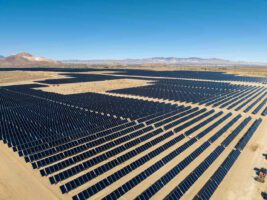
Otranto said “strong progress” is being made, including on construction of a transmission network that will power its Pilbara operations with renewables, and a 100 megawatt (MW) solar farm already in operation at North Star Junction.
Otranto says the solar farm is now meeting around a quarter of the Iron Bridge site’s electricity needs, while more than 640km of transmission lines and associated substations have been built for Pilbara Energy Connect – the transmission backbone that will support at least 190 MW more renewables.
Electric excavators and an electric drill are also already in use on site.
“We want to develop these projects, and let’s get on with it,” Ottranto said, referencing the company’s ambitions to develop a green metals market.
“We’re seeing aggressive moves by Saudi Arabia to get into this space, and I think we have a unique opportunity now, that will pass us by, to get on with it,” he said.
“Australia has the best sun wind intensity on the planet, and our legacy is in the mineral we have in the ground. So why not combine the two.
Pichot says green hydrogen remains key to Fortescue’s future, too, despite the scrapping of most of its bigger projects, with the focus now on the Green Metal Project in the Pilbara and a pilot plant expected to begin producing green iron using green hydrogen “soon.”
“Technology is improving at rapid speed, costs will come down, and the market will come,” Pichot told the webinar on Tuesday. “We’re pushing to make that happen quickly, but we’re also realistic and disciplined.
“Right now, our focus is investing in research and development. …We’re not just innovating and developing the technology to help ourselves decarbonise, we are creating solutions others may want as well.
“Yes, [our targets are] ambitious, but at Fortescue we do things that way,” Pichot said.
A