Andrew Forrest’s Fortescue Metals has begun construction of its biggest solar farm to date as it seeks to stop burning fossil fuels at its giant iron ore operations by the end of the decade, but it has conceded that its broader pipeline of green energy projects remains clouded by international uncertainty.
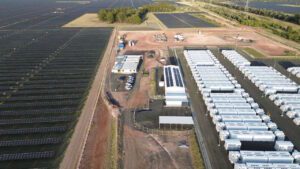
The new 190 MW solar project at Cloudbreak is due for completion in the second half of 2026.
It will be the third owned and contracted solar facility for Fortescue, adding to the recently commissioned 100 MW North Star Junction solar farm and the contracted 60 MW Chichester solar farm, which is now owned by APA Grouyp.
They will form a key part of a multi-gigawatt renewable energy supply that will power Fortescue’s Pilbara operations by the end of the decade.
Fortescue wants to reach “real zero” at its Pilbara mines by 2030, which means burning no gas or diesel for its electricity supply, or for the land transport and drilling and hauling operations at the facilities.
The company in March unveiled plans – and sought environmental approvals – to build a 666 MW solar farm south of Port Hedland. The Turner River solar hub will be one of the biggest in Australia and is part of Fortescue’s plans to build at least 1.5 GW of solar, and at least a gigawatt of wind to back its operations.
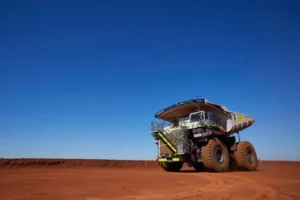
The other part of the equation is the electrification of its mining operations, with the big ticket items being the massive haul trucks, dozers and excavators.
Fortescue has already signed a $4 billion deal with Liebherr, and during the quarter delivered the power system, developed by its own Williams operations, for the giant electric trucks to be made by Liebherr.
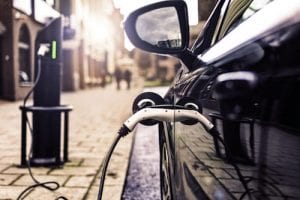
Fortescue is also refining the charging infrastructure required for the big batteries that power this equipment and its rapid charging boost has been used in the Formula E World Championships, bringing mid-race charging to the electric racing car series for the first time.
HFortescue Energy is continuing to progress and refine its Green Energy project pipeline in a disciplined manner, with timelines adjusted to reflect global market conditions and uncertain policy settings.
Development timeframes of Fortescue’s Arizona Project and Gladstone PEM50 Project are being reassessed. Fortescue anticipates having greater clarity on the impact of external factors on these projects by the end of the financial year.
Fortescue says its energy division had net operating expenditure of approximately $US700 million ($A1.1 billion) in the first quarter and capital expenditure of approximately $US400 million.
However, the outlook is less clear for the company’s broader portfolio of green energy and green hydrogen projects, given the dramatic changes in the market, and the impact of the Trump administration’s attack on green energy support schemes.
Fortescue Energy CEO Mark Hutchinson says the company continues to assess the market conditions and will update investors by the end of June.
“Fortescue Energy is continuing to progress and refine its Green Energy project pipeline in a disciplined manner, with timelines adjusted to reflect global market conditions and uncertain policy settings,” he said in a statement.
He declined to elaborate in the investor call with analysts. The projects potentially affected include its Arizona green hydrogen project and the Gladstone PEM50 project.
The company says “development timeframes …. are being reassessed. Fortescue anticipates having greater clarity on the impact of external factors on these projects by the end of the financial year.”
- Feasibility studies and planning approvals continue to progress for the Holmaneset Project in Norway and the Pecém Project in Brazil.