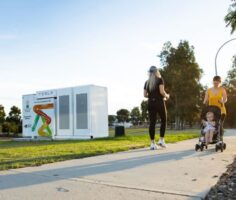
The federal government has announced that 200,000 households have installed home batteries since the start of the federal rebate in July last year, and revealed the hotspots for storage uptake are outer suburban and regional areas.
The data released by federal climate and energy minister Chris Bowen on the weekend also shows that 50,000 of the battery installs came in homes that installed solar for the first time.
“This is great for those 200,000 Australian families,” Bowen told journalists on Saturday morning.
“It’s also good for the grid because fewer people calling on coal fire in the evening means that our grid is more reliable and prices are cheaper because coal and gas are the most expensive form of energy and renewables are the cheapest form of energy.”
Wholesale prices have fallen significantly in the past six months, although this could also be the result of more large scale battery storage and the completion of a number of new large scale wind and solar projects.
But despite the heatwaves over summer, there have been no blackouts caused by a lack of supply (although a number caused by storms and fires), and rooftop solar and the growing portfolio of home batteries has helped to reduce grid demand at critical times.
Bowen says that there has now been 4.7 gigawatt hours of battery installed since last July, and the numbers of both installations and total storage capacity are expected to grow 10-fold by the time the scheme ends in 2030.
“This additional storage is helping households store more of their own cheap, clean solar energy for use at night and during periods of high demand – crucial during summer months to power ACs while keeping the grid stable,” the government said in a media release.
“Australia is already a world leader in rooftop solar, and cheaper home batteries are ensuring households can get even more bang for their buck from the energy they generate.
The government also released data highlighting the fact that the scheme is proving most popular in outer suburban and regional electorates such as Wright in Queensland, Indi in Victoria and Page in New South Wales.
It provided data on the top postcodes nationally – the top two are both in western Sydney – and the electorates in each states with the most installations. (Bowen’s electorate of McMahon did not feature in the top 5 in NSW).
Interestingly, South Australia leads in the uptake of battery rebates on a per capita basis, perhaps not surprising given the state leads in the uptake of wind and solar (which supplied 75 per cent of state demand on average over the last year), and rooftop solar occasionally accounts for all of state demand on occasions.
South Australia also has the most volatile wholesale electricity prices in the state, with more than half of all intervals revealing negative prices, but often high prices in the evening peak.
Top postcodes nationally
| Rank | Postcode | State | Suburbs in Postcode |
| 1 | 2155 | NSW | Beaumont Hills, Kellyville, Kellyville Ridge, North Kellyville, and Rouse Hill |
| 2 | 2765 | NSW | Marsden Park, Riverstone, Berkshire Park, Box Hill, Gables, Grantham Farm, Maraylya, Melonba, Nelson, Oakville, Richards, Angus, and Vineyard |
| 3 | 3029 | VIC | Hoppers Crossing, Tarneit, and Truganina |
| 4 | 6164 | WA | Aubin Grove, Banjup, Beeliar, Cockburn Central, Atwell, Hammond Park, Jandakot, Leeming, and Success |
| 5 | 6112 | WA | Armadale, Bedfordale, Brookdale, Forrestdale, Harrisdale, Haynes, Hilbert, Mount Nasura, Mount Richon, Piara Waters, Seville Grove, and Wungong |
| 6 | 3030 | VIC | Werribee, Point Cook, and Sanctuary Lakes |
| 7 | 2153 | NSW | Baulkham Hills, Bella Vista, Norwest, and Winston Hills |
| 8 | 3977 | VIC | Cranbourne, Cranbourne East, Cranbourne North, Cranbourne South, and Skye |
| 9 | 6065 | WA | Landsdale, Madeley, and Darch |
| 10 | 6155 | WA | Canning Vale, Canning Vale South and Willetton |
Top Electorates by state
Queensland
- Wright
- Bowman
- Fadden
- Blair
- Fisher
NSW
- Mitchell
- Berowra
- Greenway
- Page
- Richmond
VIC
- Indi
- Hawke
- Holt
- Gordon
- Chisholm
ACT
- Fenner
- Bean
- Canberra
NT
- Solomon
- Lingiari
TAS
- Lions
- Franklin
- Clark
- Bass
- Braddon
SA
- Mayo
- Sturt
- Boothby
- Adelaide
- Spence
WA
- Tangney
- Bullwinkel
- Hasluck
- Pearce
- Canning
State and Territories with the most CHB installations (per capita)
- SA
- NSW
- ACT
- WA
- Queensland
- Victoria
- Tasmania
- NT