
Reliable and affordable fertiliser supply was high on the agenda at this week’s Renewables in Agriculture conference, as events in the Middle East provide another reminder of just how exposed Australian farmers are to global supply chains.
With disruptions to shipping through the Strait of Hormuz putting pressure on fertiliser supplies and prices, the prospect of farmers producing their own fertiliser using locally generated renewable energy is looking increasingly attractive.
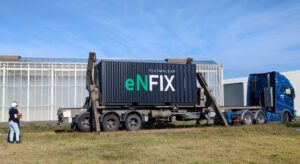
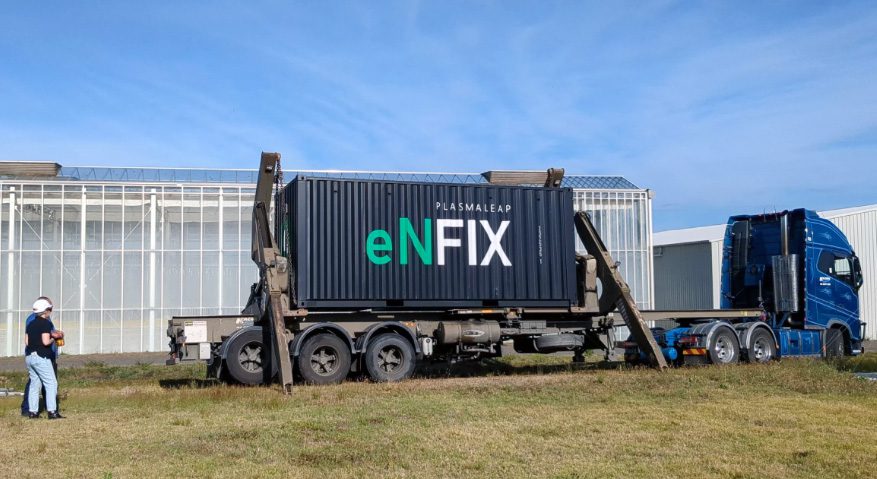
One technology on display at the conference came from Australian company PlasmaLeap, which is developing modular systems that use electricity, air and water to produce nitrogen fertiliser on farms.
Nick Bishop, PlasmaLeap’s CFO, told the conference the technology could potentially give farmers greater control over both fertiliser costs and supply, while dramatically reducing the emissions associated with conventional production.
Bishop says the nitrogen problem has been brewing for decades, in part because conventional fertiliser production is concentrated in a relatively small number of enormous plants.
“They’re very heavily centralized, they’re very expensive capex types of projects, and they’re very energy intensive.”
Nitrogen fertiliser production accounts for around 2.5 per cent of global greenhouse gas emissions, Bishop told the conference.
PlasmaLeap’s approach is different. It’s an electrochemistry and manufacturing company, not an agricultural business, that uses electricity to produce chemicals that are traditionally made using fossil fuels.
PlasmaLeap is pioneering zero-emissions ammonia and nitric acid production – key building blocks for nitrogen fertilisers – using electricity rather than fossil fuels.
Its principal input for nitrogen fertiliser is freely available.
The atmosphere contains around 78 per cent nitrogen. Bishop says every hectare of land has between 65,000 and 75,000 tonnes of nitrogen sitting above it, although only a tiny fraction could ever be practically captured.
“We take that into our reactors. We zap it with high-voltage electricity. We ionize that gas, and then we combine it with oxygen to produce nitric oxide, which goes into our nitrogenous fertilizers.”
Rather than relying on huge centralised plants, PlasmaLeap’s technology is designed to be containerised and deployed close to where fertiliser is actually used.
“Rapidly deployed, containerised, hook us up to power and water, and we’re good to go. You’re producing fert [fertiliser].”
The systems are also designed to work with renewable energy.
“Our systems can power up in less than a second. We’re perfectly fine with variability of inputs, unlike an electrolyzer, for example, so on and off is not a problem. We’re AC and DC compatible, and so we’re a nice load to pair with renewables.”
PlasmaLeap says its technology can abate up to nearly 11 kilograms of CO2 for every kilogram of nitrate produced, depending on the source of electricity. If powered by renewables, no fossil fuels are used in production.
But for farmers, Bishop argues, the bigger attraction may ultimately be certainty.
“If you were to try and price a … five-year call option on urea, the option price alone would be $225 to $250 US dollars a ton of urea. That’s before you’ve even bought the product. That’s just for the option because the market’s so volatile.”
“What we are selling here is long-term certainty.”
The technology has attracted significant backing. PlasmaLeap recently raised almost $30 million in a Series A funding round to help move from trials towards commercial deployment. The round included the Gates Foundation, Investible and Yara Growth Ventures, as well as Australian agricultural investors including the Grains Research and Development Corporation, Hort Innovation and GrainCorp.
But Bishop says one of the biggest obstacles to scaling is now manufacturing.
“We can’t build the units fast enough.”
Australian manufacturing costs are proving particularly challenging. Bishop said Chinese suppliers were quoting prices around one-third of those available locally, and could manufacture equipment roughly twice as fast.
“Being able to manufacture at scale at the cost we need to meet the expectation of growers is probably our biggest challenge.”
There are obvious safety questions about producing chemicals on farms, but Bishop says the systems are fully self-contained, with kill switches, interlocks and remote sensing. He maintains farmers routinely handle more hazardous agricultural chemicals.
“We’re designing a system which is autonomous, which you can monitor in real time, and which will simply turn itself off if there’s either anything dangerous happening or if there’s no power going through it, it will just simply power down.”
PlasmaLeap still has to prove it can manufacture its technology cheaply enough and at sufficient scale to compete with the global fertiliser industry. But amid another bout of geopolitical turmoil and fertiliser price volatility, its pitch to farmers is becoming increasingly compelling.
To join more than 29,000 others and get the latest clean energy news delivered straight to your inbox, for free, click here to subscribe to our free daily newsletter.