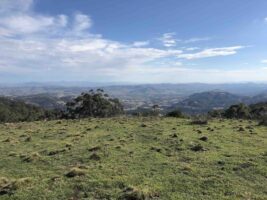
Federal environmental planners have waved through the giant Weasel solar farm and battery in Tasmania’s central highlands with no conditions.
This project envisages a 250 megawatt (MW) solar facility with a 144 MW, 576 MWh big battery to store excess solar generation, leaving the site open for solar grazing as well.
It’s being developed by local farming families, the Downie family from Dungrove which was behind the Cattle Hill wind farm, and the Bowden family from Weasel Plains, in partnership with Andrew Clark from Alternate Path.
They’re aiming to start construction of the project at the end of 2026 with commissioning in the second half of 2027, now waiting only on local development approval and a grid connection.
The proponents are also developing the proposed 350 MW Cellars Hill wind project on the opposite side of the same road, and both are feeding into a vision of an industrial precinct focused on data centres and alternative fuel production to bring back jobs to the region.
“Weasel solar farm is a key first step as it enables us to commence the renewable energy generation and connection assets to support the precinct,” Clark told Renew Economy.
“Planning for the Highland Renewable Energy Business Hub, located adjacent to the Weasel solar farm, is underway and receiving positive feedback from stakeholders and regulators.”

The Weasel solar project website says it will be Australia’s “most southern solar farm”, but notes that summer daylight hours extend longer than in northern areas, and during peak usage hours nationally. It is further south than the 288 MW Connorville solar farm currently under construction near Cressy.
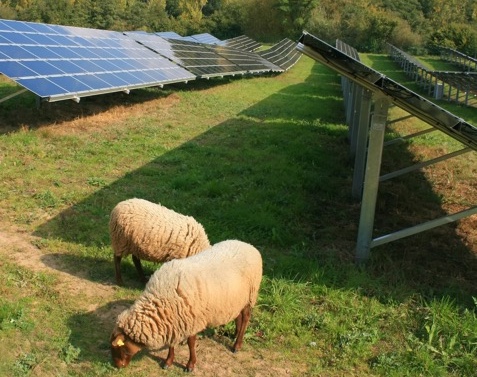
With local landowners running behind the project, it is likely natural that it will feature sheep grazing as well, a factor mentioned in its EPBC application.
The application said the solar farm would result in the permanent loss of 8.22 hectares of pastureland, but this would be outweighed “by the significant ongoing operational and management benefits… including a likely reduction [in] ewe and lamb mortality and overall improved livestock productivity”.
Clark says the developer is keen to add agrisolar to the project, and are planning for that early in order to reap benefits such as extra shelter for stock.
“Key early decisions to facilitate agrisolar include consideration of sufficient panel row spacing width, panel clearance heights, working with land contours to avoid significant earthworks, and water point and paddock location design,” he says.
The finer details of grazing sheep under solar are slowly making their way into both developer and farming consciousness.
Elements that farmers think about, such as ensuring weeds and pasture are dealt with before construction starts, are beginning to align with things developers must think about such as ensuring panels don’t create hang-up risks for sheep or that water sources aren’t so distant that sheep must walk a long way, and kick up dust around panels in the process.