When sheep and cattle farmer Lindsay Marriott sat before the Senate committee on information integrity on climate and energy, he wasn’t there to talk theory.
He was there to describe, in unvarnished terms, what gross misinformation about wind farms looks like when it arrives in a small regional community – and what it costs the people who live there.
Marriott and his wife moved with their three young children to their South Gippsland farm in 1983. The property was, as he told senators, “incredibly run-down,” with “some hills on it that were no good for anything.”
Two decades later he was approached by a small developer from Melbourne about hosting turbines. But when the Bald Hills Wind Farm was first proposed, “the community got ripped apart.”
“I went through a pretty intensive anti movement 20 years ago,” he said. “Anti programs can’t be happy. They demand unhappiness, and they demand anger, and the anger develops into hatred and they can inspire people that otherwise would never think of doing the things they did.”
A community torn apart
Marriott recalled how a well-organised anti-wind campaign, backed by “amazingly powerful people… very, very, very connected people,” turned neighbours against one another and targeted anyone associated with the project.
“Every component of my life was attacked,” he said.
At the local store, he was stunned to find that “anyone who had anything to do with me was attacked verbally.” His livestock carrier “was told to ditch me.”
He recalled being told by a “very high powered Victorian politician” to “take a nip off.” Another “very high ranking… federal Senator” assured him the project “would never happen.” He went to a few of the anti meetings until he said he was banned.
The result, he told the committee, wasn’t just heated disagreement — it was a campaign fuelled by falsehoods and intense social pressure. Marriott calls the activists who fanned the flames of hostility “suicide bombers” – people who “went out in the community, and then they would tackle anyone.”
And he’s not alone. Sitting beside him at the Senate committee inquiry was Andrew Bray, National Director of RE-Alliance, whose submission warned senators that Australia is now seeing “coordinated misinformation campaigns… eroding public confidence in renewable energy across the country.”
RE-Alliance has directly witnessed the negative impact that misinformation about renewables has had on community cohesion and welfare, including reports of farmers receiving death threats.
“Misinformation and disinformation… muddies and corrodes the fabric of community life,” their submission states. “Constructive neighbourly disagreements… become impossible in this situation.”
Lived experience vs manufactured fear
The wild claims that tore Marriott’s community apart still circulate today — and he hears them echoed in towns up and down the eastern seaboard.
“One of the reasons I’m here,” he said to the senators, “is because I’m constantly getting phone calls from various people …. and asked, how do you combat it?”
“The sad thing is that the good outcomes, the people that are living with wind farms, no one ever hears how that’s gone.”
So Marriott tells them.
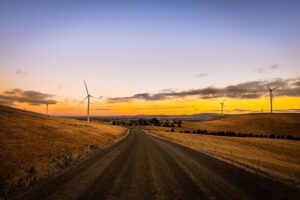
His home is 600 metres from the nearest turbine. He has 10 turbines within two kilometres and his bedroom faces the closest tower. The Bald Hills substation sits in the middle of his property, with around eight workers coming and going daily.
And his verdict is unequivocal:
“I can guarantee you 100% there is no negative impact of a wind farm. There’s no negative impact on the neighbours. There’s no negative impact on my farm.”
Not on the land. Not on productivity. Not on biodiversity. Not on livestock.
“I’ve increased productivity, probably by 20% or more,” he said. “The income has totally helped me get through some very hard, difficult weather events and commodity price crashes.”
He now employs a permanent worker. The steady lease payments have allowed the family to upgrade infrastructure and invest in drought resilience.
“We’re able to navigate those crippling, crippling times,” he told the committee — including a “micro drought” last year that saw farmers in a usually high-rainfall region run out of water and feed.
The “circle of life” under turbines
Marriott says he’s “not a twitter person”, but admits he was nervous at first about the birds – the farm sits beside a wetland reserve. So from 2015 he began keeping a diary of bird movements “because a diary entry is held in pretty high esteem in a court of law.”
His findings: nothing matches the dystopian claims circulating online.
“Each spring, there’s hundreds of Ibis that fly through my farm… They will fly under the turbines, around the turbines, over the turbines.”
He has “three or four hundred swans” grazing his pastures in winter. “All the parrots, all the ducks, all of the bird species in our region live on our farm and or travel through it.”
The most outlandish claim he’s heard? At a local meeting someone declared that turbine workers “before dawn every day, go around and hoover up all the dead birds.”
“I can look at you and say, we do not have birds killed regularly on the wind farm.”
What he sees instead is a thriving mosaic: native habitat, commercial agriculture and renewable energy co-existing “totally, fully utilised by all the local inhabitants… kangaroos, wallabies, even the occasional koala.”
European turbine manufacturers have even told him that his property represents “the three elements of a good environment — a productive livestock farm, native habitat, and renewable energy — all happening together.”
The wind farm substation has also brought unanticipated advantages: trained workers are on site daily, and often the first to spot a calving issue; local tradespeople are now skilled in turbine maintenance; and a flow-on effect for the region’s economy.
“It’s allowed me to totally upgrade my facilities,” Marriott said. “We’ve totally upgraded all our infrastructure.”
What communities need: Facts, not fury
Marriott’s story is powerful not because it is rare, but because it is rarely heard — drowned out by misinformation amplified by politics, social media algorithms and well-resourced opponents.
RE-Alliance told the committee that public support for renewables in regional Australia remains strong at 61%, but it is “fragile,” with many people wanting more trusted, local information about impacts before supporting projects.
To counter the misinformation cycle, they propose establishing 50 independent regional local energy hubs — trusted, local centres that help communities access clear information, navigate developer engagement, and benefit from the transition.
“Misinformation heightens anxiety,” their submission warns. “It increases conflict… It threatens community cohesion and personal safety.”
Marriott has lived that reality. And he left senators with a simple message:
“My lived experience is the opposite to the majority of talk. And I find it unbelievable that after all this time with so many wind farms operating, there’s still the nastiness and the anti and the absolute nonsense said about wind farms.”
For regional Australia, the transition isn’t abstract. It’s lived. And, as Marriott shows, the truth on the ground looks nothing like the fear being generated online.
Read also: “The wheels fell off:” Farmer tells Senate how misinformation killed a community battery project
And: “Dead Man Walking”: IPA’s climate obstruction on full display at Senate misinformation inquiry
If you would like to join more than 28,000 others and get the latest clean energy news delivered straight to your inbox, for free, please click here to subscribe to our free daily newsletter.