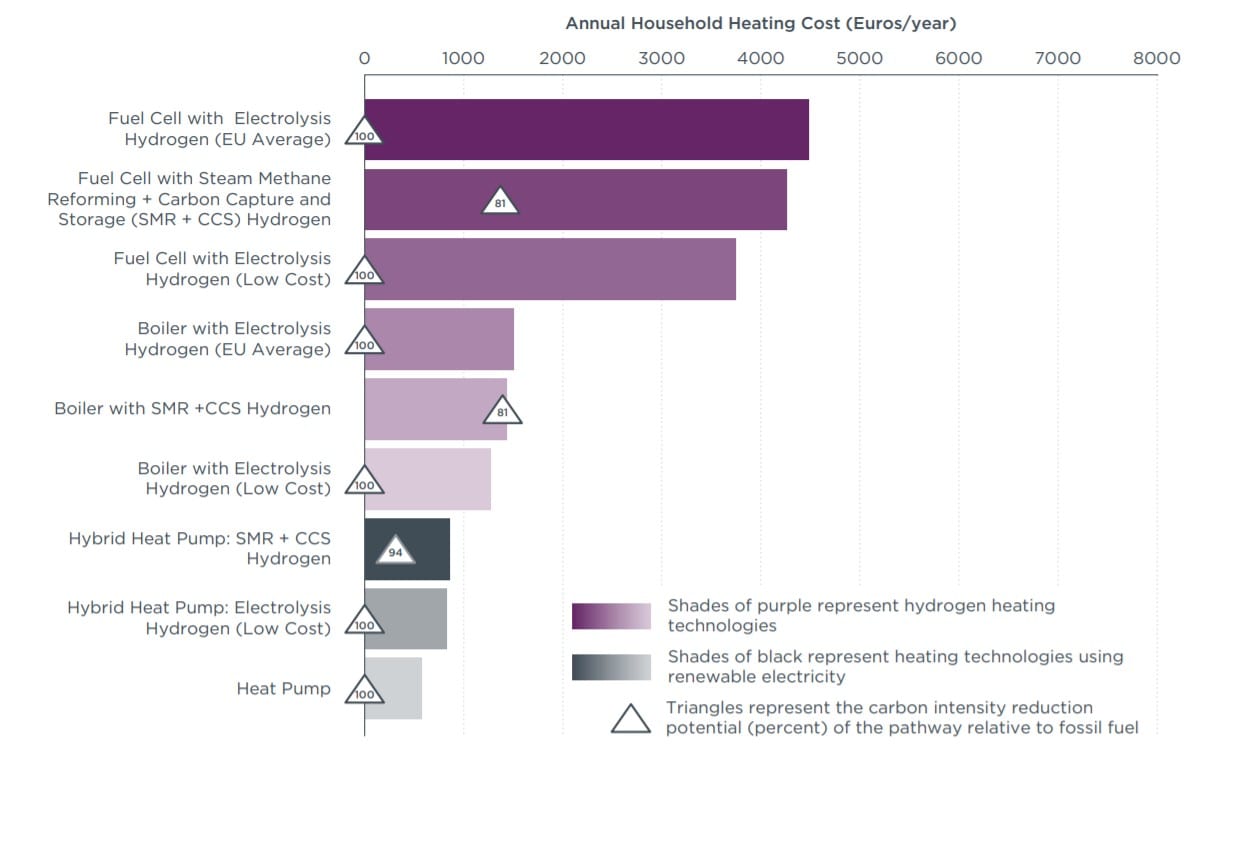
A new study released by the International Council on Clean Transportation (ICCT) has found that achieving emissions reductions through electrification in heating in European homes will be far cheaper and cost-effective than using hydrogen-only technologies. In its modelling, air-source heat pumps are the most cost-effective residential heating technology in 2050, and at least 50% lower in cost than hydrogen.
The analysis comes in the context of a new push from the European Commission to raise the 2030 greenhouse gas reduction target to at least 50%, on 1990 levels. Heating is the primary source of energy demand in European households and determining the best pathway to decarbonise this sector is as vital as the power and transport sectors, in this decade, in Europe.
“In a sensitivity analysis, we find that even if natural gas costs were 50% lower or renewable electricity prices were 50% higher in 2050 compared to our central assumptions, heat pumps would still be more cost-effective than hydrogen boilers or fuel cells”, writes ICCT, in its full report.
The report also finds that using a process known as ‘steam methane reforming’ (SMR) combined with carbon capture and storage (CCS) to produce hydrogen using fossil gas does not fully decarbonise heating, due to the leakage of gas and inherent inefficiencies in CCS.
“Even in a scenario where zero- and low-carbon energy is used to fuel the SMR process, this pathway still releases 7%–31% of the GHG emissions of natural gas. In contrast, the use of wind and solar power for heat pumps and electrolysis hydrogen would be fully zero-carbon”.
The debate around gas in homes is particularly relevant to Victoria and Tasmania in Australia, in which a large quantity of gas is burned to create heat for homes, with the consequence of a very significant quantity of greenhouse gas emissions. Talk of a potential ban of gas connections for new homes in Canberra has spurred debate. In the US, the gas industry has invested in advertising campaigns, astroturf activism and front groups to attempt to fight the electrification of homes.
A recent analysis found that improvements in energy efficiency were more than sufficient to avoid any shortfall in the future supply of fossil gas, and that they could serve as a far better alternative in terms of post-COVID19 recovery stimulus than the fossil fuel industry.
Gas turbines aren't the only large equipment with long lead times.
All Electric Homes founder Trent Jones warns that a shortage of skilled tradies, fragmented business…
For asset owners, buyers, managers and O&M teams, the webinar will cover performance metrics, service…
Less than two years after starting construction, four-hour big battery energy storage system powers up…
Fascinating chart backs up AEMO chief's observation that people are piling in on the offer…
As more and more Victorian households quit gas, there remain real and unresolved questions about…