Woolnorth wind farm in Tasmania. Credit: Flickr/Wind Denmark
A new report published by the United Nations Environment Programme has found that Australia is at the bottom of the list for directing post-Covid 19 economic stimulus towards clean, rather than polluting, options.
The Global Recovery Observatory is an initiative led by the Oxford University Economic Recovery Project (OUERP) and supported by UNEP, the International Monetary Fund, and GIZ through the Green Fiscal Policy Network (GFPN), and has been tracking the policies of the world’s 50 largest economies.
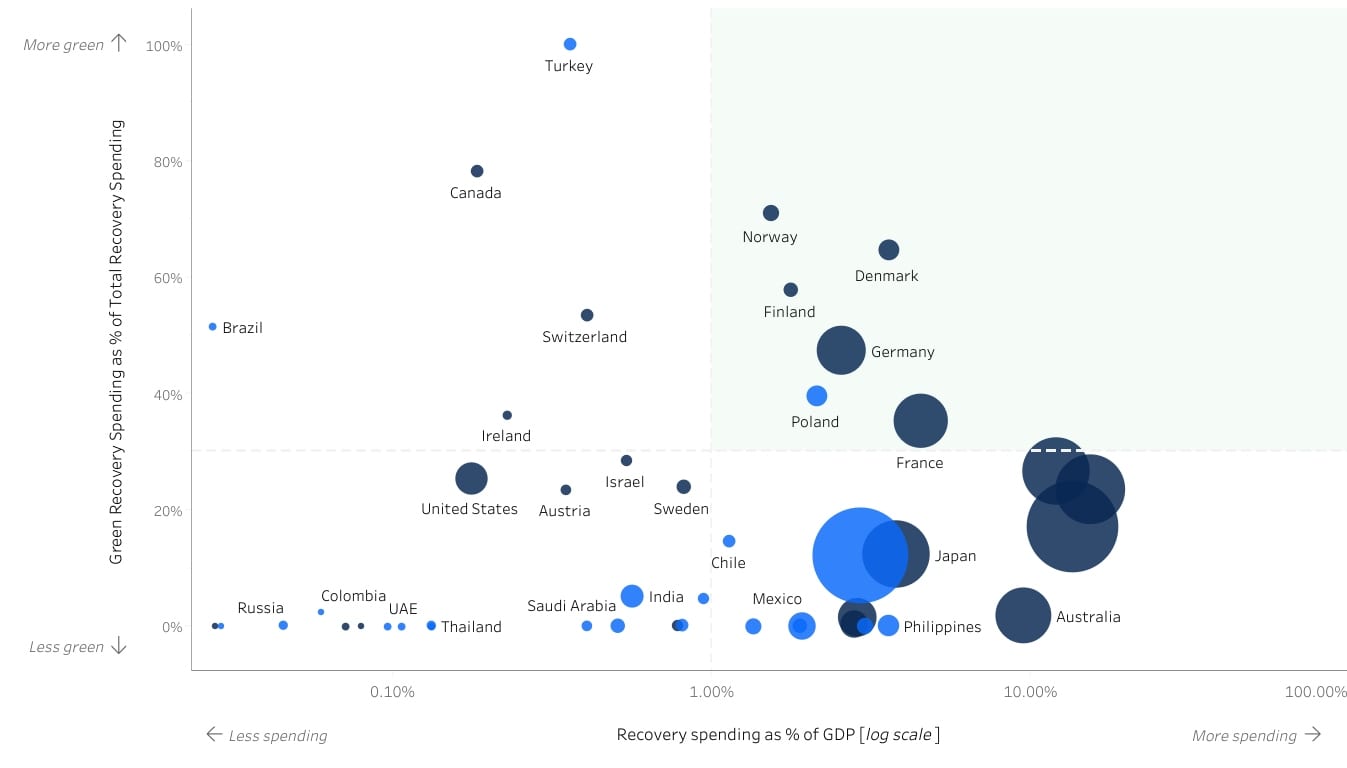
Australia’s stimulus investments have been large in scale relative to GDP, but almost entirely directed towards less green alternatives. Only South Korea, Spain and the United Kingdom had higher spending, but Australia ranks lowest on the precentage of total recovery spending directed towards green options.
“To the question, ‘Are we building back better?’ the answer is: not yet. The spending announced in 2020 paints a disappointing picture for overall efforts thus far to build forward with green priorities”, wrote UNEP, in the report.
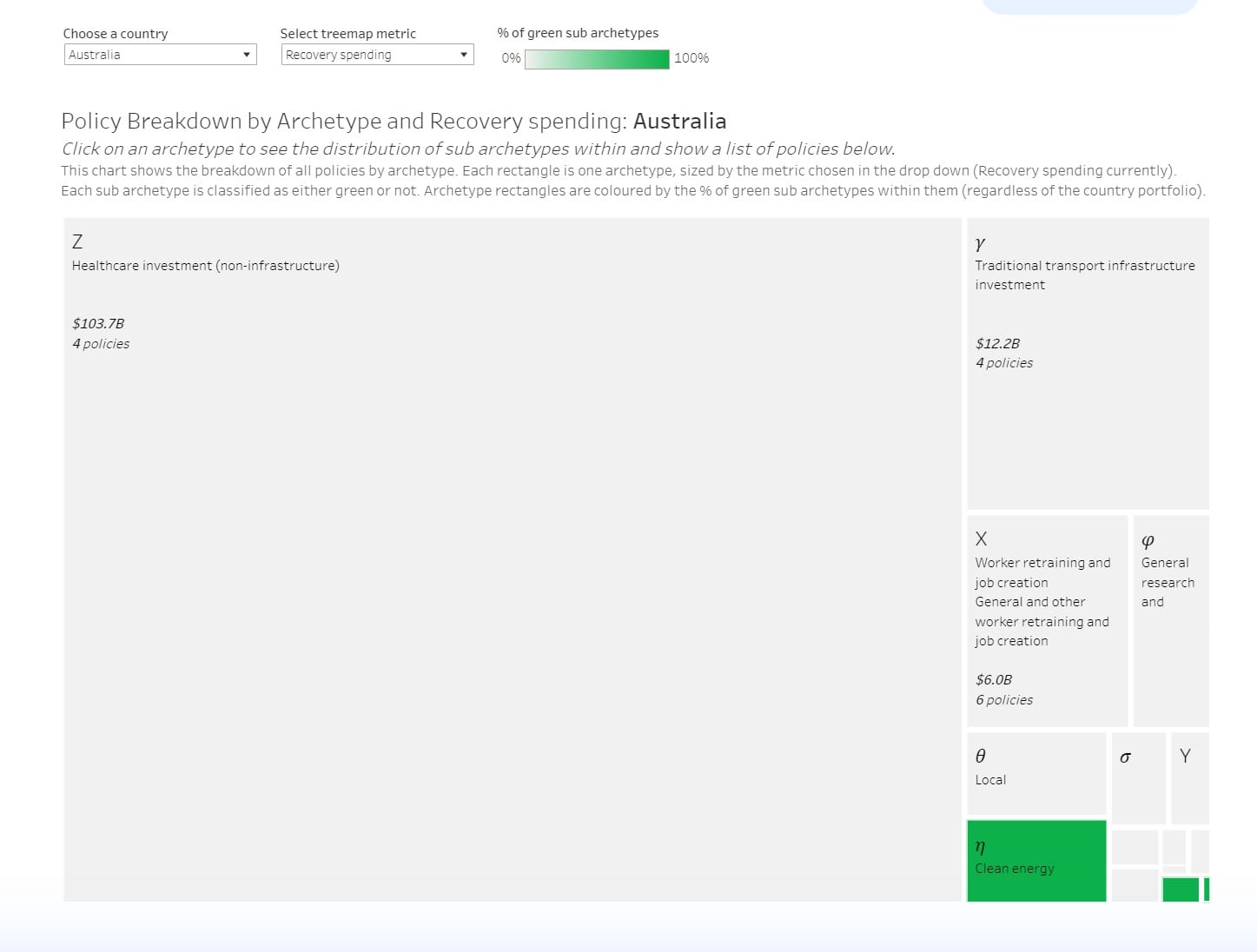
The project tracks spending on green projects such as renewable energy, transmission projects, battery storage, electric vehicles, active transport and energy efficient / green homes. Australia ranks weakly in all these categories, with most spending directed towards healthcare investment. Australia’s gas-fired recovery ranks particularly low, with the group assigning it a net negative impact on environment and human health.
Of the global data, $66.1bn was invested in low-carbon energy, thanks to Spanish and German subsidies for renewable energy projects and hydrogen and infrastructure investments. $86.1billion was announced for green transport through EV transfers and subsidies, investments in public transport and cycling and walking infrastructure.
Professor of Environmental Economics at Oxford, Cameron Hepburn said the report was “a wake-up call.”
“The data from the Global Recovery Observatory show that we are not building back better, at least not yet. We know a green recovery would be a win for the economy as well as the climate – now we need to get on with it,” he said.
Nelson Zheng from Pylon on why the battery rebate has been kinder to some businesses…
Australia has installed half a million home batteries in the last year. But how many…
NSW Greens call on federal counterparts not to support a Senate vote that could block…
The current second wave of big battery projects will kill the economics of most coal…
Few organisations have so consistently campaigned to stymie climate action – possibly anywhere on the…
Tom Geiser from Good Heat on the technologies to provide carbon-free industrial heat. Plus: LNP's…