
The Institute of Public Affairs’ appearance before the Senate inquiry on information integrity on climate and energy on Wednesday quickly devolved into a combative, fiery replay of Australia’s old climate wars – complete with denial, deflection, and self-congratulation for helping to kill the Coalition’s commitment to net zero.
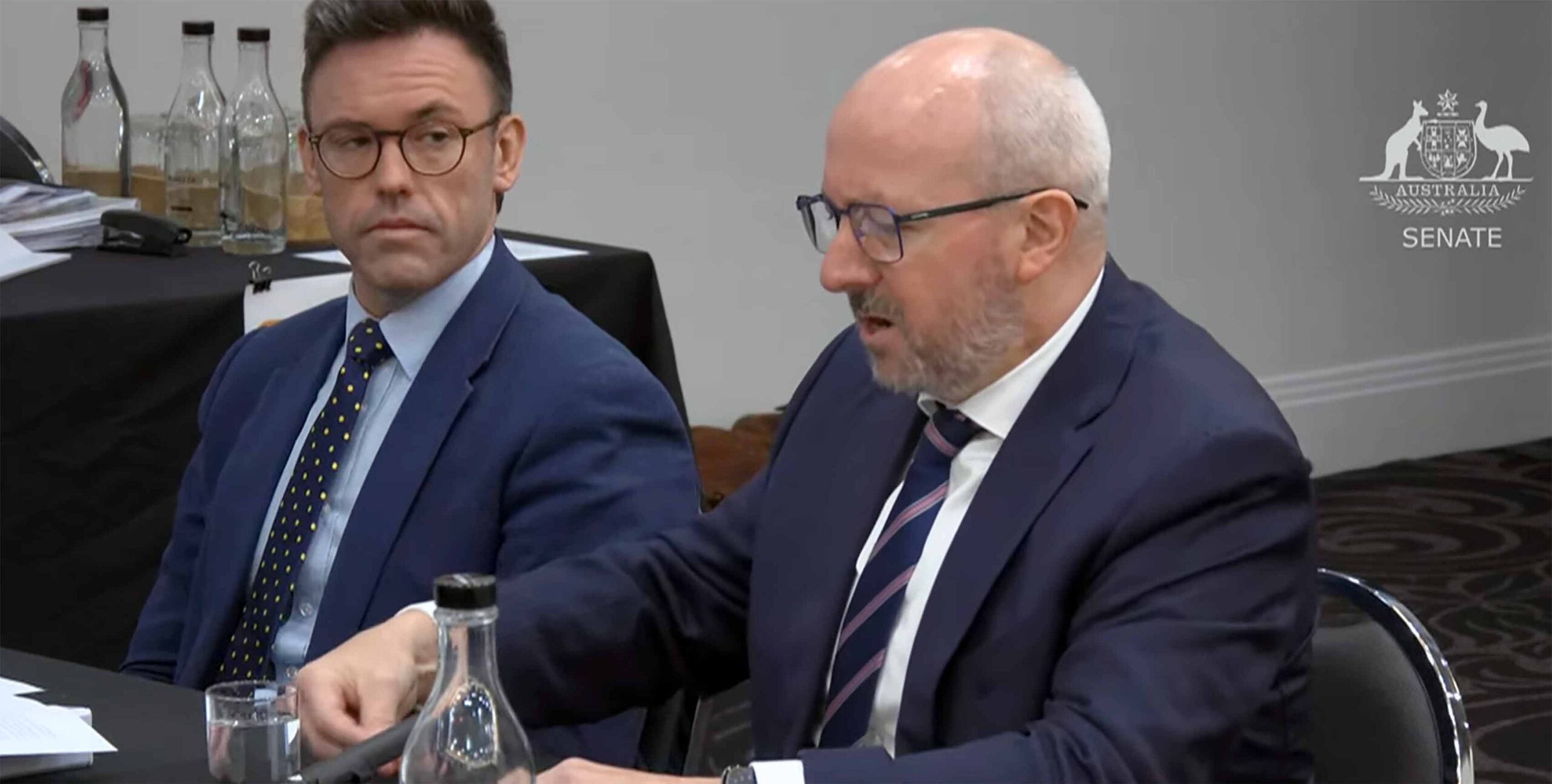
Facing questions from committee chair Senator Peter Whish-Wilson, IPA deputy executive director Daniel Wild and executive director Scott Hargreaves were pressed about an email the free-market think tank sent to 10,000 of its members last Friday.
The email declared: “Net zero, dead man walking.”
Whish-Wilson read the full letter aloud:
“Dear Senator Whish-Wilson, as IPA deputy executive director Daniel Wild said this week, don’t underestimate this. We’ve now broken the back of net zero, and net zero is now a dead man walking… The developments this week would not have happened without the work of the IPA. Only the IPA has been publishing the research and analysis revealing net zero is unaffordable, unachievable and unwanted by Australians.”
When asked whether the IPA was “out and proud about climate obstruction,” Wild dodged, demanding a definition. When the Senator provided one — “intentional action and efforts to slow or block policies on climate change commensurate with the scientific consensus” — Wild shot back: “That’s your definition.”
Hargreaves was more direct: “Our research is based on the proposition that this is bad policy, so you can call it climate obstruction. But that is not our objective… Our objective is to critique the policy and say this is bad policy, which would be bad for the freedom of Australians.”
Obstruction rebranded as freedom
Whish-Wilson pressed whether the IPA was proud to have “killed net zero for the Liberal Party.” Wild denied it, then added: “We’re incredibly proud of the work that we’ve done for over eight decades on this issue… What, I’m not allowed to have an opinion? I’m not allowed to communicate?”
When challenged on the “dead man walking” language, Wild insisted: “Did I say the word kill? … Don’t verbal me. You misquoted me deliberately.”
But moments later he conceded: “That is a commentary provided on the current political situation. It is an astute commentary on the current political situation.”
Throughout the hearing, Wild punctuated his answers with sarcasm — “I’m sorry if I used the wrong pronouns” — and accused the inquiry of political censorship.
Both IPA executives portrayed the Senate inquiry itself as an attack on free speech. Wild claimed the work of the committee is “a fiction invented by Australia’s political elite as a front to curtail freedom of speech and shut down public debate.”
Hargreaves echoed him, arguing: “It seems to me that the definition of misinformation that is being created out of this inquiry is …anything that undermines the public’s appetite for the rollout of renewables is, by definition, misinformation.”
Funding fog and friendly networks
Under questioning, Hargreaves confirmed mining billionaire Gina Rinehart remains an honorary life member of the IPA but refused to say whether she still funds the organisation: “We don’t disclose our donors… I’m not going to answer any questions about who is or isn’t donating to the IPA.”
Asked whether the IPA receives funding from Coal Australia, he again replied: “I’m not going to answer any questions about who is or isn’t donating to the IPA.”
He did confirm that the IPA remains part of the Atlas Network — a global coalition of libertarian think tanks that campaign against government regulation and climate policy — athough Hargreaves claimed ignorance of any work they’d done on climate.
“I’d defy anyone to find anything that [Atlas] has actually ever said which is focused on climate as an issue.”
Atlas reportedly works through affiliates, providing training and messaging support that shape energy debates worldwide.
Wild did, however, acknowledge the IPA has “a very convivial relationship” with Advance Australia, the right-wing campaign group that has repeatedly opposed net-zero and renewable-energy policies.
Denied astroturfing
In response to Labor Senator Michell Ananda-Rajah’s question, what proportion of the IPA’s funding is allocated towards community engagement or grassroots outreach, Hargraves claimed, “I’ve never calculated like that. It impacts the travel bill a bit.”
Pressed by Senator Whish-Wilson on whether the IPA supports the National Rational Energy Network (NREN) — a group that coordinates anti-renewable campaigns — Wild lashed out:
“Could you bring your tin hat?… It is profoundly undemocratic that you seem to have this view that we’re not allowed to talk to other people in the community on this issue.”
Both he and Hargraves insisted the IPA’s regional campaigning and support for local anti-renewable groups was “organic”: “The IPA has visited over 62 regional communities over the past three years… There is almost unanimous opposition to these [renewable] projects, other than those who financially benefit from them. These people are real. They exist.”
The return of the old climate wars
Today’s hearing laid bare the chasm between evidence-based climate policy and the ideological obstruction that continues to distort it. Wild and Hargreaves dismissed climate science, impugned the inquiry’s legitimacy, and re-branded political interference as “freedom.”
The spectacle ended where it began — with an organisation boasting that it had “broken the back of net zero,” then insisting it was the victim of censorship for saying so.
For a Senate inquiry into misinformation, it was a perfect — and chilling — case study in real time.