Fortescue plans to “copy and paste” its new 50 megawatt (MW), five hour North Star Junction battery across the other six storage projects it currently has under development.
The iron ore giant’s CEO Dino Otranto was at the battery site on Thursday, showing off to attending media the first of the big battery projects that will be rolled out across the Pilbara as part of its goal to deliver “real zero” emissions at the giant mines by the end of the decade.
“No disrespect to [contractor Monodelphous] or the project team, this is probably the most easy project they’ve ever had to build,” Otranto said while standing on the gravel pad next to the battery in question.
“The same postage stamp, there’s not much engineering in a pad and some gravel. It’s brilliant for me to see that we’re not even affecting the contours of the land. It’s a very, very low impact type of energy generation.”
The battery project itself is not huge, smaller in footprint than the workers’ village on the other side of the track leading into the site. And, somewhat embarrassingly, a diesel generator was running in the background of the site tour – Otranto quipped that he hoped it was powering air conditioning.
But even at just 50 MW and 250 megawatt hours, the battery is still short on local renewable energy to fill it.
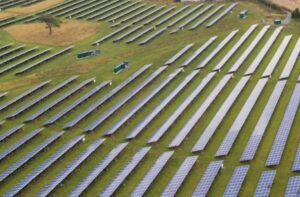
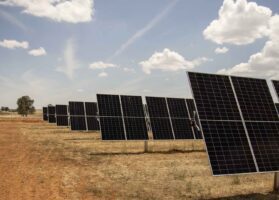
There’s not enough left over from the nearby co-located 100 MW solar farm to completely charge it, given the needs of the network.
However, the addition of the soon-to-be-built 644 MW Turner River solar project, where sods will begin turning this year not far from North Star Junction, will be sufficient, with some left over for its own on site battery.
Connecting the battery to the grid is a gas-insulated switchgear substation which allows circuits to be tested without disrupting the network – something that took place this week to test that the 42 MW battery at the Iron Bridge mine nearby could handle being islanded from the grid.
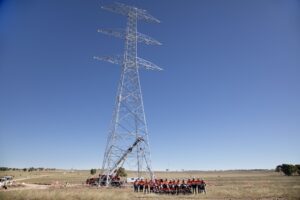
That then connects into Fortescue’s 220 kilovolt transmission system dubbed Pilbara Energy Connect, which can move 650 MW of electricity.

These projects are the first of a plan to build out multi-gigawatts of wind, solar and batteries across the Fortescue network.
It has already installed half of the half million or so solar modules at the Cloudbreak solar project, and has just started construction of its first wind project, at Nullagine, where it will deploy – for the first time – the self-lifting tower technology developed by its recently purchased Spanish business Nabrawind.
The North Star Junction battery is the first of a package deal of storage that Fortescue signed with BYD six months ago, which Otranto says is sized at 5.6 gigawatt hours (GWh).
Otranto told investors earlier this year it had already “saved our bacon” when the at-times temperamental Pilbara electricity network flickered, and he says all 5.6 GWh of capacity have been locked in at what the company says is the lowest cost for a battery yet.
“We’re aiming for power costs which are multiples less than the current power cost,” he said on Thursday.
Furthermore, they chose a small 20-foot container to make it easier to install: the 40 tonne unit was delivered on normal roads in a normal truck. Anything bigger would have needed an over-sized transport plan.
The iron ore giant’s current battery stock – three projects totalling 92 MW, according to RenewMap – is not yet enough to fundamentally change how the company operates, but that is what it’s expecting in future.
“Eventually we will over-build the solar greater than what our daily use is, and that over build will essentially shift the generation from day shift into night shift through the battery. So we’ve got load stabilizing batteries, and we’ve got load shifting batteries,” Otranto says.
Renew Economy travelled to the Pilbara as a guest of Fortescue.
If you would like to join more than 29,000 others and get the latest clean energy news delivered straight to your inbox, for free, please click here to subscribe to our free daily newsletter.