The first gigawatt scale battery built by AGL Energy, which remains the country’s biggest generator of coal fired power, has recently begun charging and discharging from the grid, and will be guided by algorithms developed by the company’s own in-house team.
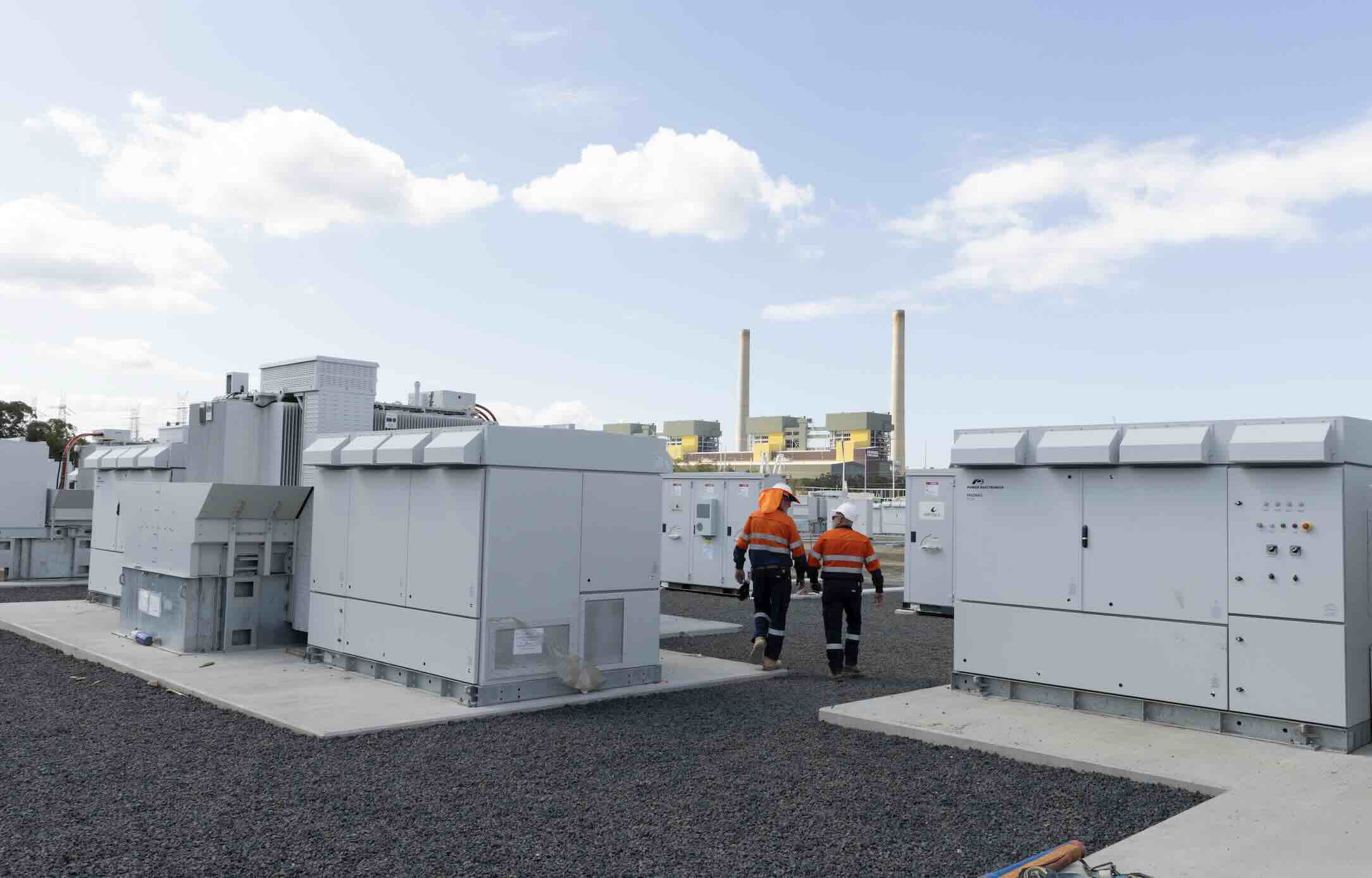
The 500 megawatt (MW), 1,000 megawatt hour (MWH) Liddell battery is being built in the shadow of the remains of the Liddell coal generator, just across the road from Bayswater coal generator that will continue to operate into the 2030s.
It is by far the biggest battery built by AGL to date – double the power and four times the storage of the Torrens Island battery in South Australia and 10 times bigger than the Broken Hill battery in NSW.
It will, however, be overtaken soon enough by the 500 MW, 2,000 MWh Tomago battery down the road which is taking advantage of sharply lower battery prices to double the amount of storage.
AGL CEO Damien Nicks told Renew Economy earlier this week that Liddell is now at its first “hold point”, part of the vigorous testing and commissioning process imposed by the market operator before a new project is allowed to operate at full capacity.
AGL expects the first 250 MW, 500 MWh stage of the Liddell battery to be fully commissioned in the next two months, while the second stage of the same size should be completed by the end of June. The Tomago battery should be complete by the end of 2027.
The company’s existing battery assets – which include several off-take agreements and its own Torrens Island and Broken Hill batteries – are performing well, with Torrens Island showing returns of a healthy 24 per cent on its investment.
AGL chief commercial office David Moretto put this at least partly down to the success of the trading algorithms it has been developing in-house with a team of five over the last few years.
“Three years ago, we took the decision to, rather than buy something off the shelf, to actually build in house,” Moretto told Renew Economy.
“We were of a scale that we thought it was worth making that investment. So we’ve actually got five people dedicated to actually building up battery bidding algorithms. We’re really proud of it, and once we get Liddell on line later this year, it’s going to be a big step change for us.”

Batteries are expected to become significant component of the company’s earnings in coming years. In the latest half, they were one of the main bright spots, lifting their contribution by 40 per cent to $35 million on an Ebitda level.
AGL is likely to follow these projects with a series of other big batteries, including the 500 MW, 2,000 MWh Tuckaroo battery in Queensland, several small projects in the same state, and the 400 MW, 1,600 MWh Pottinger battery, although this will be built as part of the Pottinger wind project in the south-west of the state.
“We are really pleased with the performance of the batteries, and we continue to invest there, and we have a big pipeline to bring to market at the right time,” Nicks told Renew Economy.
“It’s about finding the right locations, if there’s constraints in market or constraints from our portfolio perspective.
“I think we’ve got some of the best technology in terms of trading, when I say trading those batteries, optimizing the use of those batteries in the market, not just for arbitrage, for FCAS, for capacity, all those type of things.
“I think our battery performance just for Torrens and Broken Hill was up 10 mil half on half in what was an incredibly low volatility period. And I think that’s the other piece that we don’t see that low volatility playing out like that on an ongoing basis. It’s not the structural norm.
“There’ll be cycles up and down, because demand is going through some also some huge growth right now, and winter, winter is the new summer.”
See Renew Economy’s Big Battery Storage Map of Australia for more information.
If you would like to join more than 29,000 others and get the latest clean energy news delivered straight to your inbox, for free, please click here to subscribe to our free daily newsletter.