The average emissions intensity for Australia’s National Electricity Market (NEM) is down 25 per cent since 2020, and down 40 per cent since 2015.
David Osmond, a principal wind engineer at WindLab, the owner and operator some of the country’s most significant renewable energy projects, now controlled by Andrew Forrest, recently highlighted on his LinkedIn account an update on Australia’s electricity emissions.
Citing data from OpenElectricity, Osmond showed that average emission intensity for the NEM over the 12-months to the beginning of February was 510 kilograms of CO2-equivalent (kg CO2e) per megawatt-hour (MWh).
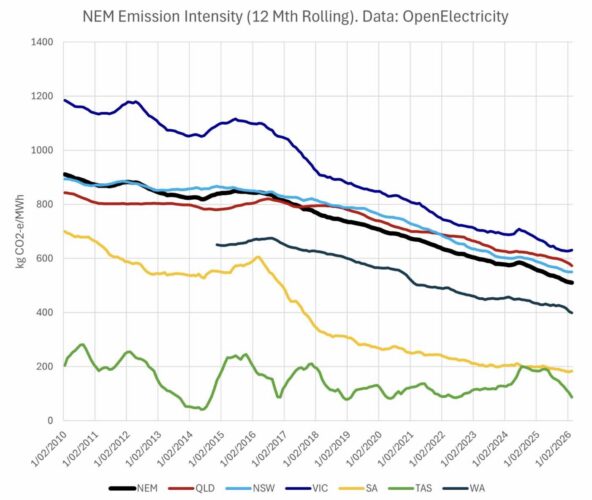
Unsurprisingly, South Australia leads the way with the greatest level of reductions thanks to its massive focus on renewable energy, down 28 per cent since 2020 and down 68 per cent since 2015.
“SA’s performance all the more impressive given that is has zero hydro generation,” said Osmond. “All very low carbon grids of the world tend to have significant hydo generation.”
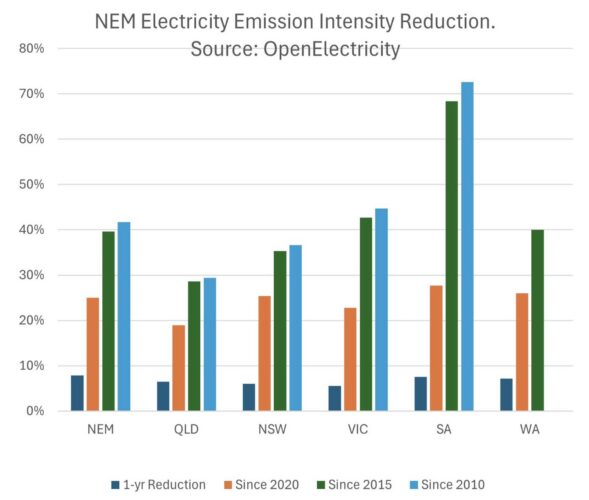
The interesting aspect of this graph is that it is the country’s two most coal dependent states – unsurprisingly – who have dragged the train, with emission falls fall lower than the national average, and what’s been achieved in South Australia and other states.
S.A. ended coal generation in 2016, W.A. plans to do so by the end of the decade, and Victoria has a legislated target of 95 per cent renewables by 2035.
NSW is trying to build enough wind and solar quickly enough to allow its remaining coal generators to retire, while Queensland’s LNP government has ripped up that state’s renewable energy targets and vowed to keep burning coal until the late 2040s or even the early 2050s.
Note: The emissions data includes electricity imports from other states.
If you would like to join more than 29,000 others and get the latest clean energy news delivered straight to your inbox, for free, please click here to subscribe to our free daily newsletter.