Key Takeaways
- Australia’s Clean Energy Finance Corporation (CEFC) receives an extra $2 billion to support large-scale wind and solar projects.
- The new mandate aims to address financial bottlenecks and encourage private capital investment in renewable energy.
- At least 10 gigawatts of new renewable energy needs to be built each year through to 2030 to meet emissions reduction targets.
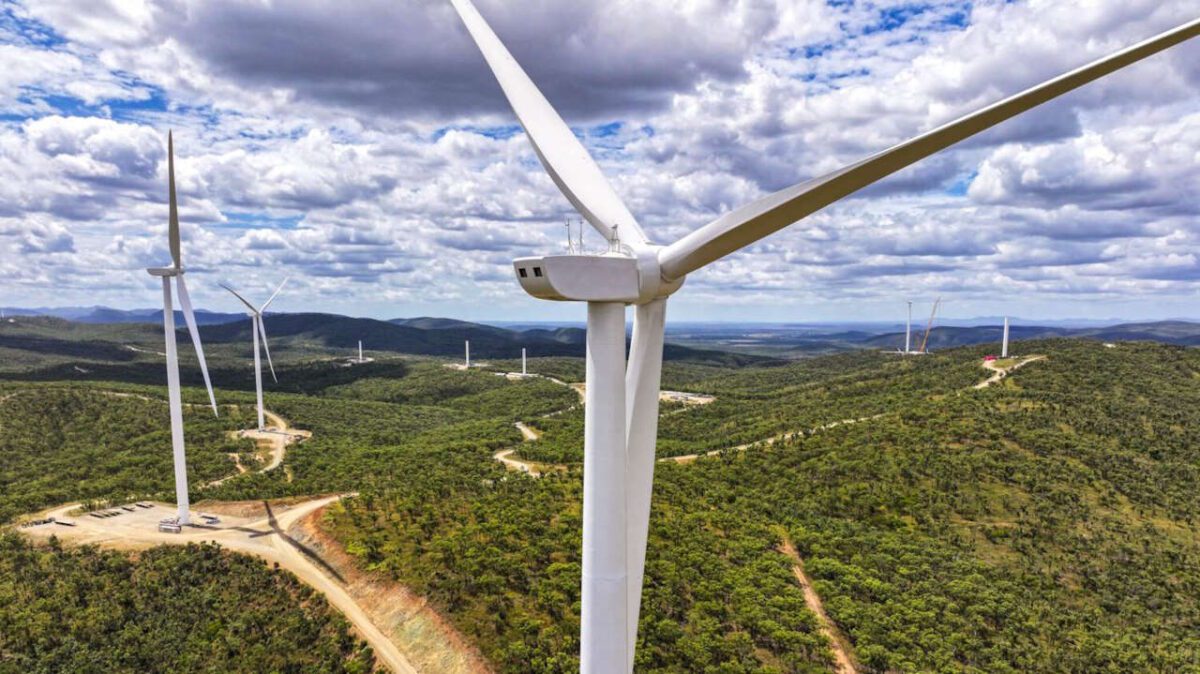
Australia’s green bank is to get a new mandate, and an extra $2 billion, to support the rapid rollout of large scale wind and solar to help the federal government reach its 2030 renewable target, its new 2035 emissions target and a longer term goal of reaching around 97 per cent renewables by 2050.
The extra $2 billion for the Clean Energy Finance Corporation was announced by the Labor government on Thursday as part of its 2035 emissions target and net zero plan, which sets a range of a 62 per cent to 70 per cent reduction in emissions, and also allocated $5 billion for a new net zero fund.
The new mandate and extra funds for the CEFC appear designed to break the financial bottlenecks that have seen no new wind projects reach financial close so far in 2025, and not enough solar projects.
“The Government will update the CEFC’s investment mandate to include a new focus on the rapid roll out of renewable projects to drive down electricity prices, and commit up to $2 billion more to the CEFC General Account, to be drawn down in line with these changes,” it says in the report.
“This will enable the CEFC to continue to crowd-in private capital for initiatives to modernise our electricity system and reduce emissions across the economy.”
The CEFC played a critical role in providing lower cost finance to key wind and solar projects in past years but its recent focus – and several billion dollar of commitments in the last 12 months – has mostly been on transmission projects, green loans, EVs and electrification.
Now it’s needed again to grease of wheel of finance for wind and solar, particularly given the effective buyers’ strike by big utilities and other major corporates, rising wind costs, and the reluctance of bankers – and many developers – to bet on merchant finance arrangements.
The rollout of wind and solar has not been keeping up with the scale and pace needed to reach the 82 per cent renewable energy target by 2030, despite efforts to fast track and expand the Capacity Investment Scheme auctions, which now seek 40 gigawatts of wind, solar and storage.

The net zero plan published by the government on Thursday indicates that at least 10 gigawatts of new renewables needs to be built each year through to 2030, and a high rate of deployment needs to continue in the following decades.
This is important for the main grid, but also the separate Western Australian grid (see ‘WEM’ in graph above), and the “off-grid” installations such as the giant mining regions in the Pilbara, where the likes of Fortescue are seeking to lead by example with a goal of “real zero” in its mining emissions by 2030.
Both the Climate Change Authority advice, and the federal government report, make it clear that Australia has the technologies to achieve significant emissions reductions, challenges remain in the rollout.
“By shifting from coal to renewables, scaling renewable supply, and improving performance of our networks and how we use electricity, Australia can decarbonise the sector and service new demand,” the government report says.
“Whilst there is a clear technological pathway for the decarbonisation of electricity supply, challenges remain in rolling out the required generation and network infrastructure.
“It will be critical to manage electricity system security – the system’s capability to withstand and recover from disturbances and contingencies – as Australia’s energy transformation gathers pace and synchronous power plants like coal exit the system.
Climate Change Authority chair Matt Kean, asked on the latest episode of Renew Economy’s Energy Insiders podcast what caused a lowering of the target range from the 65-75 per cent originally canvassed, and if the slow roll out of renewables was a cause of that, said:
“These are challenges to be overcome, but I’ve got every confidence we can do that. We’ve got a lot of the policy architecture in place to be able to speed things up.
“This is really hard. Think about … the rollout of renewable energy, we’ve seen supply chain constraints, we’ve seen labor shortages, we’ve seen social license issues and generally frustration through the planning process in getting a lot of these projects approved.”

The net zero plan suggests that – like the Australian Energy Market Operator’s Integrated System Plan, Australia’s coal fired power plants will be closed down in the mid-2030s – assuming of course that enough new bulk wind and solar can be built in time.
It says long-duration energy storage technologies like batteries and pumped-hydro can also be used to manage predictable, daily and seasonal fluctuations in generation.
However, when these technologies are depleted during periods of low solar and wind generation, it says peaking gas generators offer the cheapest insurance against periods of extended low generation.
But it expects gas to account for just 3 per cent of total generation in 2050, meaning that renewables, back by storage, will be delivering the other 97 per cent.
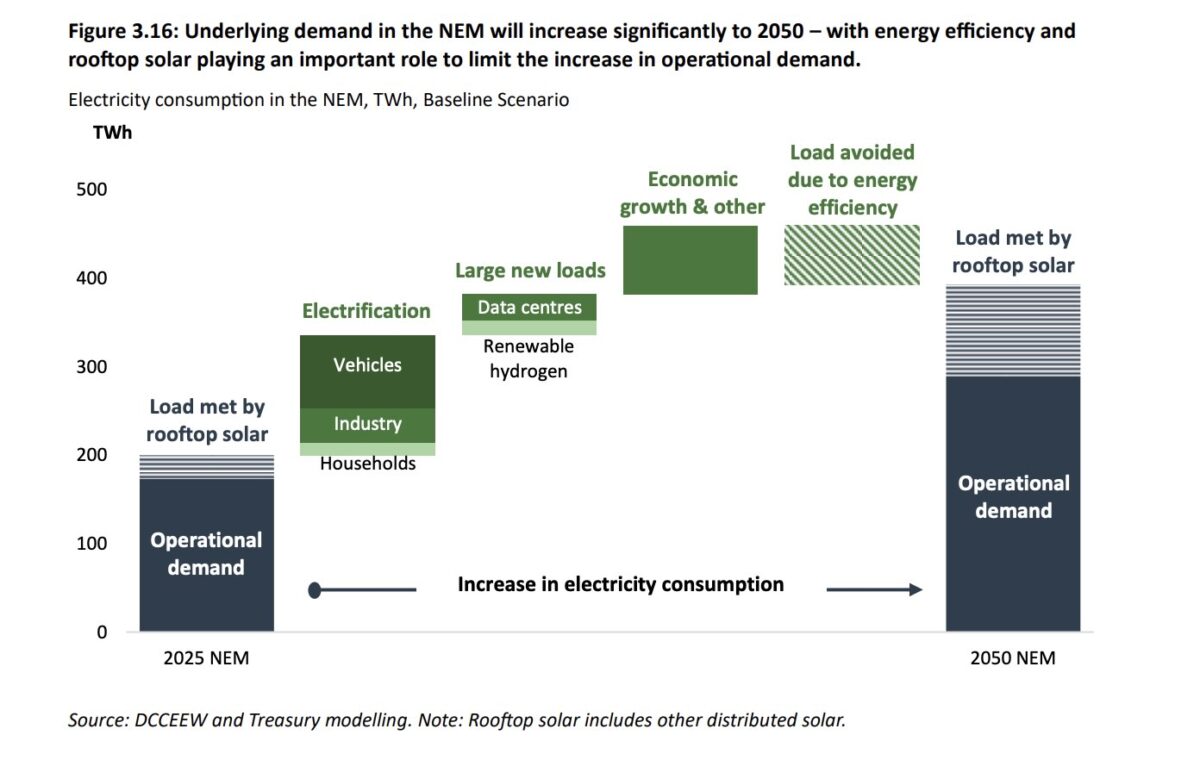
And this is despite a more than doubling in electricity demand as a result of electrification and new emerging industries such as data centres.
“Energy efficiency improvements can partly offset the impact of demand growth, reducing the need for new generation capacity. The impact on operational demand – that is, the amount of electricity that needs to be supplied by utility-scale generators – is also offset by rooftop and other distributed solar generation.
The Clean Energy Council said the new emissions target and other measures would set the direction for the next chapter of Australia’s energy transformation.
“We’ve done this before, and we can do it again. Australia has more than doubled the renewables in our energy system in less than a decade, and there’s no reason we can’t go the rest of the way,” said interim CEO Brett Wickham.
“Every wind farm, every solar project, every big battery makes the next one easier. We’re hitting critical mass now, and momentum is on our side.”