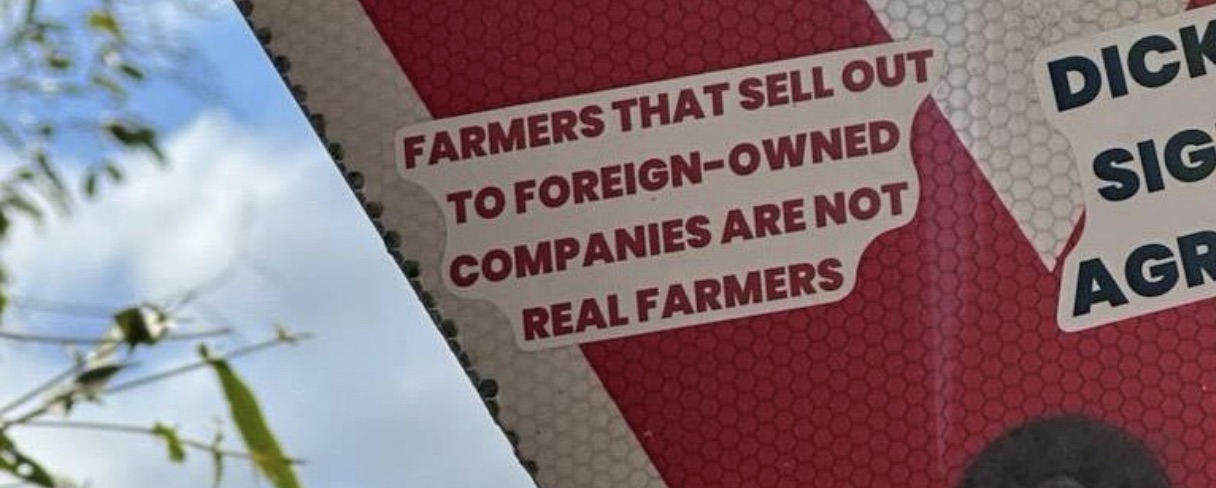
Verbally abusing children, boycotts of a farming business, and painting threatening messages on roads are just some of the intimidation tactics being used against people who host renewable energy projects.
These examples were detailed in the Clean Energy Council’s submission to the Senate inquiry into climate and energy mis- and dis-information.
It is one of the few submissions of the 150-and-counting to describe how individual landowners are being treated, and mirror reports by New South Wales Energy & Water Ombudsman Janine Young who told similar stories about landowner ostracism at the Australian Energy Week talk in June.
Clean Energy Council chief policy and impact officer William Churchill lays the blame for this breakdown in communities and behaviour at the door of false information being spread online.
“Clean Energy Council Members are reporting a direct increase in the level of hostility and intimidation directed at farmers and their families that are hosting clean energy infrastructure,” he says in the submission.
“We believe this activity is directly correlated with the increase in misinformation and disinformation circulating through digital platforms and is playing a substantial role in driving community tensions.”
The Senate inquiry is looking into climate and energy mis- and disinformation campaigns, and foreign and local organisations funding “astroturfing” – fake grassroots movements that are actually coordinated marketing campaigns.
Many of the submissions claim the government is the biggest purveyor of these campaigns, and a number of individuals’ submissions outline anxiety over having big projects near homes.
But it’s landowners who are facing the wrath of groups opposed to renewables, or to projects in their areas, alone and online forums are making the problems worse, Churchill says.
“The increasing mis- and disinformation circulating freely online is creating conditions that intensify psychosocial risk factors leading to unsafe environments for hosts, workers and members of communities,” he says.
“Inflamed tensions in communities unnecessarily fuels conflict between hosts of renewable projects and neighbouring landholders and community members.
“This has real and concerning consequences including bullying, intimidation, harassment, fear and confusion in communities, and even threats to the lives of those working in the sector.”
The submission described an anonymous case study where the daughter of a landowner who hosts a renewable energy project was verbally abused while at the local pub by a member of a local anti-renewables group.
That group has since organised a local boycott of the landowner’s grain business, and “there is a growing sense that opposition groups are coordinating efforts to economically isolate landowners who support renewable infrastructure.”
Another case study was of Lachlan Sullivan, a farmer from Boomey, NSW, who stood up in a meeting last year to try to correct some of the misinformation about the Kerrs Creek wind project.
He says while some in the community quietly support him, he has faced backlash which has taken a toll on his health.
Churchill says his group’s members are reporting that key messages, based on mis- and dis-information, are being copy-and-pasted and shared broadly through social media interactions, media engagement, letterbox drops, community meetings and environment and planning submissions, in a concerted effort to destabilise the industry.
“False claims spread rapidly, often amplified through emotionally charged framing and social media algorithms. This fosters confusion and resentment within communities,” he says.
“Often, the exact same text can be observed across several anti-renewables Facebook groups.”
See also: Astroturfing inquiry flooded with claims that government and climate science are the problem
And: “The grapevine will beat you every time:” How regional towns are managing anti-renewable push
And: Farmers for Climate Action hit by social media attack, says fake news drowns out rural voices