In an article last week I detailed how three government policies could build upon recent success in small batteries to stimulate the installation of an additional 22 gigawatts of rooftop solar by 2035, beyond the 47GW in AEMO’s current Step Change estimates.
This is across Australia’s two main power grids the National Electricity Market (NEM) and WA’s South-West Interconnected System (SWIS). This would greatly assist efforts to decarbonise the grid, raising renewable energy’s share of power supply by close to 9%.
This is explained in further detail in a report we prepared for the Australian Conservation Foundation and the Smart Energy Council – A re-evaluation of the potential for growth in rooftop solar and small-scale batteries.
However, given solar already regularly exceeds half of power supply over the middle of the day, some will be understandably concerned this extra solar capacity could pose problems for power system management, and possibly just result in additional curtailment of other renewable generators.
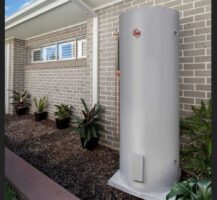
Until very recently I, too, would have shared this concern. But the thing that’s changed my perspective is the surprisingly large battery systems households are choosing to install since these systems became eligible for the STC rebate.
The chart below shows in the green bars the average size of battery systems registered with the Clean Energy Regulator each day since 1 July when batteries became eligible for the STC rebate. The dotted blue line overlaid on top shows the moving seven day average, which has been gradually creeping up and has now reached 20kWh.

Given the post-rebate cost of adding incremental additional capacity to a battery system is quite small, we expect that over the next 12 months the average size of residential battery systems will continue to creep upwards to reach 25 kilowatt-hours. Such large residential battery systems will completely transform how household solar is used.
At present a typical household with a 6.6 kilowatt solar system (still a highly popular system size although the overall market average is higher) will export a substantial majority of the solar system’s output to the grid – 70% to 80% is common. These exports are heavily concentrated around the hours surrounding midday.
However, in our modelling of how a 10kW solar system (which is likely to become the average size soon) would operate in conjunction with a 25kWh battery we found these midday solar exports largely disappear.
The chart below shows the hourly distribution of how a solar and the battery system would be utilised in a typical all electric home with one electric car in NSW over summer and winter.
In summer over the period from 7am to 6pm the solar generates enough power to cover all household consumption (the light green) and then most of the excess (shown in dark green) goes into charging up the battery, with a very small amount left over (shown in red) which would be exported to the grid.
Then in the evening peak period between 6pm and 9pm the battery will actually export to the grid a large proportion of its energy – shown in dark blue. That still leaves ample capacity in the battery to then satisfy the household’s energy needs overnight (the light blue).
In winter time the battery is too large to be fully charged by the solar and will on average need to import a small amount of power from the grid (shown in the negative value red bars).
Nonetheless if the battery is fully charged (like we’ve assumed in our modelling by importing power), it will still have plenty of excess capacity that can be used to export power to grid during the evening peak, as well as cover the home’s power consumption overnight.

The large batteries households are now adopting effectively convert rooftop solar generation into something akin to what you’d see from a baseload generator – except with a gas peaker also thrown in.
If 25kWh batteries become the default standard adopted when a solar system is installed or upgraded (which we expect will happen), it dramatically expands the scope for us to effectively exploit the use of rooftop solar to replace coal and gas power plants.