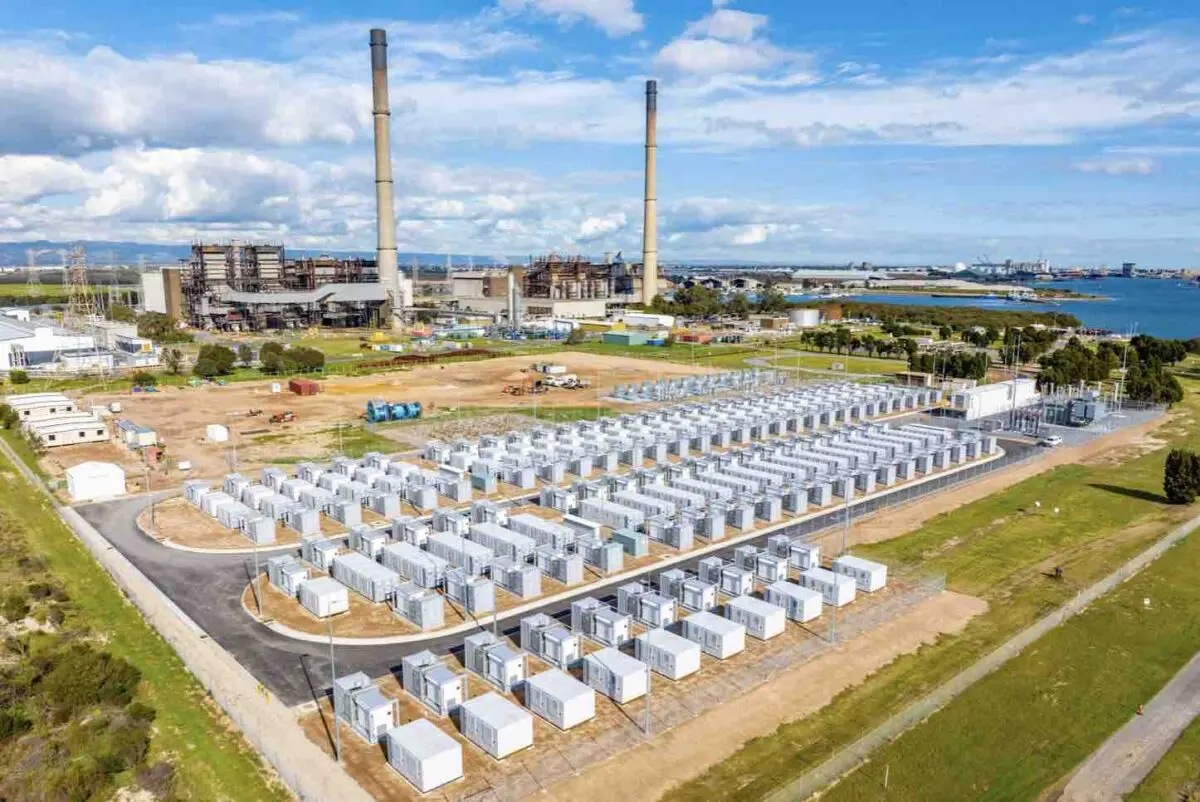
South Australia set a new early-morning battery-discharge record on Sunday morning, reaching a peak of 40.6 per cent of state demand at 4.50am, beating the previous peak of 40 per cent of demand that had been set in the evening last Tuesday.
The early discharge was followed by a steep daytime fall in total demand as rooftop PV flooded the system. From ~10:45 to 15:15, total demand turned negative, meaning rooftop PV output exceeded SA native demand.
Utility solar and wind was largely curtailed, unable to find demand to dispatch to and even if it could, probably at a loss.
Batteries switch from discharge to charging during the negative-price interval, providing welcome load, then return to discharge late afternoon as prices normalise and gas lifts beyond system-strength requirements to meet demand at a profit.

Observations & considerations
– The deep behind the meter Rooftop PV induced demand trough hollowed out total demand.
– Utility solar and wind became a “victim” the Dolphin Curve of abundance: With no demand to serve, and export limits binding, utility solar faced near-total dispatch suppression and complete “revenue destruction”.
– Early discharge not driven by a morning ramp: At 04:50, demand was steady and SA price was $31/MWh — too low to justify gas and too moderate to usually explain aggressive discharge on price alone.
– SA prices showed a full-day spread: High: $232/MWh at 21:55 | Mean: -$4.45/MWh | Low: -$323/MWh at 09:35.
– Arbitrage and MSL preparation both plausible: Batteries may have been creating headroom for expected negative-price charging, or pre-emptively reducing state of charge ahead of the Minimum System Load Market Notices issued for later in the day — no battery Intervention Notices were issued.
– Curtailment was extensive: The classic “Dolphin Curve” appears as rooftop PV growth forces utility solar (particularly) and wind out of the market for the “solar hours”.
Curtailment note: Daylight hours utility solar and wind curtailment reflected an extreme rooftop-PV surplus — a reminder that behind-the-meter growth increasingly shapes NEM operations. Minimal Gas — approximately 80-90 MW — was required for system strength purposes during this period.
SA’s operating envelope continues to tighten: deeper demand troughs from rooftop PV, predictable storage swings on sufficient price spreads, and recurring curtailment for utility renewables and “revenue destruction” when local demand is insufficient.
This story was adapted from a LinkedIn post with the permission of the author.