A day after it was first revealed that the main battery supplier to Australia’s most powerful big battery was facing potential collapse, the US company has publicly confirmed that tariffs imposed by US President Donald Trump are compounding its problems.
The Colorado-based Powin has told local authorities that it may have to completely shut down its business, and lay off its employees, by July 28 if its financial situation does not improve, as Renew Economy reported on Tuesday.
In a later statement sent to Energy-Storage.news, which broke the original story, Powin said a financial advisor had been appointed to help manage its business.
“Powin is navigating a period of significant financial challenge, reflective of ongoing headwinds in the broader energy storage industry,” the statement read.
“These challenges have been compounded by recent tariff developments that have added cost and complexity to the company’s operations and ongoing uncertainty surrounding the Investment Tax Credit (ITC).”
The ITC, of course, is one of a number of key policy supports introduce by the Biden administration, and which Trump has vowed to scrap as part of its assault on green energy technologies, and its support for fossil fuels.
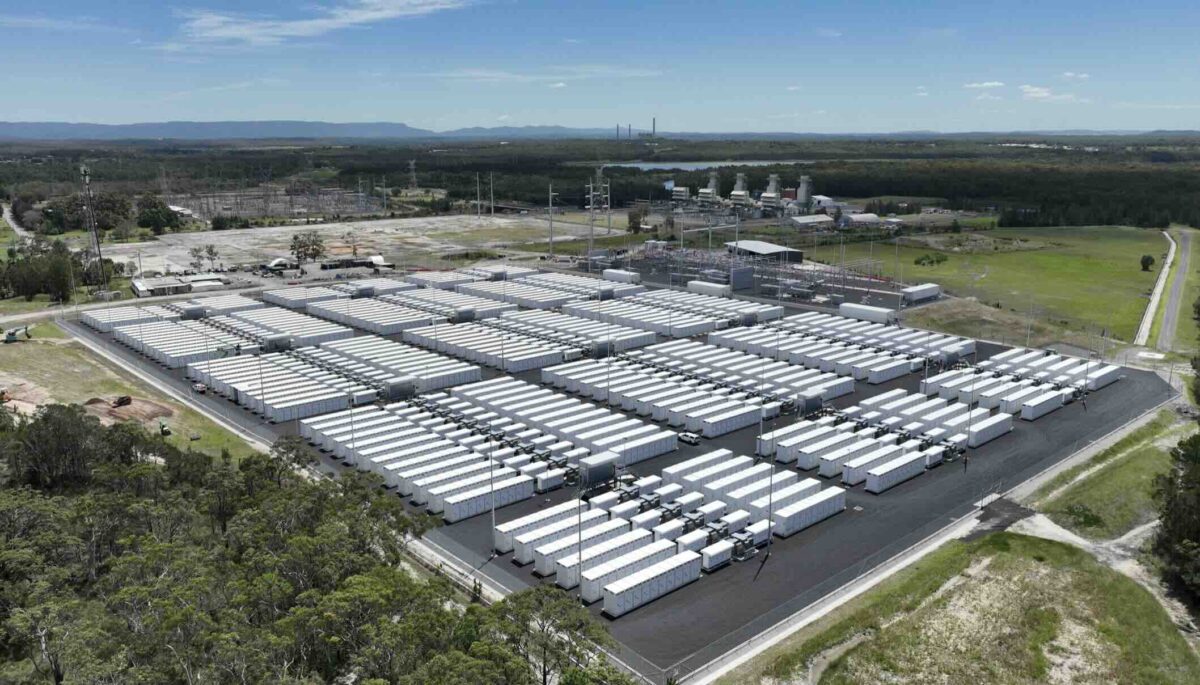
Powin was a relatively new player in the battery storage industry and had big plans for Australia when it emerged a couple of years ago as the surprising supplier for Akaysha Energy’s 850 MW, 1680 MWh Waratah Super Battery in NSW.
It is also supplying Akaysha’s 150 MW and 300 MWh Ulinda Park battery that is under construction in Queensland.
The Waratah battery – which is the biggest single unit (850 MW) ever to be is connected to the Australian grid – is contracted to deliver a unique service, acting as a kind of giant shock absorber at certain times that will allow transmission lines to transport more power into the major load centres in Sydney, Newcastle and Wollongong.
That type of service is not entirely new – several other batteries have been contracted to deliver a similar service – but never at this scale, or anything close.
It was designed to help fill the gap created by the anticipated closure of the country’s biggest coal generator, Eraring, in August this year, but the delay of that closure to at least 2027 appears to have diminished the urgency of that service.
As it turns out, the commissioning of the Waratah battery is running late, and the original target completion date of March this year has been shifted to late August, and most recently to the end of the year.
The impact on the batteries at a Waratah and Ulinda Park by the potential collapse of Powin will be mitigated by the fact that the batteries have already been installed.
It is not known how the issues will affect integration and maintenance, but Akaysha said on Tuesday that it has been aware of the issues at Powin, and has put in contingency plans to manage the situation.
Powin’s situation highlights the predicament of US battery suppliers under the Trump regime, with constant changes of tariffs and multiple threats creating massive uncertainty and leaving come contracts out of pocked.
These battery makers usually source their battery cells from China, and are usually unable to pass any tariff impacts on to customers under pre-arranged contracts.
Industry consultant Wood Mackenzie, in a new report, says that estimated cost increases for utility scale storage projects in the US range from 12% to more than 50%, depending on the tariff scenario.
“While US battery cell manufacturing capacity is expanding, it is not expanding at a pace nearly fast enough to meet even a small fraction of battery projects in the US,” it says.
“In 2025 we estimate there is sufficient domestic manufacturing capacity to only meet about 6% of demand and by 2030 domestic manufacturing could potentially meet 40% of demand.” It adds that agreements and contracts simply won’t be written because of the uncertainty.
It is not clear what other problems Powin may have had, or if it was facing claims for the delays in the commissioning of the Waratah battery, or any other project.