Australia’s most powerful battery – and the biggest single unit ever to be connected to the country’s main grid – is now expected to be fully operational by the end of the year, many months later than its original target.
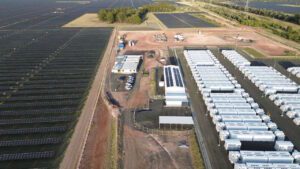
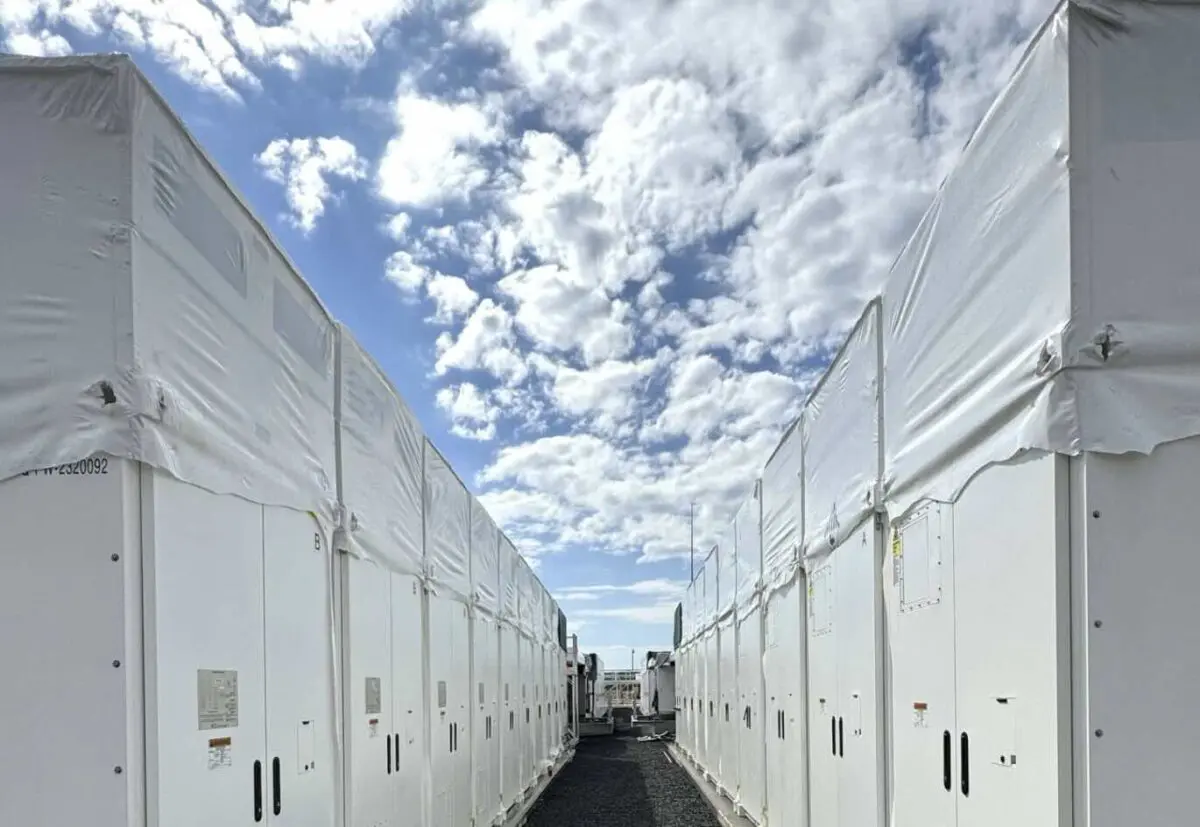
The 850 MW, 1680 MWh Waratah Super Battery is being built on the site of the former Munmorah coal fired power station, partially as a replacement for Australia’s biggest coal generator, Eraring, which is located just up the road.
Waratah is expected to act as a sort of giant shock absorber for the grid, and has negotiated the biggest contract of its type in Australia, and likely the world, to allow transmission lines feeding into the major load centres of Sydney, Newcastle and Wollongong to be operated at full capacity.
The original completion date was set for March, 2025, to make sure it was ready in time for the anticipated closure of Eraring in August, 2025. But the urgency to meet that deadline faded once the closure of Eraring was delayed by at least two years to August, 2027.

Renew Economy wrote last week that the battery project – despite early success in obtaining registration, and making a surprise role in helping the market operator negotiate tight supply conditions in November last year – was making slow progress through the commissioning period.
That is not unusual in Australia, with its notoriously difficult connection processes – it happens to plenty of projects, and Waratah is complicated by the fact that it is the biggest unit of any kind to be connected to the grid, and is the first major project in Australia by a new entrant, the US-based battery technology provider Powin.
Documents filed to regulators and the state-run EnergoCo, which has carriage over this project and other key infrastructure needed for the state’s transition from coal to renewables, show that problems emerged early last year, although they were mostly weather related at the time.
Owner Akaysha Energy made multiple requests to state authorities for extensions of working hours to try and make up for lost time, citing heavy rains in early 2024, then in spring of 2024, and then in December, 2024, and in January, 2025. It said the extensions were essential to make sure it could complete the project on time.
The most recent request came on January 13 this year, when Akaysha asked for another extension of working hours to ensure that its crucial Hold Point 3 testing could go ahead as planned in late January.
“There has been significant rainfall on site in the months of December 2024 and January 2025 to-date, which has slowed commissioning progress,” Akaysha wrote in its letter to the state government.
“The date for Hold Point 3 testing could be jeopardized if significant rainfall continues to occur between now and the commencement of Hold Point 3 in late January.
“If Hold Point 3 testing cannot go ahead as planned in late January 2025, this could take several weeks to re-schedule and lead to a material impact on the Waratah Super Battery Program.”
The reference to hold point 3 testing is important. That usually represents an advanced stage of the commissioning process.
For many projects, it is the final hurdle, and there is usually only a short period of time between that testing and full commissioning. For big units like Waratah, it is possible that the market operator and the transmission company required more hold points because of the size of the projects.
Either way, something appears to have gone wrong.
Renew Economy understands that several issues did emerge, first with the setting of the battery inverters and with undisclosed issues within Transgrid’s own network. Those issues are apparently now resolved, but it has meant the project has had to move through various hold points again.
So, what does this mean for the project’s timing and contract, officially known as SIPS, for system integrity protection scheme?
The answer is we don’t know. An audit report submitted by Akaysha to the state government on January 24 this year includes an assessment by consultant NGH that says the SIPS contract has been delayed to August, 2027, the new closure date for Eraring.
But Renew Economy has been told that this is incorrect, and that the SIPS contract – which requires the battery to provide up to 700 MW and 1400 MWh of capacity at certain times, will kick in this year as planned. However, Renew Economy has also been told Waratah will be delivering half of the SIPS capacity, at least initially.
The battery, Renew Economy has been told, will now be fully commissioned by the end of the year. This is later than the August completion date now on the EnergyCo website. No party is willing to speak on the record.
It is unclear how this affects payments for the 5 and a half year SIPS contract, given the complete lack of transparency over the exact timing and quantum of payments to be made for its role as a giant shock absorber.
A regulatory assessment published in 2022 noted that payment amounts will be reduced if there is a delay in achieving Interim Commercial Operation or Commercial Operation, and that the timing of the contract could be extended.
Payments could also be reduced if the battery acted on a higher merchant basis if less capacity was needed for the SIPS service – a possibility given the delay in the Eraring closure. But no figures are provided, and there is no clarity over whether liquidated damages payments – often imposed when projects are delayed – can be imposed.
The lack of clarity contrasts with similar smaller contracts that have been awarded in the past, to the Hornsdale battery in South Australia and the Victoria Big Battery near Geelong, where the quantum of payments in those contracts was released.
Not so in the case of the Waratah Super Battery, with the Australian Energy Regulator providing its approval with pages and pages of blacked out text, numbers and tables.
Australia’s National Electricity Market is often praised for its transparency, but the reality is often very different.
The Victoria state government, for instance, entered into a contract with EnergyAustralia over the closure timing of Yallourn. No details have ever been released on the quantum or timing of those payments.
There are many other parts of the NEM that are invisible to the consumer, including bilateral contracts, hedging agreements and others. Trying to make sense of it is like being told a football score, but not being allowed to watch the match, or even know who is playing the game.