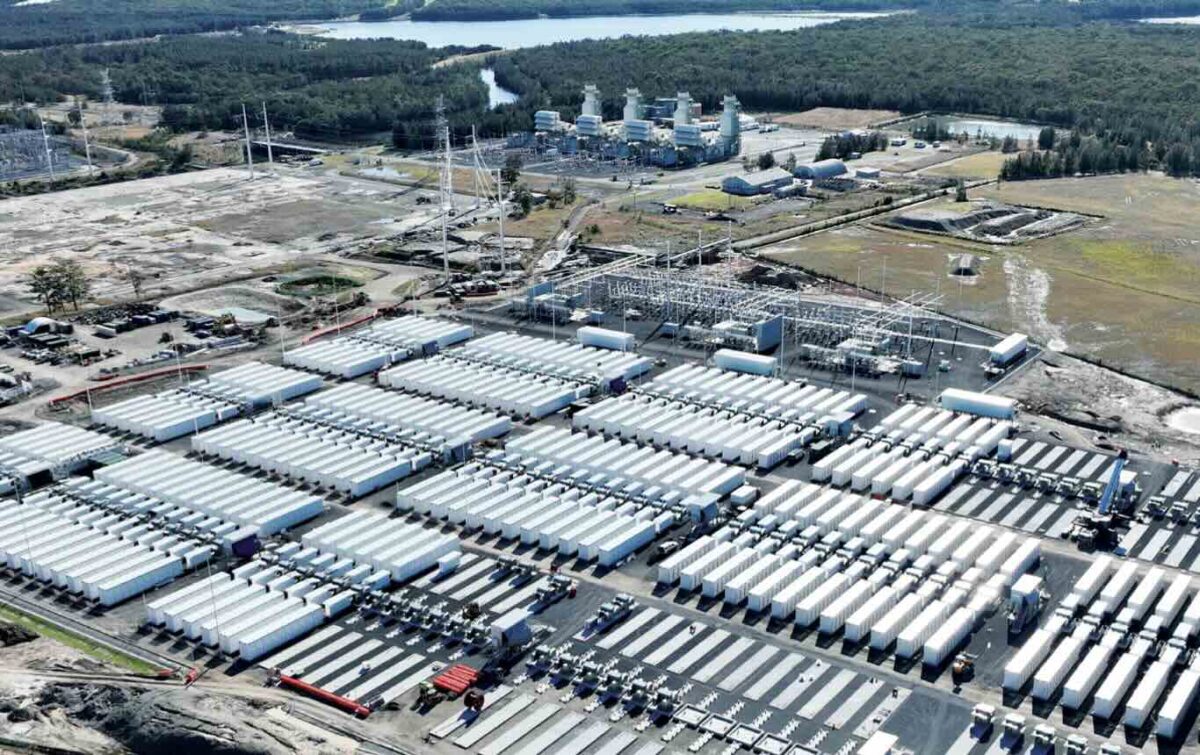
Australia’s most powerful battery, and the biggest unit of any type to be connected to the country’s main grids, is now officially working as a kind of giant shock absorber to the grid.
The NSW transmission company Transgrid on Friday advised the Australian Energy Market Operator that the Waratah Super Battery – located on the central coast of NSW – has now been enabled to deliver its System Integrity Protection Scheme.
This SIPS scheme requires the Waratah battery to operate as a kind of giant shock absorber, which allows more power to be carried over the transmission lines going into the major load centres in Sydney, Newcastle and Wollongong, meaning that more can be transported and less wind and solar output is curtailed.
The Waratah battery – which is being built by Akaysha Energy, and is in fact that company’s first delivered battery project – will be sized at 850 MW and 1680 MWh when complete, although it is still working through its commissioning process, so is not yet operating at full capacity.
The 850 MW power capacity makes it the biggest unit of any type to be connected to the Australian grid, beating the 750 MW Kogan Creek coal-fired generator in Queensland.
Other batteries currently under construction, including the 700 MW, 2,800 MWh Eraring battery up the road, will have more storage because they have been pitched as four-hour, or in some cases eight-hour facilities.
The SIPS scheme requires the Waratah battery to make available up to 700 MW and 1,400 MWh at various times, and less capacity at others, depending on the season and the time of day. Initially, it will deliver half of that contract size until it completes its commissioning process, expected before the end of the year.
The original timeline for the project was for it to be delivered in full by May, although that timeline was allowed to slip after the decision by the NSW to underwrite a two-year extension to the Eraring coal generator, that is now expected to close in 2027, although it may stay open longer.
The Waratah project suffered a series of delays, mostly due to weather but also because of the complications of connecting such a big machine with a specific role that is unprecedented at this scale in Australia, or even the world.
On top of that, the battery supplier, the US-based Powin, struggled financially and eventually filed for bankruptcy protection.
“There’s been a lot of challenges,” Akaysha CEO Nick Carter tells Renew Economy in the latest episode of the weekly Energy Insiders podcast.
“We knew that this was going to be very hard … the single biggest connection point by by megawatts, we think it’s still the largest or the most powerful battery in the world. It takes a huge amount of capital.
“So pretty much every thing that could happen, as you said, happened and but … we’ve got through the interim COD on that project now, so half of the SIP service is there. We’re still doing the hold point testing for the remaining portion of the plant, and that’s all on track at the moment.”
Akaysha is also putting the finishing touches on the smaller 150 MW, 300 MWh Ulinda Park battery in Queensland, which is also supplied by Powin (but all the batteries are installed), and the 400 MW, 1600 MWh Orana battery, which is using Tesla Megapacks.
Carter says the company – backed by BlackRock, has big ambitions, and hopes to see more contracts for SIPS style services to boost transmission capacity and support the rollout of renewables, and Carter says he is pretty happy with the Capacity Investment Scheme, which is now seeking more than 14 GW and 56 GWh of battery storage.
The Waratah battery will effectively be on standby for the capacity required to meet its SIPS contract, but has an extra 150 MW and 280 MWh built into the project, and more will be available for general market trading at those time when less capacity is required for the SIPS.
“Transmission operators and state governments and federal government need to be thinking about ways that might continue to leverage the current transmission network, because, as you guys know, and keep saying on your podcast, there’s no way we’re going to do enough transmission in Australia,” Carter says.
“And I think we can try to bridge that gap by having larger batteries (delivering these services).”
The Orana battery has an underwriting deal with the NSW government, and a “virtual tolling” agreement with EnergyAustralia, and will also operate as a merchant asset.
Ulinda Park, which is expected to be complete in coming months, has a revenue swap agreement, dubbed the first of its kind, with RE2 Capital, while the new 205 MW, 4210 MWh Brendale battery project in the outskirts of Brisbane has its own battery revenue swap agreement with Gunvor Group.
You can find the full interview with Akaysha’s Nick Carter, and an update on the news of the week, in the latest episode of the Energy Insiders podcast here.