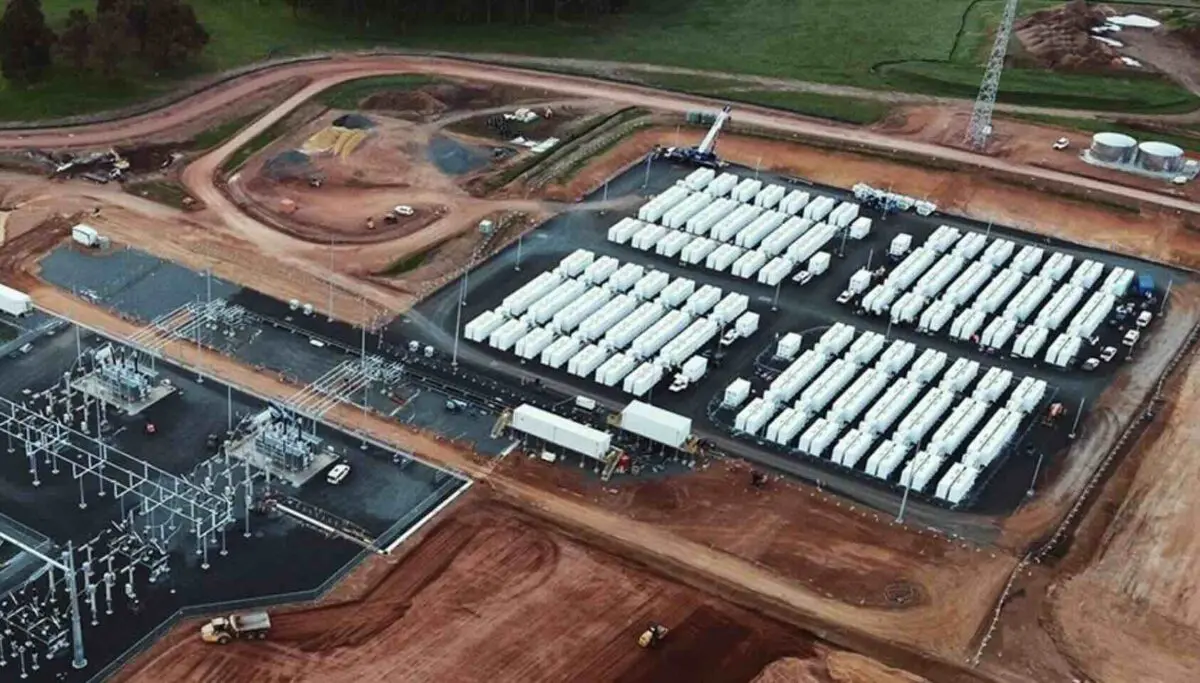
Australia’s biggest battery – and the first to feature more than two gigawatt-hours (GWh) of energy storage, has raced through its commissioning process and is now fully operational, ready to deliver on its expanded “solar soaker” contracts within a few weeks.
The Collie battery owned by Neoen Australia, now controlled by global asset management giant Brookfield, is sized at 560 megawatts (MW) and 2,240 megawatt hours (MWh) over its two stages, the first of which was completed last year.
That represents more than `17 times as much storage as the original Tesla big battery at Hornsdale (100 MW and 129 MWh), and more than five times more than the Victoria Big Battery (300 MW and 450 MWh), that then became the biggest.
The Collie battery has 40 per cent more storage capacity than the Waratah Super Battery (850 MW and 1680 MWh) that recently overtook VBB as the biggest in the country. Waratah is yet to reach full capacity, and will remain the most powerful battery because of its huge connection (850 MW).
See the latest news on Waratah: Super “shock absorber” battery smashes records again as it charges and discharges at unseen levels
Collie won’t stay the biggest in terms of storage for long. By 2027 it will be overtaken by the 700 MW, 2,800 MWh Eraring battery, and then perhaps the Supernode battery in Queensland which is aiming for more than 3,000 MWh.
In coming months and years, Collie will also be joined by a number of other 2 GWh battery projects across the country that have already begun construction, are nearing completion or are fully committed.
These include another at Collie, the Tomago battery in NSW and the Reeves Plains battery in South Australia (all three sized at 500 MW and 2,000 MWh), and the Richmond Valley battery (275 MW, and 2,200 MWh), which will be the biggest eight hour battery in the country.
Others projects of a similar size, or even bigger, are also in development, waiting for financial close or grid connection approvals.
All this will have a marked impact on the shape of the grid, and help flatten out the solar duck curve that has become a feature of the grid because of the rapid uptake of rooftop PV across Australia.
The two Collie batteries – and a number of other batteries at Wagerup and Kwinana – have won contracts in Western Australia, which is home to the world’s biggest isolated grid – to soak up rooftop solar over four years in the middle of the day and discharge the output over four hours in the evening demand peaks.
The first stage of the Collie battery has already been doing this for a year, and the newly completed second stage will officially be delivering on its share of this contract from early October. In the meantime, it will be earning money from arbitrage (charging when prices are low and discharging when prices are high, and other grid services.
The impact on the grid is already clear, with battery charging accounting for up to 17 per cent of demand in the middle of the day, and regularly accounting for around 18 per cent of supply at times in the evening peaks. These impacts will grow as the Synergy battery and others come on line in coming months.
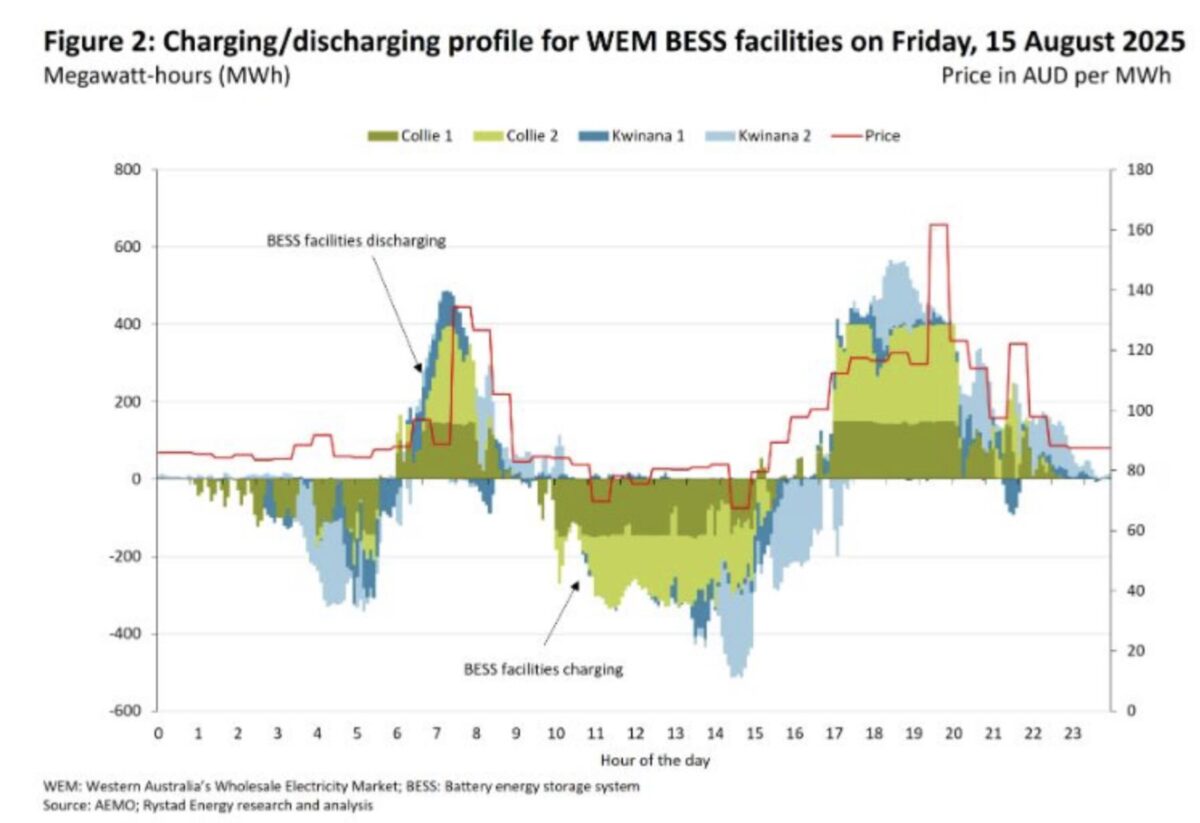
Rystad Energy’s Sally Bogle last last week published this chart to illustrate the activities of the new batteries on the grid – including Collie stages 1 and 2, and the Synergy-owned Kwinana stages 1 and 2.
Obviously, the batteries are charging at the low price point of the day and injecting power into the evening peak, when prices are higher, as the Cunderdin solar battery hybrid facility is also doing. See: The solar farm that winds down at dusk, charges up for dinner and is still generating at midnight
Neoen’s Collie stage 2 battery is yet to begin its solar soaker contract, so for the moment it is just taking the price points, and probably making a fair bit of money from it.
The interesting thing about the Collie 2 situation is how fast it moved through the various hold points, completing the commissioning process in just four months, having started in March and finishing in July.
This contrasts to the slow pace of the Waratah battery, which began in September last year, and is not expected to finish its commissioning process for a few months yet, even though it has also started meeting part of its “shock absorber” contract with EnergyCo.
There are a couple of reasons for this. One is that Collie had already commissioned its first stage, and Tesla – which is supplying its Megapack battery units – is well versed with the commissioning process. And, developers say, the process is easier in Western Australia.
Waratah is also dealing with the fact that it is the first battery project for its technology supplier Powin, and first up projects are often difficult for new arrives in Australia. And the size of the battery – the biggest machine of any type to be connected to the Australian grid, will also have been a factors.
And, just to top things off, Powin also suffered financial difficulties and in June filed for bankruptcy protection. Waratah owner Akaysha Energy has been busy snapping up key staff from the beleaguered Powin.
See also an interview with Akaysha’s Nick Carter in this recent episode of the Energy Insiders podcast.
All eyes now are on the Synergy battery up the road from the Neoen battery in Collie, which is due to be operating within a few months.
Bogle says Rystad Energy‘s database indicates that that more than 1.6 GW/6 GWh of battery capacity will be operational in W.A.’s main grid by the end of 2025.
It will then double again – thanks to underwriting from the federal government’s capacity investment scheme, and local capacity contracts – to more than 3 GW/11 GWh by the end of 2029 when the remaining state-owned coal generators, and potentially the privately owned Bluewaters coal plant will have closed.
See also: Big Battery Storage Map of Australia