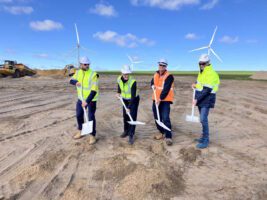
Australia’s first large-scale solar farm co-located with a wind farm was formally opened on Thursday, the first of more than a dozen projects likely to follow suit within the next few years.
Wind and solar have been paired in various off-grid locations, but the 10MW Gullen Range solar farm south of Crookwell in NSW is the first large-scale solar farm on Australia’s main grid to be co-located with a major wind farm.
It shares facilities with the 165MW Gullen Range wind farm, and could soon be joined by the 100MW Biala wind farm which Beijing Jingneng Clean Energy wants to develop later this year.
The Gullen Range solar farm was actually switched on and began contributing to the grid late last year, but the formal opening was made this week after testing and commissioning were complete.
The wind-solar combination will be repeated at Goldwind’s White Rock project, near Glen Innes, where a 20MW solar farm is being built next to the 175MW wind farm of the same name, and at Windlab’s Kennedy energy park in north Queensland (15 MW solar, 43.2 MW wind, and 2MW of storage).
APA is adding a 20MW solar array to the Emu Downs wind farm north of Perth, DP Energy plans a huge wind, solar combination in South Australia, and CWP is also planning a solar farm to adjoin its Sapphire wind farm in northern NSW. Others are also in the pipeline.
The advantages of a wind-solar combination are two-fold: one is the shared infrastructure such as sub-stations, which lowers costs and minimises environmental impacts; and another is the timing of the output.
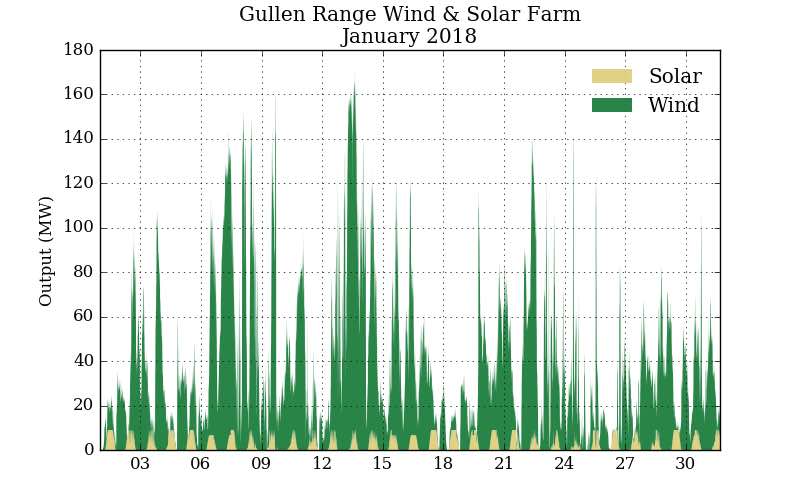
Solar, of course, only produces during the day, while many wind farm produce significant quantities of electricity at night.
This graph below shows the output of the two facilities over the past month, although the huge different in size of the two projects make direct comparisons difficult.

The Gullen Range solar farm received funding of $10 million from the Australian Renewable Energy Agency, which was keen to see such co-locations put into effect.
“This is an historic moment for clean energy in Australia,” said Weiwei Shi, General Manager of BJCE Australia. “Gullen Solar Farm is an important demonstration project – right at the forefront of renewable energy integration technology.”
BJCE deputy general manager Derek Powell said the Biala wind project would initially be developed on a merchant model, meaning the output would be sold into electricity markets, rather than relying on a contracted off-take.
“We think there is strong business case for renewables and it is getting stronger,” Powell told RenewEconomy. BJCE aims to grow a portfolio of 1GW of wind and solar by 2020.
The two facilities are owned and operated by New Gullen Range Wind Farm, a joint venture between Hong Kong-listed Beijing Jingneng Clean Energy (75 per cent) and Chinese wind energy giant Goldwind (25 per cent). The solar farm was built by Decmil Group and Balance Services Group.