Coal-fired power stations across Australia’s National Electricity Market suffered 108 outages during the 2025-26 summer period, demonstrating once again that coal is unreliable and needs to be replaced.
A new report published on Wednesday by Reliability Watch found that of the 108 outages recorded between October 1, 2025, and February 28, 2026, 18 of the outages were scheduled and 90 were unplanned.
In fact, the coal fleets of both New South Wales and Victoria had an average of 25 per cent of their capacity offline at any point during the period – equivalent to 5.3 GW – while Queensland’s coal fleet was only marginally better at 24 per cent.
Reliability Watch, an initiative of the Nature Conservation Council of NSW, Queensland Conservation Council, and Environment Victoria, monitors breakdowns at fossil fuel-powered stations across the National Electricity Market (NEM). A total of 15 coal-fired power stations are still operating in the NEM, including three brown coal power stations in Victoria, four black coal power stations in NSW, and eight black coal power stations in Queensland.
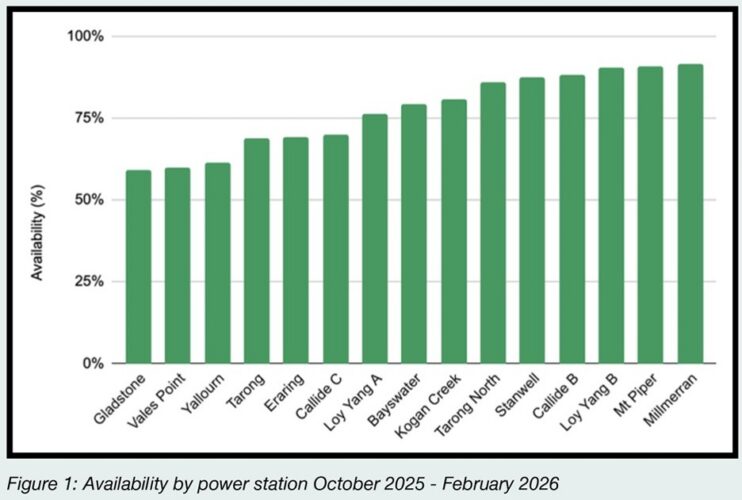
Over the five-month period, Gladstone and Callide C in Queensland, Loy Yang A in Victoria, and Eraring in NSW, each had more than 10 breakdowns.
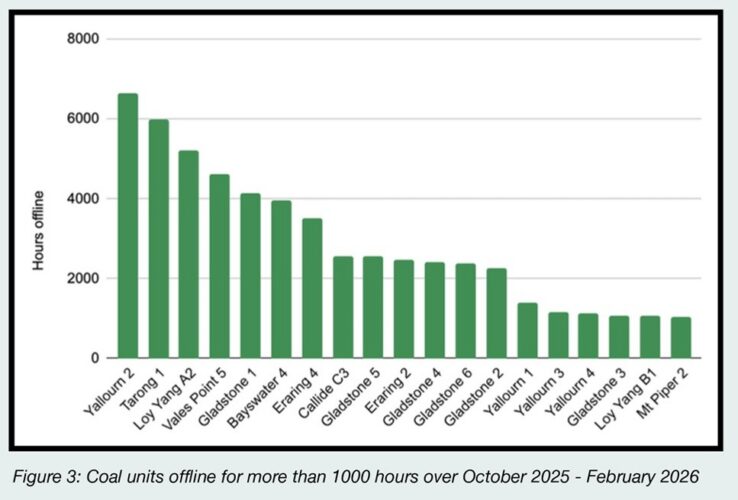
And on top of the many unplanned outages recorded, almost all units that underwent scheduled maintenance overran the forecast time their outages were planned to take by an average of two weeks.
For example, maintenance on unit 2 at Victoria’s second-largest power station, Yallourn, and on Tarong 1 in Queensland, took around twice as long as predicted – 138 days instead of 70 at Yallourn 2 and 114 days instead of 53 at Tarong 1.
“These report findings are hard, indisputable evidence that our coal clunkers are failing and need to be replaced,” said Dr Kat Lucas-Healey, Environment Victoria’s senior climate and energy adviser.
“We need reliable and clean energy. Victorian coal-fired power stations have the highest carbon emissions intensity in the country. Loy Yang A in Victoria and Eraring in NSW each had more than 10 breakdowns in the peak summer period.
“Words won’t keep the lights on and bills down – actions will. We need to be building the best solar, wind and battery projects that are already in the pipeline and connecting them to the rest of Victoria.”
The state of Australia’s coal-fired fleet isn’t just struggling during summer. Reliability Watch reported in December that the country’s coal fleet suffered a combined 119 breakdowns or unscheduled outages between April and September.
This ongoing spree of breakdowns, ongoing and delayed maintenance, and unplanned outages highlights the increasing difficulty operators are having just keeping the stations online, which in turn is exposing customers to higher prices due to the increasing risk of supply shortages.
Conversely, renewable energy contributed over the summer period around 50 per cent of electricity in the NEM, helping keep wholesale prices lower than the previous two summer periods in spite of increased demand.
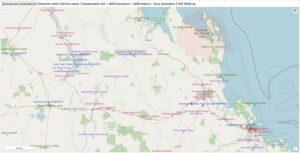
The Reliability Watch website provides a live tracking of coal station outages across the east coast.
If you would like to join more than 29,000 others and get the latest clean energy news delivered straight to your inbox, for free, please click here to subscribe to our free daily newsletter.