Australia’s electricity grids are undergoing a profound transformation, with large-scale batteries rapidly emerging, already moving from ancillary to central roles, by-passing the need for gas.
Batteries now provide crucial services including firming, ramping and system security. Recent planning by the Australian Energy Market Operator (AEMO) indicates that the influence of batteries will continue to grow, and we contend will quickly outpace traditional gas and hydro resources in the coming decade.
Western Australia’s Wholesale Electricity Market (WEM) stands at the forefront of this transition, with batteries already overtaking utility solar and at increasingly frequent intervals, surpassing gas generation sources in meeting peak demand.
Perhaps the WA grid can show how the net zero transition will put gas out of the grid support business. Perhaps the WEM’s isolation from other grids, and high solar uptake from households, makes it an ideal view of the net zero future.
We begin by looking at the National Electricity Grid (NEM) where this by-passing of gas is also underway.
Main grid: Batteries surpass peaking gas
In the National Electricity Market (NEM), a major milestone was reached when large batteries discharged more energy in November than peaking gas generators for the first time (Figure 1). This shift reflects both the rapid rollout of new battery projects and increased market volatility, which favours fast, flexible storage technologies.
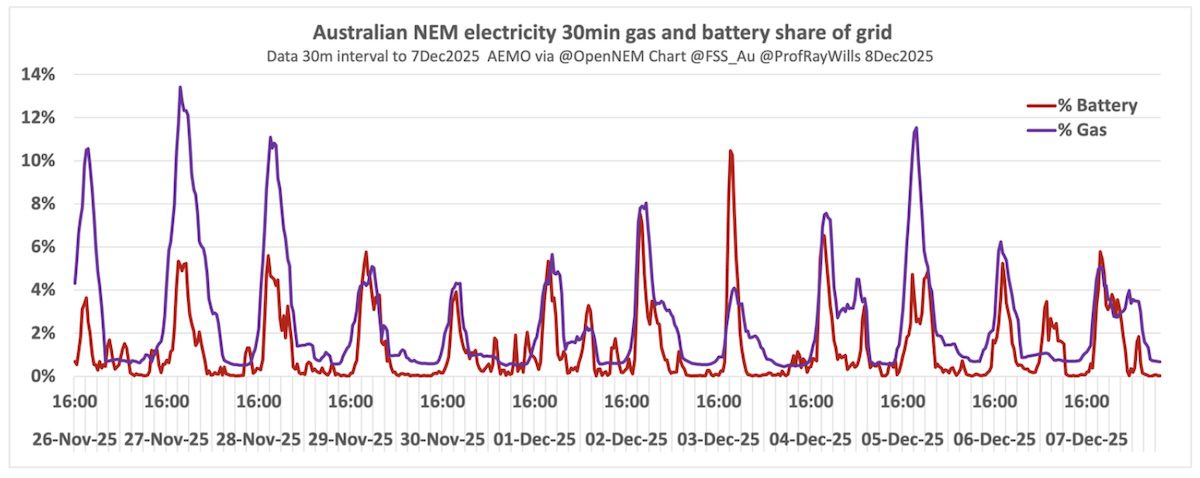
Figure 1. In late November and early December 2025, large batteries on the NEM discharged more energy than peaking gas generators.
Industry analysts now expect batteries to become the primary tool for firming renewable energy within a few years, surpassing the combined output of gas and hydro in the NEM.
Major new projects, including the Eraring, Mortlake, and Melbourne Renewable Energy Hub batteries, are set to add several gigawatt-hours of storage capacity, further accelerating this trend, and providing further support to renewables (Figure 2).

Figure 2. The same period as Figure 1 showing discharge of large batteries on the NEM compared to renewables contribution over the same period.
AEMO’s 2024 Integrated System Plan (ISP) projects that both grid-scale and coordinated consumer batteries will provide most of the firming capacity under all step-change scenarios. Distributed storage, including behind-the-meter batteries and electric vehicles, is expected to supply more aggregate storage than utility-scale assets.
These projections are supported by capital spending trends where annual investment in battery construction has surged from less than $100 million to several billion dollars per year, with expectations that this scale will be maintained across the remainder of the 2020s.
The by-passing of gas in grids like the NEM are not yet fully recognised by the political decision-makers, especially the new Liberal-National policy stance, but the trends in the WEM are now showing how quickly this transition is happening.
Western Australia’s WEM: A global testbed for batteries
Within the WEM, utility-scale battery dispatch has frequently exceeded utility solar output daily, thanks to the deployment of major new systems at sites such as Kwinana and Collie, which collectively provide over 5 GWh of storage.
Battery deployment continues to grow. In a recent week, batteries supplied more than 20% of the evening peak and contributed to consistently high renewable energy penetration—at least 20% at all times, with daily levels reaching 80% or more (Figure 3).

Figure 3. While gas has a more substantial share of the WEM in Western Australia than in the NEM, in late November, coincident with a strong contribution by renewables, discharge of large batteries on the WEM surpassed peaking gas generators for the first time.
Throughout November, Western Australia’s main grid achieved an average renewable share of approximately 55%, outperforming the NEM’s 50% and achieving this without hydro or interconnection. The system relied instead on rooftop and utility solar, wind, and batteries.
Several records were set during this period, including instances where wind and solar met 100% of domestic demand. Batteries enabled some coal and gas units to remain synchronised but largely undispatched, illustrating a developing “fossil engines off” mode of operation.
These trends suggest coal will rapidly die and gas will increasingly be by-passed in our power grids.
Conclusion: The dawn of Australia’s storage-led energy transition
Recent operational data and planning documents demonstrate that Australia has entered an early phase of a storage-led transition to net zero. Large batteries are already replacing peaking gas in the NEM, and are completely reshaping the WEM’s isolated grid around high solar and wind penetration.
The trends suggest Australia is laying the foundation for a future electricity network where stability is provided primarily by fast, inverter-based resources rather than fossil-fuelled spinning machines.
Ray Wills is Adjunct Professor at The University of Western Australia and managing director at Future Smart Strategies
Peter Newman is John Curtin Distinguished Professor at Curtin University