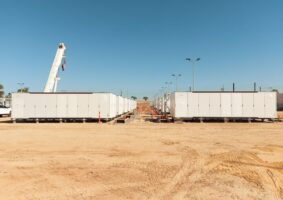
The “Maverick” rapid-deploying solar generation technology of Australian innovator 5B has been selected as the first to receive funding from federal Labor’s $1 billion Solar Sunshot program, in one of its first major energy policy announcements since being re-elected.
Federal energy minister Chris Bowen announced on Wednesday that the Australian Renewable Energy Agency has awarded $46 million to the South Australia-based company to scale up production of its Maverick solar units at its Adelaide manufacturing facility.
First conceived by UNSW renewable energy engineers Chris McGrath and Eden Tehan more than 10 years ago, 5B’s Maverick is a prefabricated, pre-wired, accordion-like unit made up of 90 modules totalling around 50kW capacity that is unfolded on site using a forklift.
This makes it easy, cheap and quick to install – around 10 times faster than a run-of-the mill large-scale solar farm. This makes it a popular choice for powering off-grid projects like mines. In 2024, 5B installed 1.25MW in one day with eight people at a lithium mine in WA.
Bowen says the SunShot funding will help 5B scale up its factory produce 200 MW of Maverick units over three years. Last year the company’s Adelaide facility was producing one Maverick unit every four hours – roughly 100kW a day, or 36 MW a year.
“When it comes to powering Australia’s future nothing will beat our sun and our solar knowhow,” the minister said on Wednesday.
“That’s why bringing solar manufacturing to our shores is so critical for unlocking our future as a renewable energy superpower and securing the job of the future.
“As demand for solar surges, homegrown technologies like 5B Maverick help us make solar supply chains stronger and build Australia’s future right here.”
5B CEO David Griffin says the funding from Arena will help slash the cost of the company’s technology by 25 per cent, grow its team and boost its scale. He said 5B had already received its biggest order yet.
“We have today secured our largest order to date – over 100 MW with (off-grid power specialist) Zenith Energy,” Griffin told Renew Economy on Wednesday.
“That’s a fantastic outcome. It’s the first of what we think …[will be] a significant number of large orders. So the whole grant program is proving to be an important catalyst in increasing the scale of our orders.
“There’s always an inherent difficulty for a technology to break an incumbency,” Griffin says. “Single axis trackers are the dominant solar array technology in Australia and around the world.
“This type of program …really helps our customers to spend that extra time to realise the commercial and technological advantages that we offer are irresistible, so they will place those orders and get comfortable with that.
“This levels the playing field,” Griffin says.
Arena CEO Darren Miller says the Maverick production represents “the best of homegrown Australian technology and innovation” geared at making solar deployment faster, cheaper, safer and more efficient.
“ARENA has a vision of reaching 1 terawatt of installed solar PV in Australia by 2050 to achieve our renewable energy ambitions. Projects like this are what we need to get there,” Miller said on Wednesday.
“Today represents a step towards building Australia’s resilience in the solar value chain as the global demand for renewable energy technologies, products and knowledge intensifies.”
The Albanese government’s Solar Sunshot policy was first unveiled in March 2024, and then launched in September, with solar manufacturers named as the target beneficiaries of the first $550 million in grant funding.
The $46 million for 5B is made up of a production credit of up to $26 million based on the company’s Australian-based production – it has an offshore plant in Vietnam and is setting up another in India – used in large-scale solar projects in Australia.
Another $20 million capital grant will be used to implement technology design improvements to the company’s solar photovoltaic (PV) deployment technology system, Arena says.
In an interview with the Solar Insiders podcast last year, 5B chief strategy officer Nicole Kuepper-Rusell, said the company was a solid candidate for Sunshot funding, given its singular focus on using home-grown innovation to cut the delivered cost of solar.
“You know, [Chris and Eden] quit their jobs, they ate baked beans, they lived on … couches for a while, and they built this company from scratch. They filed patents, developed prototypes, started selling the first 50kW, the first 100kW, the first 500kW; the first megawatt project, the first 10MW project.
“They were seeing the packaging waste, the challenges with labour, the challenges with land; you know, working in an inherently risky environment, wet weather events and what that was doing to project delays.
“And Chris McGrath had a light bulb moment and thought, there has to be a better way to do this … and, essentially on a napkin, drew the first version of what a Maverick would then become.”