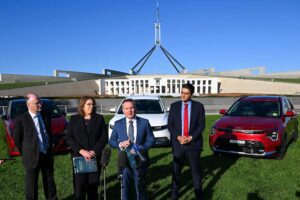
Chris Bowen was man of the hour on Monday night in Belém. The Carbon Market Institute hosted the reception for his arrival in Brazil, a tradition at every COP and the presence of the Climate Change and Energy Minister was the drawcard.
The event was billed as an exclusive, RSVP-only event with an open bar, held in the massive exhibition hall in front of the Australia pavilion, next door to the Turkish pavilion and directly across from China. Before long the number of people who turned up spilled out beyond the walkway, and the organisers had given up.
Bowen had moved through the crowd, shaking hands and making small talk until it came time to speak. His subject was Australia’s bid to host COP-31 in South Australia and his address was designed to rally the troops.
People had come to him saying they had heard Australia was giving up, he said, others had suggested Australia had it in the bag.
Australia took a “pragmatic” and “sensible” approach to climate change, he said. Turkiye was still refusing to budge in an act of brinkmanship with both the COP process and the nomination, but Australia was not giving up and would keep pushing until the last.
“It is not done yet, it is not resolved,” Bowen said. “We’re in it to win it, we’re in it to the end.”
It was a phrase Bowen had repeated throughout the day, a typically Australian appeal to sporting idioms when under pressure, one that felt flat to outsiders. His presence, however, had suddenly filled a vacuum.
Australia had initially sent Assistant Minister for Climate Change and Energy Josh Wilson to represent the government in the opening stages of the process.
Wilson flew out on Thursday, and in the four days before Bowen’s arrival on Sunday, the vacuum in leadership it created left the Australian delegation without a decision maker. Into this gap flooded an ocean of rumour, speculation, gossip, cynicism and unbounded optimism.
Once on the ground, Bowen had wisely sought to make his presence felt. On Monday, he opened two events at the Australia Pavillion. Both were morale-building exercises – a few minutes of kind words to rally the representatives from civil society who had made the trek with no real bite.
During his first appearance, where he opened a panel on decarbonising metals, Bowen announced in passing Australia had joined the Industrial Deep Decarbonization Initiative, a coalition of governments that pledged to work together to build demand for sustainable building materials.
The announcement wasn’t enough to merit its own press conference.
“You think about the fact that steel alone is 8% of the world’s emissions, metals in total 13% of the world’s emissions,” Bowen said. “There’s no net zero without decarbonising steel making, metals production, and it’s something that Australia has made good progress in, but has a lot, lot more to do.”
A few hours later, he opened another event promoting South Australia’s massive renewable energy build-out in the decade since the catastrophic blackout in 2016.
It took place during a downpour. The torrential rain caused low-level flooding outside the pavilion, and flooded the Moana Blue Pacific Pavilion, forcing its closure – a dark irony not lost on many given the potential fate of Pacific islands. It also made Bowen hard to hear.

“When you think that South Australia, just 20 years ago, had 1% or 2% renewable energy, and it’s now on track to achieve 100% renewable energy by 2027 – not long after COP31, it’s a remarkable achievement,” Bowen said.
Rounding out his speech, Bowen sought to reassert leadership. He was needed in negotiations, but stressed that Australia was still pursuing its COP31 hosting bid.
“We are in it to win it,” he repeated. “Let me make it clear, and we’re not going anywhere.”
Across COP30, conversations were being had about a fossil fuel phaseout and the International Court of Justice advisory opinion that found states continuing to expand oil, gas and coal production could be held liable under international law.
A day later, Australia was criticised for sitting out a public call by more than 20 climate ministers for a clear roadmap away from fossil fuels to be adopted before the end of the conference.
On Tuesday afternoon, local time in Belém, the group appeared at a press conference organised by the Beyond Oil and Gas Alliance, to demonstrate public support for a plan outlining how the world might phase out oil, gas and coal.
It included Ed Miliband, UK Secretary of State, Climate Change and Energy, Tina Stege, Climate Envoy for Marshall Islands, Carsten Schneider, German Minister for the Environment, Nature Conservation, and Nuclear Safety of Germany, Irene Velez Torres, Colombian Minister for Environment and Sustainable Development, Ali Mohamed, Kenyan Climate Change Envoy, Jiwoh Abdulai and Sierra Leone’s Minister for Environment and Climate.
Absent was Bowen, although Australia is understood to have privately signalled support for the adoption of a roadmap in some form.
Speaking at the conference, Miliband said that the group represented a “global coalition with Global North and Global South countries” saying the UK was already taking steps to end oil and gas expansion.
“We have an opportunity to make COP30 the moment we take forward what we agreed at COP28,” he said. “The actions we are taking in the UK not to issue new oil and gas licenses is about climate, energy security and costs.”
“The more secure option for us is cheap, clean renewables. We prioritise this not because it is easy, but because it is hard. This is an issue that must not be ignored, cannot be ignored, and we are saying very clearly it must be at the heart of this cop.”
Tina Stege, Climate envoy, Republic of Marshall Islands, described current proposals as “weak”.
“The best chance of landing an agreement is in a Mutirão package, the current reference in the text is weak and is presented as an option – it must be strengthened and adopted,” he said.
The term “Mutirão”, originally from the Tupi-Guarani language and translated as “collective effort”, has been adopted by the Brazilian COP Presidency to describe proposals put forward during negotiations.
Dr Simon Bradshaw, from Greenpeace Australia Pacific, said the adoption of a roadmap “could be the turning point of COP30 in Belém as a large group of countries had formed to press for a clear direction on the future of fossil fuels.
“The big question is where was Australia?” Bradshaw said. “As the aspiring COP31 host, Australia is yet to publicly join the growing call for a roadmap to transition away from fossil fuels. This is not what climate leadership and accountability looks like.
“It is way past time for Australia to get squarely behind Pacific Island nations and start championing the transition away from fossil fuels.”
During the earlier plenary, when ministers were given three minutes to deliver a national statement, Australia followed Belize.
Where Bowen’s Belizean counterpart described the existential threat of climate change to his people and referred to the ICJ advisory as a “turning point for the world”, Australia’s pitch was a pragmatic, sensible, pro-business approach to tackling climate change.
“While the current global environment is without doubt challenging, the fact is, the world remains seized at the opportunity before us,” he said. “That’s because the net zero transition is no longer just necessary. It is the engine room of global economic growth.”
“It underscores that we need to be unwavering and unrelenting in our collective efforts to realize the goals of The Paris Agreement.”
As proof Bowen offered up a flurry of statistics – renewables had overtaken coal as the largest source of energy, more than one in three Australian homes had solar panels on the roof. But even there, when speaking to a global audience of climate ministers, Bowen’s eye was firmly on domestic politics.
“Some of those installed panels because they want to address climate change,” he said. “But most of them did it because what’s good for the planet is also good for your pocket.”