The Australian Energy Market Operator has released its new technology priorities to allow it to accommodate periods of 100 per cent renewables on Australia’s main grids, with much of the focus on grid forming battery inverters and consumer resources such as solar, batteries and EVs.
The latest update to AEMO’s Engineering Roadmap outlines 29 priority actions for the coming year, as it seeks to facilitate periods of higher renewables, above last year’s peak of 75.6 per cent penetration in Australian’s main grid, and 85.1 per cent in the isolated South West Interconnected System in Western Australia.
AEMO has admitted that there have been periods where the “potential” supply of renewables is more than enough to meet grid demand, but this has not occurred – either because the share is “self limiting” from negative wholesale prices, or because AEMO has imposed its own constraints to ensure system security.
Solving the challenge is equally important for grid operators, producers, consumers and the federal government, whose target of reaching 82 per cent renewables by 2030 depends on extended periods when renewables, mostly wind and solar, account for all of the grid’s demand.
States like South Australia reach 100 per cent renewables on almost a daily basis, but are able to export excess power to neighbouring states. Small isolated grids, particularly mine sites, can operate at 100 per cent renewables, but although the technology challenge is broadly the same, AEMO is not ready to go there for the whole grid.
The biggest of many challenges are ensuring that the essential grid services – frequency control, inertia and system strength – that are traditionally provided by coal, gas and hydro generators can be delivered with the inverter based technology used by wind and solar, and particularly the grid forming inverters now favoured in battery storage.
Control of consumer energy resources, which include behind-the-meter technologies such s rooftop solar PV, household batteries, smart appliances and electric vehicles, are another key focus.
“A key priority over the next 12 months will involve advancing understanding of future technology capabilities, including grid-forming batteries to support power system security,” says Merryn York, the head of system design at AEMO, in a statement accompanying the updated roadmap.
“Other priorities include enabling further integration of consumer energy resources (CER), uplifting AEMO’s operational capabilities, and preparing for transition points such as coal retirements.”
Grid forming inverters have already been a focus of AEMO’s engineering roadmap, and figure high in the plans of state-based transmission companies to manage the system strength issues that they are responsible for.
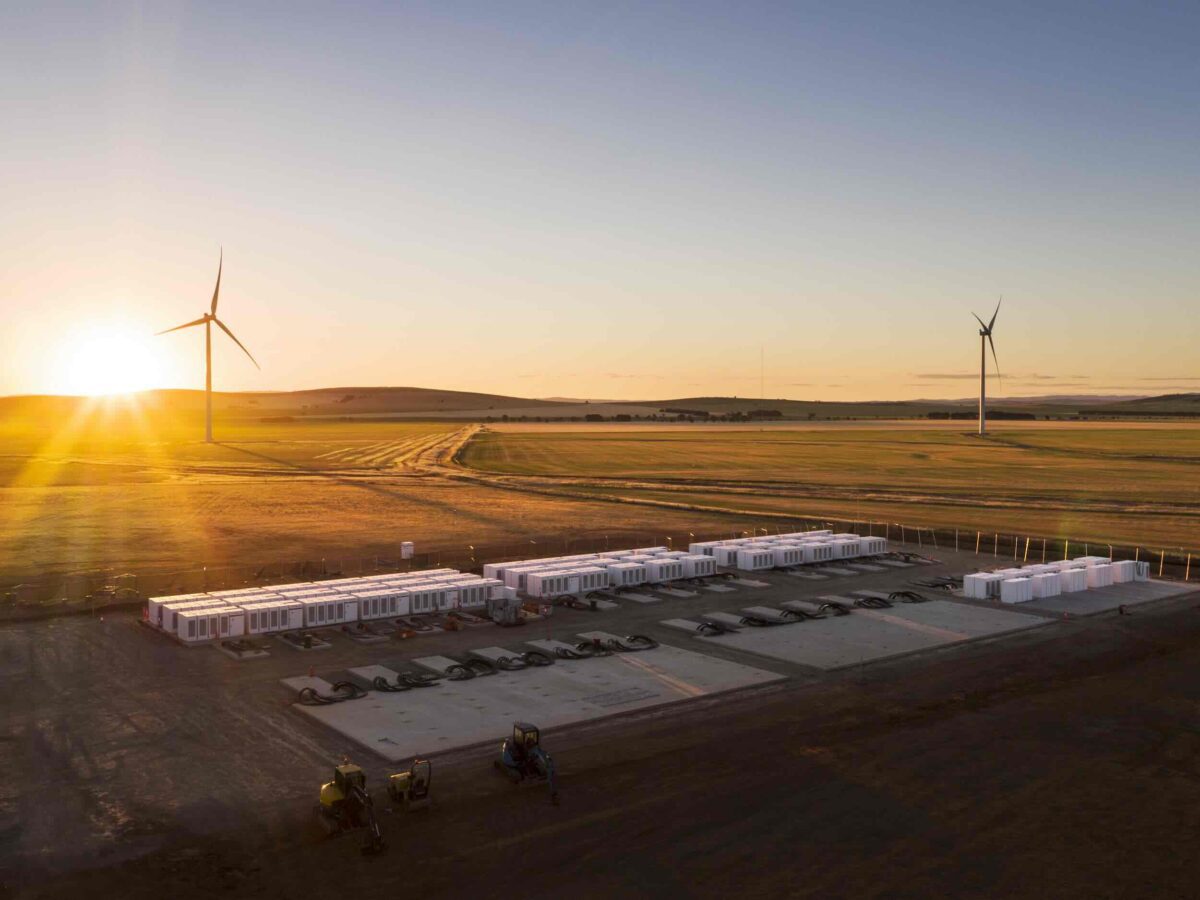
Big batteries have already proved that they can cover frequency control and inertia, and developers like Tesla insist they can cover system strength issues too. But AEMO and the big networks are being cautious, saying they need more proof at scale to be convinced that they can adequately cover fault current issues.
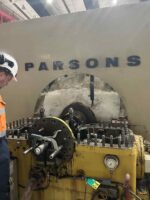
Transmission companies such as Transgrid now find themselves obliged to turn to spinning machines known as synchronous condensers to supply the system strength gaps that will emerge in the next five years or so as coal fired power stations are retired.
The problem is that these syncon machines are big, heavy, expensive, difficult to obtain, and not much good for anything else.
Big batteries, on the other hand, can dedicate part of their grid forming inverter capacity to the issue, and still perform other functions such as arbitrage, storage and acting like giant shock absorbers, so the cost of supplying system strength is only a marginal part of the cost of the battery.
The new Engineering Roadmap identifies three priorities, including analysis of fault current contributions from GFM (grid forming) battery energy storage systems.
They also include “transition point planning analysis,” which includes planning for coal retirement, periods of high distributed PV generation, and conditions where the power system is operating with up to 100% renewables.
And in Western Australia, the focus is on a review of market settings for operational storage requirements, dynamic load contingency limits, and RoCoF (rate of change of frequency) limits.
“Looking ahead to the next five to 10 years, AEMO expects Australia’s energy systems to encounter several transition points – events and milestones that require material changes in the operational approach to managing power system security,” the document says.
Examples include:
- – Forecast retirements of coal-fired power stations, including Eraring and Yallourn Power Stations in 2027 and 2028 respectively, Collie Power Station in 2027 and all remaining state-owned coal-fired power stations in Western Australia by 2030 … which represent a substantial reduction to baseload synchronous generation;
- – Operating NEM sub regions, such as South Australia, at times without any synchronous generation, operation with large amounts of grid-following (GFL) BESS, noting that in the SWIS, BESS capacity will soon exceed SWIS average demand;
- – And provision of system strength and inertia services shifting from traditional large-scale generation towards GFM BESS and synchronous condensers.
Among the main achievements in the last 12 months, has been the development and implementation of minimum system load services, the result in the growth of rooftop solar PV which displaces large scale generation to the point where AEMO worries it has insufficient levers to keep the system secure.
Its actions have included protocols to shut down rooftop solar if needed, and to have battery storage put standby to inject demand into the grid if needed. The growth in electrification – households and transport – could also mitigate those issues, but the management of two-way power in a grid originally built for one way flows is also a challenge.