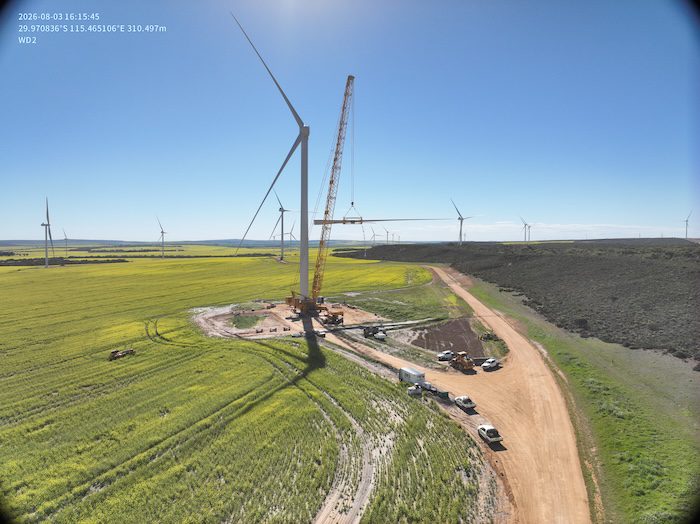
Plans to install up to 92 wind turbines and a big battery in Western Australia’s Wheatbelt region have been referred for federal environmental assessment, less than one month after being put forward for state approval.
Locally based developer Lacour Energy is seeking approval under the EPBC Act for its West Arthur Energy project, which proposes to develop, fund, construct, and operate an up to 736 megawatt (MW) wind farm around 3 km south of Darkan and 40 km east of Collie.
The project would also include a Battery Energy Storage System (BESS) with a capacity of up to 500 MW and 4,000 megawatt-hours (MWh), as well as access tracks, roads, substations, electrical reticulation and transmission infrastructure.
As Renew Economy has reported, the project – which would connect to WA’s main grid, the South West Interconnected System (SWIS) – is one of 12 recently added to federal Labor’s National Renewable Energy Priority List, which promises a faster yes or no for projects considered valuable to the energy transition.
According to the project website, energy from the wind farm would flow via the Clean Energy Link – East to the Collie region and then into the wider Western Power network through the existing power lines that already run from the coal fired power stations to all users in the south-west grid.
“The project is therefore strategically positioned to support the energy transition from coal-fired generation to renewable energy,” it says.
The EPBC referral documents say that the project is proposed for construction on freehold tenure and Crown land within the Wheatbelt Region in the Shire
of West Arthur, with all proposed infrastructure set to be on freehold land, except for underground cables and high voltage transmission lines.
The land proposed for the project is described as “a sparsely populated rural area, consisting predominantly of pastoral or grazing properties for livestock production – and the vast majority of which (98%) has been previously cleared for agriculture.
One endangered bird species, the Carnaby’s Cockatoo, has been recorded in the proposed project area, the documents say. But no nesting habitat and no known roosting habitat is present in the project area.
The proposed site is located within the Gnaala Karla Booja Native Title Claim Area (WI2015/005) and represented by the GKB Aboriginal Corporation and the South West Aboriginal Land and Sea Council (SWALSC).
Ultimately, Lacour suggesrs its project shoud not be considered a controlled action as it has been assessed as unlikely to have a significant impact on any matter of national environmental significance.
“Detailed assessments have been undertaken for Forest Red-tailed Black Cockatoo, Carnaby’s Cockatoo, Baudin’s Cockatoo, Chuditch and Red-tailed Phascogale, and concluded that the proposed action would not result in impacts of a nature, magnitude or extent that would meet the significant impact criteria,” the documetns say.
“The Proposed Action has implemented impact avoidance and reduction through design and will continue to implement best practice measures to avoid and minimise impacts throughout all stages of the Proposed Action’s lifecycle. This includes the adoption of a Construction Environment Management Plan.”
The project is open to public submissions until November 26.
If you would like to join more than 29,000 others and get the latest clean energy news delivered straight to your inbox, for free, please click here to subscribe to our free daily newsletter.