Australia’s most powerful battery has flexed its muscles again, completing the second of its important tests to act as a giant shock absorber to the grid, and also charging up to its full capacity, drawing record amounts from the grid.
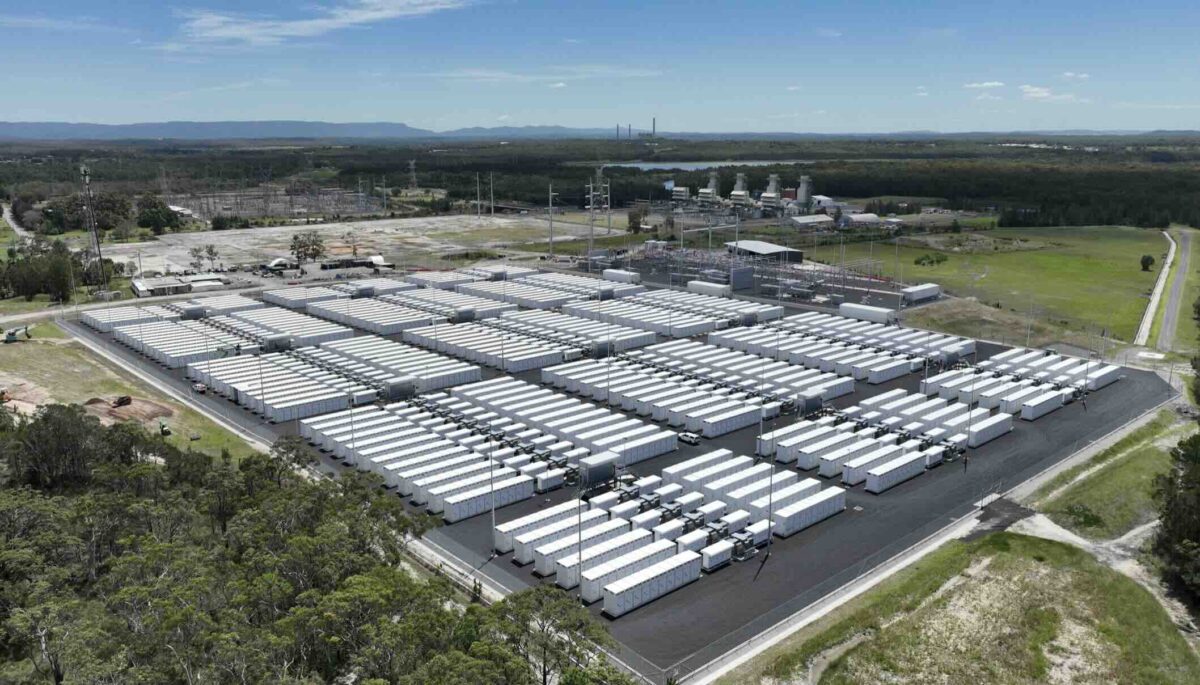
The 850 megawatt (MW) and 1,650 megawatt hour (MWh) Waratah Super Battery, built by Akaysha Energy at the site of the shuttered Munmorah coal generator on the Central Coast of NSW, recently completed the installation and energisation of a replacement transformer and is clearly in a hurry to lock in its delayed grid security contract.
Earlier this week, as Renew Economy reported, it conducted a two-hour long discharge into the grid at 700 MW in a first test of its ability to meet the full requirements of its Security Integrity Protection Scheme, essentially acting as a kind of giant shock absorber to the grid that allows transmission lines to import power from the regions at greater capacity.
On Friday, between 1pm and 3pm, it conducted the second of these tests, discharging an average 700 MW over two hours. And, for good measure, then charged at 850 MW for a brief period to show the full range of its capacities. (See graph below courtesy of Open Electricity).

The milestones were celebrated online by Akaysha CEO Nick Carter.
“Great day of testing today up at the Waratah Super Battery,” Carter wrote on LinkedIn. “SIPS test #2 conducted at 700MW. Also had a bonus 850MW charge for a short time.
“Plant performance was good and is a testament to the whole Akaysha Energy team and all our partners for the endeavour and perseverance to get to this point. Onwards ….”
Renew Economy understands that Akaysha will now wait for the tests to be verified and then for its lucrative full SIPS contract to be put in place, more than a year behind its original schedule. It has been operating on an interim basis since late last year.
The project and contract timeline was originally pushed back by delays in construction, and then by a “catastrophic” failure of one of its transformers, which had to be replaced, and damage to another, which was repaired in June.
The SIPS contract, designed to boost grid security and allow more renewable energy to be imported from the regions to support the major demand centres, requires the Waratah battery to inject up to 700 MW into the grid for at least two hours in case of a line failure.
Three generation projects – the Metz solar farm, the Sapphire wind farm and the Tumut pumped hydro generator – have contracts as “pairs”, meaning they will be paid to dial down their output to offset the injection by Waratah should it be required.
Waratah will also be available to flex its entire 850 MW capacity should it be required by the Australian Energy Market Operator in the case of a potential supply shortfall, flagged as a LOR (lack of reserve) event.
To join more than 29,000 others and get the latest clean energy news delivered straight to your inbox, for free, click here to subscribe to our free daily newsletter.