The CEO of Fortescue says that the switch to renewables – which the iron ore giant is seeking to lead by reaching “real zero” in just four years – has been made much easier by the impact of President Donald Trump’s ill-advised war on Iran.
Fortescue has long argued that the switch to wind, solar, battery storage and electric trucks and other mining equipment has been an economic necessity as well as an environmental one.
But it says that economics have been given a huge lift by the surge in fossil fuel prices in recent months, and the lingering uncertainty about the state of the market.
“It cost me 400 bucks to fill up my dual cab (ute) the other day with diesel, and then two weeks later, cost me 200 bucks,” Fortescue CEO Dino Otranto said at the Pilbara Summit in Karratha this week.
“Already I’m starting to think, well, that was just an anomaly. I’m not going to change my ways, right? But if you look back the last 20 or 30 years, you can now start counting those anomalies, you can measure them as a frequency.
“What we’ve seen in the Strait of Hormuz, and I can’t believe I’m going to be saying these words, but Trump’s done more to progress the climate agenda in three months than anybody has in the last 100 years.
“He (Trump) is saying that we can no longer rely on security of energy for us. Trying to economically forecast capital deployment when you’re getting 200 per cent swings in energy supply is completely crazy.
“When we’re talking about the economics of turning off diesel and diesel price doubles, diesel fuel tax incentives alone get blown out of the water. It’s simple economics. It is now a no-brainer.”
Fortescue says the Pilbara – one of the key economic drivers in Australia’s economy, and responsible for the vast riches of Gina Rinehart, Fortescue founder Andrew Forrest and the wealth of BHP and Rio Tinto – remains one of its most fossil intense, with renewables currently accounting for just two per cent of total electricity supply.
“You probably would have heard and received a lot of the same criticism that I and all of our companies have received, that you can’t build things here, you can’t connect infrastructure,” Otranto said.
“This is some of the harshest conditions on earth. You can’t change the way you’ve been mining for hundreds of years, and you definitely can’t run a heavy industry without fossil fuels.
“Right now we’re building one of the world’s largest, if not the largest off-grid energy networks on the planet. When it’s complete, it’ll include more than a gigawatt of solar generation, hundreds of megs (megawatts) of wind, gigawatts of battery storage, and hundreds of kilometres of transmission infrastructure.”
“By early next year we’ll have 290 megs of firm renewable energy across operating across our network, and that’s already the equivalent of about half of Perth’s energy demand, and that’s just the start.
“As more of these green grids come online, we’ll be talking about enough renewable energy to power the equivalent of an entire city, and by late next year we’ll be able to process all of our ore around the clock in our operating functions with all energy supply 24/7 from renewable power.
“Right now we have 1.1 gigawatts of solar under construction across many hubs in the Pilbara. There’s nobody in Australia right now building more solar than what we’re doing, and excitingly, there’s another 133 megs of wind underway right now at Nullagine.”
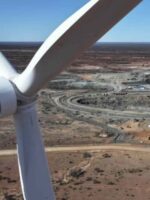
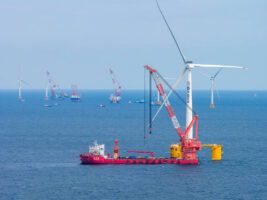
Otranto pointed to some of the cutting-edge technologies that the company has adopted, including the “self-lifting” wind turbine technology developed by Nabrawind, now owned by Fortescue.
It means that all components can arrive in class A truck and the turbines can be erected injustice 24 hours. “This is unheard of,” Otranto says.
Other innovations include the 5.6MWh of battery storage provided by BYD in shipping containers, with “thousands” being delivered to its facilities in Port Hedland, and the automated solar piling and module racking systems that can install panels at scale and at speed, despite the harsh conditions.
“It’s actually quite simple to put that technology to work and install solar panels at scale, and it’s a little bit like your automatic lawn mower back at home. You basically start it and let it go, and you just feed it with solar panels. It’s very simple.
“We’ve adopted technologies that are on the cutting edge, bleeding edge, and sometimes are non-existent. Robotics and automation is core to what we do, because if we’re serious about building renewable energies at scale, and that’s what the world needs, you cannot do it the same old way.
Otranto says that the entire Pilbara’s share of renewables will rise to 25 per cent from 2 per cent by the time that Fortescue has finished its wind, solar and battery installations, and this in turn will offer the opportunity for second and tertiary industries such as green metals, data centres and hydrogen.
“This is not just a morality cause for climate change, it is economic, profitable, and a no-brainer,” he said.”I think there’s been a lot of talk, and we’ve been behind a lot of it over the last five years, but the world is now starting to open.”
If you would like to join more than 29,000 others and get the latest clean energy news delivered straight to your inbox, for free, please click here to subscribe to our free daily newsletter.
If you wish to support independent media, and accurate information, please consider making a one off donation or becoming a regular supporter of Renew Economy. Please click here. Your support is invaluable.