Getting weather forecasts wrong is costing some solar farms a significant sum of cash, a new report finds.
Solar farms paid out 32 per cent of all frequency performance payments (FPP) penalties between June last year and April this year, despite producing only 8.7 per cent of total generation on the east coast.
But this is the system working exactly as it should be, says report author Julian de Hoog, founder of solar forecasting company Solstice AI.
“It does look to me like the whole system is working as intended,” de Hoog told Renew Economy. “Even though it looks like solar is overly penalised, that is just the nature of how solar works.”
De Hoog’s data takes in the start of a new system introduced by the Australian Energy Market Operator, the FPP, which penalises generators that cause destabilising effects on the grid and reward those who stabilise it.
The nature of renewable energy sources such as wind and solar means they will see sudden and unexpected changes that are out of their control – an unexpected cloud, a random burst of wind – so they pay a penalty.
The big winners have been batteries followed not by gas, but by coal and hydro services.
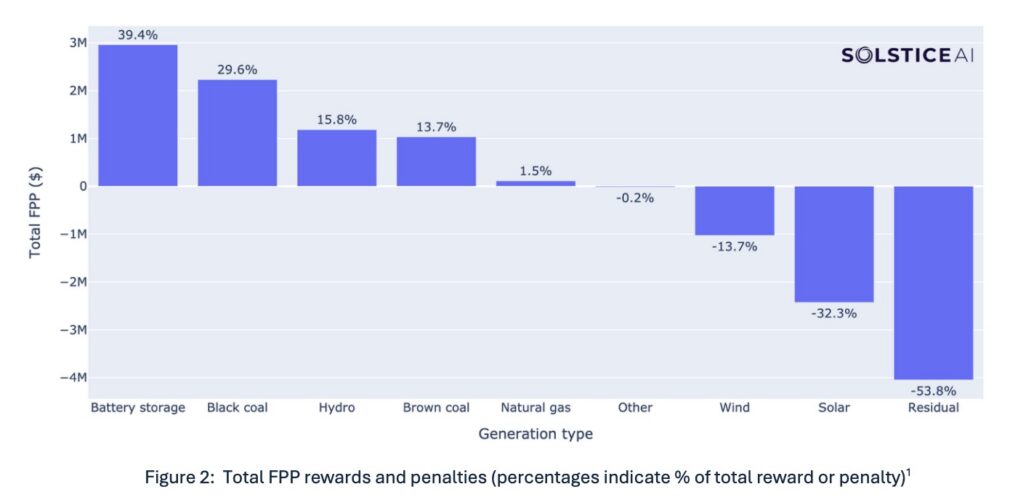
Total frequency-related costs averaged $0.38 per megawatt-hour (/MWh) over the initial June-April period, equivalent to 1.23 per cent of wholesale market revenue, found the report One Year of Frequency Performance Payments.
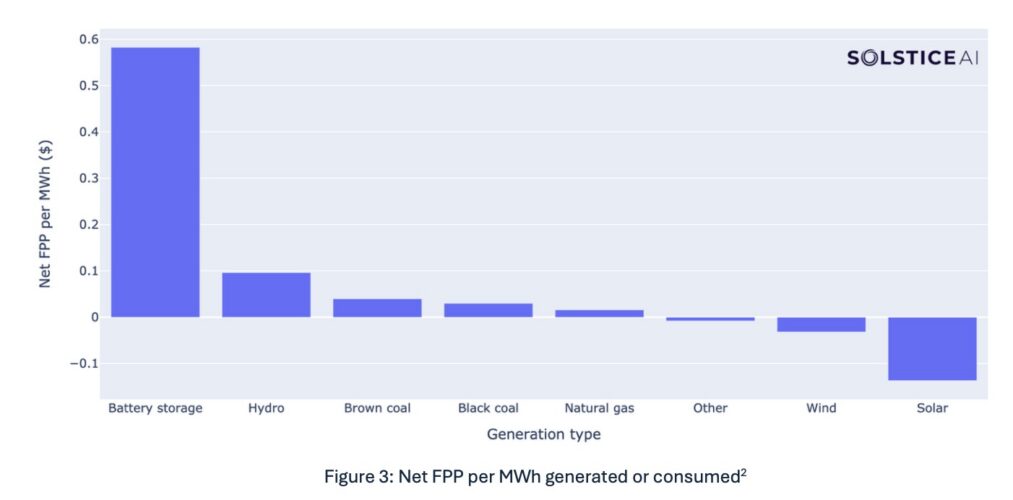
But that number masks big differences in regions, across seasons, and even between individual solar farms.
September through November were the high-cost months for solar, generally, thanks to weird weather movements.
“One thing that I was really looking for in doing this analysis was major regional impacts,” de Hoog says.
“Are there times of the year when all the solar farms [in New South Wales for example] are paying penalties and all the solar farms in Victoria are earning rewards? And there is a little bit of that.”
In fact, NSW solar farms tended to have the highest costs per MWh generated of of $3.57 million in total, and it was solar farms in South Australia that incurred the lowest of $219,000.
The report speculated that this is because more local weather variability makes it harder for solar farms to accurately follow their electricity dispatch targets, as well as decisions made by owners as to how they run their assets.
Wrong forecasts are expensive
What surprised de Hoog most was that two solar farms next door to each other could be simultaneously paying and receiving FPP penalties and rewards.
On November 3 last year, three solar farms in the Kerang region of Victoria were experiencing a very different day: one was paying more than $2/MWh, one was earning that much in FPP rewards, and one was paying a tick under $1/MWh in penalties.
“That confirms that the way [owners] operate [assets] and the decisions they’re making has quite a big impact,” de Hoog says.
“That comes down to forecasting and operating decisions, and the ones doing that more accurately will be doing better.”
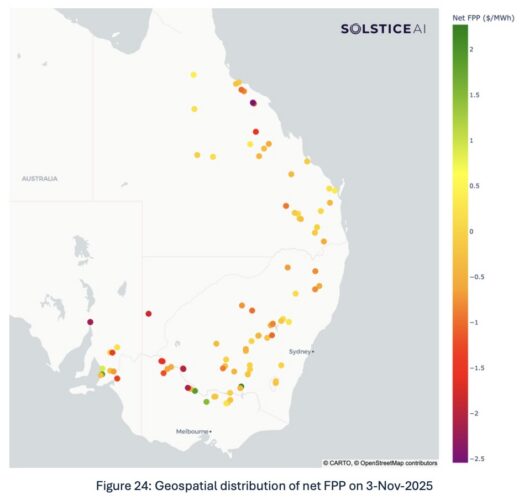
FPP penalties or rewards paid on November 3, 2025. Image: Solstice AI
And while solar farms are beginning to operate at night, thanks to batteries, they clearly aren’t generating power.
And yet 22 per cent of solar farms’ FPP and other frequency costs come at night, or about $1.47 million worth.
This is because the FPP is tied not to participation in any given moment, but the fact that a generator is connected to the grid. The cost of frequency control and ancillary services is still charged to a grid participant, even if it’s a solar farm and it’s 2am, if they’re part of a relevant portfolio of cost recovery.
Equally frustrating is that sometimes the solar duck, when too much solar power is being generated during the day, can also mean higher regulatory penalties.
“A sunny spring day may lead to low or negative spot prices due to solar over-supply, while also leading to higher FCAS regulation prices to properly manage frequency,” the report found.
“For solar farms, such situations may lead to relatively high regulation cost exposure during periods when energy revenues are low.”
If you would like to join more than 29,000 others and get the latest clean energy news delivered straight to your inbox, for free, please click here to subscribe to our free daily newsletter.