Potential demand for non-Chinese made poly-silicon – crucial to the solar sector – could put Australia in a box seat for the material, if the country can turn a $1.3 million report into an actual industry.
The Australian Renewable Energy Agency (ARENA) has spent $1.3 million of the $1 billion Solar Sunshot fund on a report into whether a poly-silicon plant in the Hunter Valley might be feasible.
The answer is yes, provided the plant has access to cheap power, manufacturing materials and low capital costs, and if the final product could offer “sustainable” pricing.
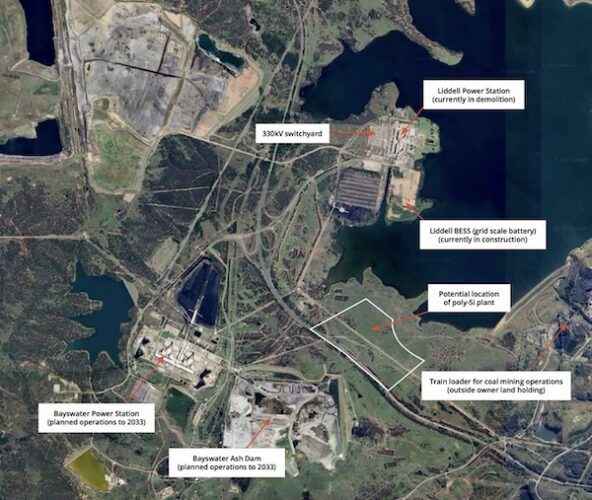
A 50,000 tonne a year polysilicon plant at AGL’s Hunter Energy Hub in the Bayswater/Liddell coal power plant site could throw off a huge number of benefits – not least replacing thermal coal exports as Australia’s primary energy export, the report says.
That volume would be enough for 27 gigawatts (GW) of solar panels, for a start.
Polysilicon production is the most energy-intensive part of making a solar panel, turning metallurgical silicon into PV-grade material. Product is limited to places with cheap electricity and investors with strong stomachs – currently China, the US, Germany, Malaysia and Oman.
With solar prices at $0.04/kWh in Australia last year, the country is well placed at least on the electricity side, the report says.
“A structural shift in the global polysilicon market is creating a unique opportunity for Australia in a diversifying and rapidly expanding solar supply chain,” the report says.
“The growing demand for non-Chinese poly-Si enables Australia to build a new, globally relevant and viable industry exporting a critical, processed mineral with a high embedded energy content.”
And while Chinese-made polysilicon prices crashed to below $10/kg in 2023 due to oversupply – a situation that last year still saw capacity at 3.5 million tonnes versus demand of 1.2 million tonnes – the report still claims that non-Chinese made product can command three to five times the price premium.
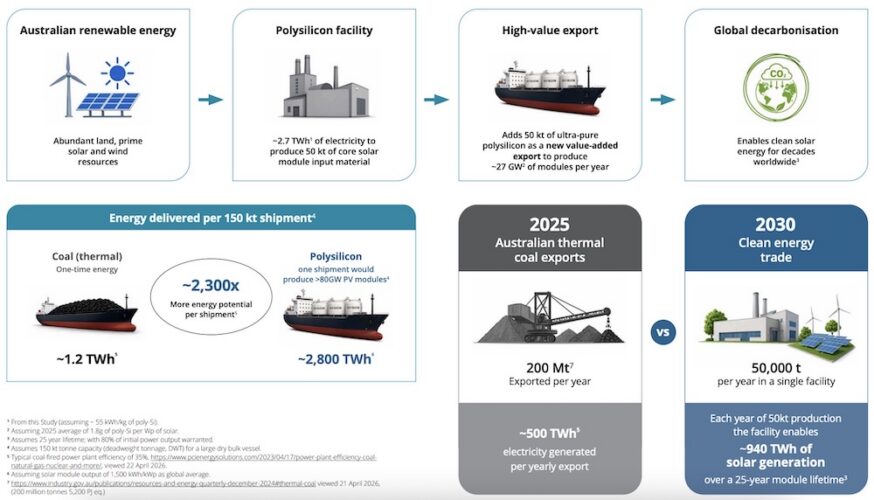
It would take a major mindset shift to move from coal exports to manufactured polysilicon — or even PV panels — but this ambitious ARENA-backed report says it might be possible. Image: ARENA
The reports suggests there is a projected supply gap of non-Chinese made polysilicon of about 240,000 tonnes by 2035 and 350,000 tonnes by 2040.
“An Australian poly-Si facility commencing production by early 2030’s would be well positioned to fill the emerging supply gap,” it says.
But to do this, planning, engineering, and funding must start immediately to have a factory running in time.
And a Hunter Valley plant alone would cost $2.5 billion to $3.5 billion, albeit spinning off an estimated $1.1 billion a year into the economy.
This kind of factory is what was envisioned by the Future Made in Australia platform in 2024, from which the most recent budget stripped $300 million in uncommitted funding from the Battery Breakthrough Initiative and Solar Sunshot programs.
If a Hunter polysilicon plant were to be built, it would not have competition from Townsville, where major clean energy investor Quinbrook had been backing a factory.
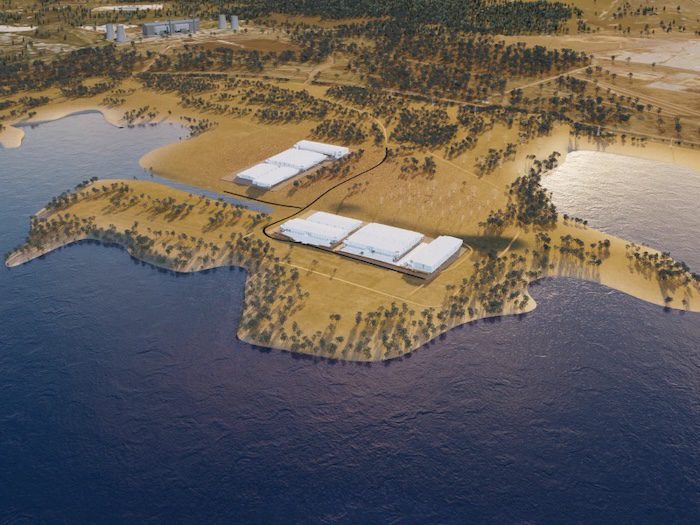
That site still includes a solar materials precinct, backed by a massive 2,200 megawatt-hour (MWh) battery, but the plan is to make metallurgical silicon from locally mined quartz, a precursor to the further refined polysilicon.
The Townsville plans are beginning to move through formal planning processes.
If you would like to join more than 29,000 others and get the latest clean energy news delivered straight to your inbox, for free, please click here to subscribe to our free daily newsletter.