The federal and state governments have announced the results of two key renewable and storage tenders for Western Australia, with six wind farms, two solar-battery hybrids and another two minimum seven-hour battery projects emerging as winners.
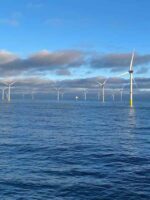
The tender for renewable generation was the first of its type in Western Australia and will see six new wind farms built totalling 1.5 gigawatts (GW) of new capacity, although it does include one project, Tilt Renewables’ Waddi wind farm, that had already reached financial close and has an off-take deal with AGL.
Two solar-hybrid projects emerge victorious – Trina’s 350 MW Killawarra project winning in the generation tender, and Enpowered and Plenary Group’s Collie battery and solar hybrid, with 200 MW and 1518 MWh, which won the separate dispatchable tender.
Two other standalone eight-hour battery projects also won contracts in the dispatchable tender, Neoen’s 200 MW, 1600 MWh Yathro project and Frontier Energy’s 82 MW, 565 MWh Waroona project, which was allowed to resubmit in this tender after failing to meet conditions in a previous tender which it won.
All told, the generation tender will deliver 1.9 GW of new wind and solar capacity and 2.1 gigawatt hours (GWh) of storage, while the dispatchable tender will deliver 482 MW of capacity and 3,683 MWh.
The projects represent more than $5 billion of new investment, and all are due to be delivered before 2030, by which time the last of the state owned coal fired generators will be shut down.
The 10 winning projects were chosen from 25 that submitted in the tender, and will end up delivering significantly more capacity than was sought. The state government expects its grid will be operating on a share of 80 per cent renewables by 2030.
“These projects will help keep the lights on, put downward pressure on power prices and cut emissions with cheaper, cleaner renewable energy backed by storage,” the two governments said in a statement.
Federal energy and climate minister Chris Bowen says it is the biggest electricity boost in the history of the state, which faces a unique challenge in its transition from coal because it is regarded as the largest isolated grid in the world, with no connections to other states. So it cannot rely on other grids, or pumped hydro.
“(This is) exactly what the Capacity Investment Scheme was designed to deliver. Cleaner, cheaper energy, backed by storage, built in the regions and powering Australian homes and businesses,” he said in a statement.
“WA’s energy system is changing, and the Albanese Government is making sure that change means more reliability, more investment, more jobs and lower bills and emissions.”
The CIS has been criticised because many of the projects that have won underwriting agreements in the country’s main grid have yet to move forward, although Bowen has defended the scheme, saying it was not designed to deliver electrons yet, but by the end of the decade to meet the 82 per cent renewable energy target.
However, in an interview in a recent episode of Renew Economy’s Energy Insiders podcast, Bowen conceded that “more work needs to be done on wind,” sparking speculation of potential rebidding or other changes to the scheme.
See: Energy Insiders Podcast: Chris Bowen on renewable target, wind delays, EVs and electrification
The statement said 65 successful CIS projects have been announced to date, which translates to 13 GW of renewable generation and 21.6 GWh of clean dispatchable capacity.
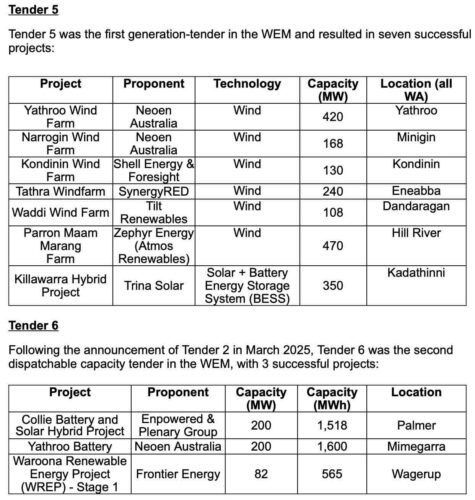
Neoen emerged as the biggest winner of the latest tenders, continuing its extraordinary success at such auctions at state and federal level.
It wins for its 420 MW Yathro wind farm, and the separate 200 MW, 1,600 MWh battery, as well as the 168 MW Narrogin wind project. It has also built one of country’s biggest operating batteries at Collie, sized at 560 MW and 2,240 MWh, beaten only by Synergy’s 500 MW, 2,500 MWh battery just up the road.
Those batteries will now be joined at the Collie battery and solar hybrid, taking total battery capacity at the state’s biggest coal centre to around 1.5 GW and more than 6 gigawatt hours.
Other winners include Synergy’s Tathra wind farm, Zephyr Energy’s Parron Maam Marang wind project, and Shell and Foresight’s Kondonin wind farm.
Both Parron and Kondonin already have off take agreements with state government authorities and have been given priority status – as has Narrogin – and many of the projects have proposed capacities over and above the amount awarded in the CIS contracts.
See: State rolls out red carpet for four new wind projects in race to replace ageing coal generators
The governments say the estimated social licence commitments for these projects include over $1.1 billion in shared community benefits, $894.8 million in benefits for First Nations communities and over $1.1 billion in Australian steel.
If you would like to join more than 29,000 others and get the latest clean energy news delivered straight to your inbox, for free, please click here to subscribe to our free daily newsletter.