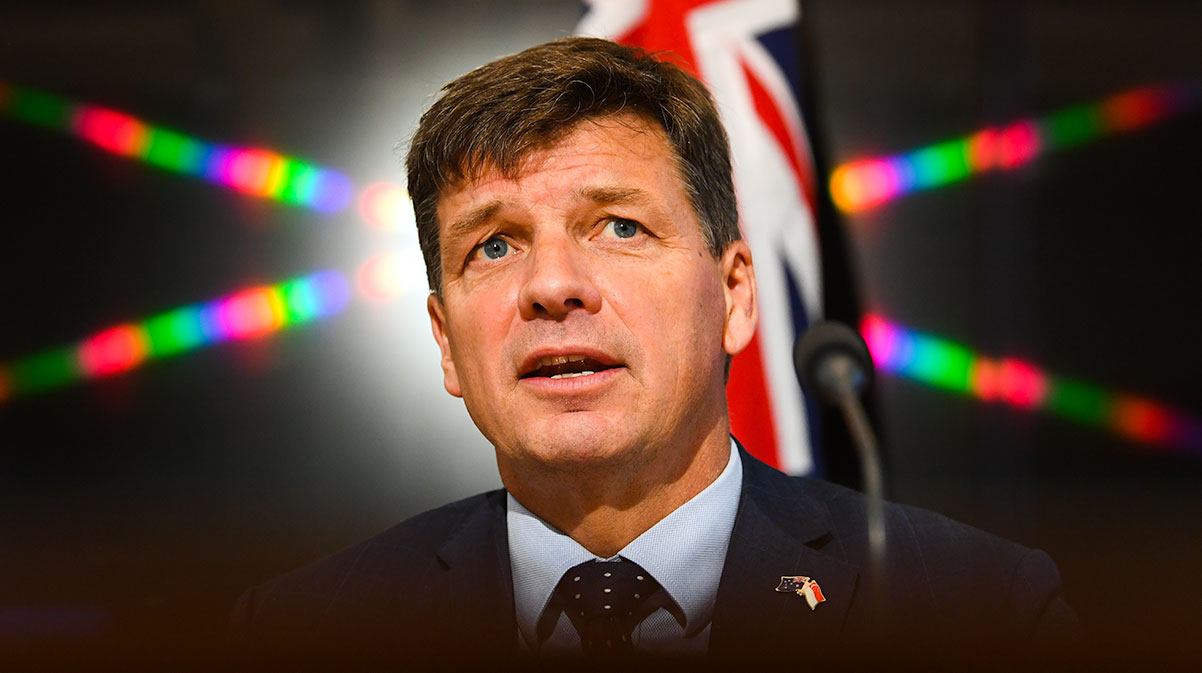
Angus Taylor has been appointed leader of the federal Liberal opposition after winning a vote against Sussan Ley, 34 to 17, and cutting short her stint as the first woman to lead the party to just nine months.
Ley, meanwhile, has returned the favour by quitting parliament and kicking off Taylor’s reign with a potentially damaging by-election.
The leadership spill followed polling that showed the Coalition’s primary vote had slumped to a record low – and overtaken by Pauline Hanson’s One Nation, which now counts ex-Nationals leader Barnaby Joyce in its ranks.
Taylor, the member for Hume in New South Wales, said in a Facebook post on Thursday that his reboot of the LNP would start by holding the “failing Labor government to account, for their total mismanagement of our country, and advocate for solutions to the problems that Australians are facing.”
But Taylor takes the helm with a few failures of his own to reckon with. His pre-election 2022 spell as shadow Treasurer, for example, was recently described by Sky News host Andrew Clennell as a “litany of errors,” that contributed significantly to the LNP’s defeat.
Then there is Taylor’s years-long stint in the energy and climate portfolios of the Morrison government, including as minister for energy in 2018-2019, energy and emissions reduction (2019–2021), and industry, energy and emissions reduction (2021–2022).
To quote Greens Senator Sarah Hanson Young in an interview on Thursday, also on Sky News, he failed at that, too: “‘fantastic, great move, well done Angus’.”
So what can we expect from opposition-leader-Angus-Taylor on energy and climate? Let’s take a look at his record.
On climate, Taylor embodies the ideological division that has riven the Coalition for more than a decade.
Having been the co-architect of the Liberal Party’s net zero by 2050 policy, by late 2025 he was widely believed to be part of the conservative push to have the party formally abandon it – a job Ley got done in November last year.
In 2018, when first appointed as energy minister, Taylor declared there was “too much wind and solar in the grid” and argued that “baseload” coal and gas needed to be supported.
He has also been known to declare that wind and solar is causing “de-industrialisation” and to describing renewables as a “wrecking ball to the economy.”
Taylor – and his family – has a particular antipathy for wind energy, describing it as an “economically unviable industry” and notably attending at least one anti-wind protest.
Confusingly, however, one of his last major acts as federal energy minister was to announce the successful passage through parliament of the Offshore Energy Infrastructure Bill, in September 2021.
“An offshore electricity industry in Australia will further strengthen our economy,” Taylor told parliament at the time.
“Offshore generation and transmission can deliver significant benefits to all Australians through a more secure and reliable electricity system, and create thousands of new jobs and business opportunities in regional Australia.”
In 2020, as Minister for Energy and Emissions Reduction under Morrison, Taylor masterminded the Coalition’s plan for “gas-fired recovery” from Covid.
“We are building a robust and competitive gas industry that will allow both gas producers and users to thrive, with lower prices and lower emissions benefiting all Australians.”
That has not panned out. Research from The Australia Institute in July last year revealed that Australia’s gas exports have led to the tripling of wholesale east coast gas prices and doubling of electricity prices, since they began in 2015, the last year of Tony Abbott’s prime ministership.
As Renew Economy’s Giles Parkinson put it in 2022, “Taylor is … widely regarded as the most useless energy minister in living memory: A giant bollard standing in the way of smart policy and huge investments.”
We hope to discover this is no longer the case. But early indications are not promising.
“Australia needs an energy policy that is based on common sense, not Labor’s net zero ideology,” Taylor said on Friday in his first press conference as Liberal leader.
“We will get rid of Labor’s bad carbon taxes, on the family vehicle, on manufacturing and food in this country, and of course on electricity.”
With some reporting from AAP