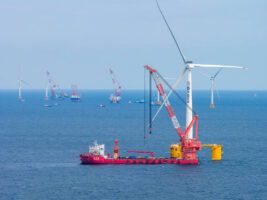
The Victoria state government has announced that it now plans to hold the long awaited but delayed first auction for offshore wind farms in Australia in August this year, but is yet to finalise the details of its structure.
Victoria is the only state government in Australia to have a specific target for offshore wind – it wants 2 gigawatts in place by 2032 and 9 GW by 2040 – and was to kick off the auction process last September.
But that was delayed – amid uncertainty about port and transmission facilities, and the new energy market design – and was a crushing disappointment for some of the most advanced projects in Gippsland, particularly the Star of the South project which is generally regarded as the most likely first project.
On Tuesday, Victoria energy minister Lily D’Ambrosio said a request for tender, the initial part of the auction process, for 2 GW of capacity will open in August this year.
She said work continues on the design process, which will also depend on the final shape and details of the new Electricity Services Entry Mechanism that has been proposed by the Nelson review on market settings as the new mechanism to support renewable and storage projects in Australia.
“We want to give industry the certainty it needs to invest and help us keep building the renewable energy Victorianeeds to push down energy bills,” D’Ambrosio said in a statement.
“We’re working closely with developers on the progress of this exciting auction to ensure strong competition to secure the best projects and best value for Victorians.
“We’ve always said Victoria will host the country’s first offshore wind industry and that’s why Victoria pushed for the ESEM to accommodate technologies including offshore wind.”
The move comes amid mixed news for the offshore wind industry in Australia and around the world. In the US, the Trump administration is trying to destroy the industry, issuing stop work orders that are slowly being overturned by court appeals.
However, in Europe, 10 countries announced on Monday plans to build an interconnected offshore wind power grid in the North Sea that is expected to provide 100GW of renewable electricity.
In the UK earlier this month, the latest tender delivered a surprisingly high 8.4 GW of capacity and a lower than expected price low(ish) strike price of £90.91 ($A182.91/MWh), and at £89.50/MWh in Scotland.
That price is still considerably higher than the prevailing wholesale market price in Australia, and particularly run Victoria where wholesale prices are generally low.
It is difficult to see how Australia can deliver offshore wind at a lower price than the UK, even though its proponents argue that its value lies in delivering power to the grid at times of high demand, particularly the evening peak, when wholesale prices are higher.
Still, the move was heralded as a “milestone” from environmental groups, and was welcomed by the owners of the Star of the South project, which says it is ready to go.
“We are ready for the next steps, having lodged Star of the South’s environmental approval applications with government and purchasing the land required for the project’s shore crossing,” Charles Rattray, the CEO of Southerly Ten, which is developing the Star of the South project, said in a statement.
“Bass Strait is home to world-class offshore winds and shallow seabed – our extensive site studies confirm that Star of the South is feasible and ready to deliver benefits to Gippsland, Victoria and Australia.”
Environment Victoria noted that the auction news came amid a new heatwave, and as the remaining coal fleet continues to experience serious reliability issues, with repeated unplanned outages at Yallourn and Loy Yang in recent months.
“Victoria is already making strong progress, with renewables providing 42.4 per cent of the state’s electricity last financial year and delivering the lowest wholesale electricity prices in the country,” said Environment Victoria’s Senior Climate and Energy Advisor Dr Kat Lucas-Healey.
“An offshore wind industry will build on that momentum and deliver the large-scale, reliable clean energy needed to fully replace aging and unreliable coal-fired power stations over the next decade.”
“Offshore wind is a crucial part of Victoria’s future renewable energy mix, and today’s announcement is a milestone in harnessing our state’s significant offshore wind resources. “
Gippsland represents Australia’s best chance of developing offshore wind, given the rejection of the technology by South Australia, and the failure of floating offshore wind projects to gain a foothold, or even generate any interest now, in NSW.
Last week, the federal government announced feasibility licences had been issued for three projects totalling 4 GW for Western Australia, but also announced none had been issued for the Bass Strait (out of Tasmania) because the proposals were not competitive.
Victoria says it has some of the best offshore wind resources in the world, and argues it is critical over the long term as it closes the last of its brown coal generators in the Latrobe Valley that have underpinned the state’s grid for the last half century.
Victoria has a state-based renewable energy target of reaching 95 per cent renewables by 2035, assuming that the last of the brown coal generators (likely Loy Yang B) is all but shut by that time.
It has recently created the state-owned SEC, which is supporting renewable and storage projects and has already taken control of two key onshore projects – one wind, and one solar and battery storage – that were struggling to get to market through their private owners.
“Thanks to our record investment in renewable energy, Victoria consistently has the lowest wholesale electricity prices in the country,” the government said in its statement.
“Building more new renewable energy sources adds more affordable energy to the grid an helps to lower power bills for everyone.
“The offshore industry is expected to create over 6,000 jobs and generate billions in investment. Gippsland has=always been critical to keeping the lights on and to continue to keep downward pressure on power bills.