
Well, that turned out just as expected. Origin Energy, the biggest energy utility in the country has announced that the country’s biggest coal generator, Eraring, will close four years after the original “early closure date” announced way back in 2022. But it’s not for the reasons you might expect.
At 2.88 gigawatts, Eraring accounts for around 20 per cent of the electricity needs of NSW, the biggest state grid in the country. To close it requires more wind, solar and storage to be built, something that didn’t happen in time for its first “early closure” date of August, 2025.
But there is no reason to think there would have been a shortfall of supply in August, 2027, the second “early closure” announced in 2024, despite the determined efforts of Origin not to build or contract any new wind or solar before that date, and the miserable efforts by the other big energy retailers.
The new reason cited by Origin for the third and final early closure date of April, 2029, is not energy “reliability” – whether there is enough power to meet demand – but energy “security”, the question about grid resilience in the face of massive disruptions, such as the sudden loss of a transmission line or an ageing coal plant like Eraring.
The issue was highlighted as an “unresolved issue” in the Australian Energy Market Operator’s Transition Plan for System Security released in early December.
That document, as Renew Economy reported at the time, highlighted emerging system security issues in the biggest grids of NSW and Victoria, particularly with the impending retirement of coal fired generators such as Eraring and potentially Vales Point in NSW, and Yallourn in Victoria.
Ironically, the only state without a system security issue is South Australia, the country’s most advanced renewable grid, with a share of 75 per cent wind and solar, and a goal to reach 100 per cent net renewables by the end of next year.
That’s because South Australia ditched the last of its “baseload” coal generators a decade ago, and has had plenty of time to figure out what happens next, and has become a testing ground for new technologies such as grid forming batteries inverters that can deliver those critical grid services.
In the eastern states, where old fossils still reign supreme – on the grid and the corridors of power – there is still an obsession with spinning machines.
The likes of Tesla, Fluence and other battery suppliers have insisted that their grid forming inverter (GFM) technology – which now comes part of nearly every new big battery project connected to the grid – can deliver all those critical services, addressing issues such as inertia, system strength and fault current.
See: How to break Australia’s dependence on spinning machines, and run the grid with fossil engines off
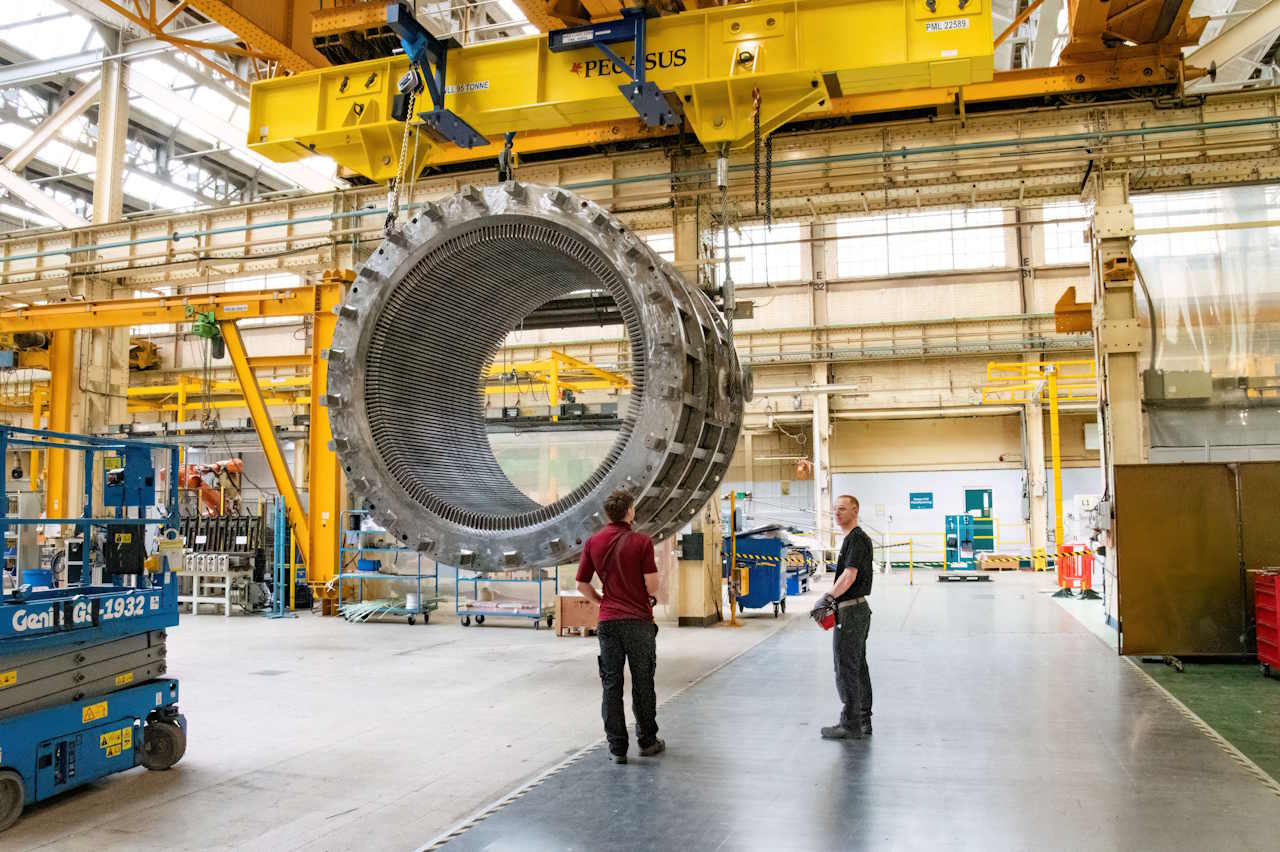
The problem is that AEMO, and particularly the big transmission companies who are held accountable for the provision of these services, are not yet fully convinced. They are half way there, but want the assurance of synchronous condensers, a 50-year old technology that provides spinning machines without burning fuel.
The problem is that syncons – apart from being very expensive kit – are nearly impossible to find in the timeframes needed to accommodate the near term closure of Eraring, or even the remaining three coal fired generators in the state.
Origin needed little encouragement, knowing how much money it can make by keeping Eraring open for another two years, and cited the AEMO system security report high up in its press release.
AEMO is planning to fast-track a number of trials – including a world first test where they will create an “islanded grid” with more than 100 megawatts of demand to test the credentials of grid forming inverters – but it will be too late to alter the delay to the Eraring closure.
Which means several things. For a start, there will be a lot of battery grid forming inverters doing useful things for the grid, and some are even contracted to deliver “system strength”, but they will not be used to anywhere near their full capabilities.
As Tesla and others have insisted, they can do this for a fraction of the cost of bulky and costly syncons, mostly because they can do more than two things at once. But AEMO and the transmission companies say they need more evidence.
The Eraring delay is also bad news for other clean energy investment. The Clean Energy Investment Group says the Eraring extension will dent the confidence of investors to back new energy projects.
“The decision to extend Eraring is a consequence of slow and inefficient planning approvals for new clean energy and we can’t let this happen again,” said Richie Merzian, CEO of the Clean Energy Investor Group.
“Investors are ready to deliver the clean energy we need in NSW, but inconsistent planning, slow assessments and grid access constraints are delaying projects and pushing back the transition.”
This was echoed by Johanna Bowyer, the lead analyst for Australian Electricity at Institute for Energy Economics and Financial Analysis (IEEFA), who said coal life extensions scares off new renewable investment.
“Eraring was already extended once, extending it for another two years undermines certainty right when investors in new replacement generation need clarity,” she said.
“Clear, credible coal closure dates are essential if we want new clean energy built on time. Extending coal plant lifespans before fully utilising lower-cost, cleaner options like energy efficiency and appliance upgrades in NSW homes is a missed opportunity.
“The original agreement between the NSW Government and Origin Energy, which left open the option for Eraring to run until 2029, has prolonged uncertainty about the plant’s closure.”
Energy expert Joel Gilmore, a Climate Councillor and head of policy at Iberdrola Australia, says the rollout of renewables needs to be accelerated, rather than slowed down “so that we don’t keep dipping back into the destructive well “of fossil fuels.
“Every year we extend a coal plant we increase the risks of relying on an ageing and unreliable facility,” Gilmore said.
“The evidence is clear that once these plants get beyond 40 years of age they increasingly start to fail, and that is an expensive risk and a dangerous one, particularly at this time of year when they are more prone to outages just when people most need to know they can rely on power.
“Eraring is the next coal plant of many that is reaching the end of its life in New South Wales and we can’t keep extending these banged-up old jalopies at huge financial and environmental cost to each and every one of us.”
The irony is that, despite the new extension of Eraring’s coal life, NSW may find itself at time without any coal fired generation at times – within five years, according to the AEM system security report.
That’s because Eraring and Vales Point will be retired by then, and the remaining generators at Bayswater and Mt Piper will either be on planned or unplanned outages for maintenance.
AEMO is concerned there will not be enough syncons, and that gas generators won’t have enough gas. Those isolated grid trials – and the acceptance that big grids can run with “engines off” and no spinning machines – cannot happen quickly enough.
Tesla insists that it can be done, although to accept this fact may require a different way of thinking about the grid, and certainly not through the eyes of legacy technologies.
“While grid-forming batteries can be tuned to provide similar responses to syncons, it’s important to recognise that they are different technologies,” Tesla writes in a white paper released last September.
See: Tesla says battery inverters can do the job of spinning machines at a fraction of the cost
“Technical assessments should focus on power system outcomes, rather than replicating the characteristics of legacy synchronous sources of inertia.”
And once this is done, it will mean we will not have to depend on spinning machines, least of all the ones that burn coal and send out emissions that could be the death of us all. For now, we are being held hostage by this obsession with spin.
If you would like to join more than 29,000 others and get the latest clean energy news delivered straight to your inbox, for free, please click here to subscribe to our free daily newsletter.