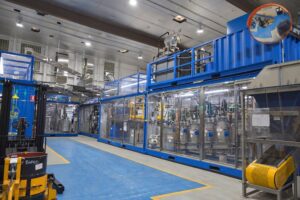
The second two gigawatt hour battery to be built in the old coal town of Collie has started operations, heralding the extraordinary transformation that is seeing the town transform into a massive battery bank.
Collie is playing host to the country’s two biggest batteries (in terms of storage), with Neoen’s 560 megawatt (MW), and 2,240 MWh Collie battery already operating, and Synergy’s 500 MW, 2,000 MWh Collie battery also charging and discharging into the grid for the time in the last two weeks.
Both batteries – like some other smaller installations – will play a key role in soaking up excess rooftop solar and injecting it into the evening peaks, the part of the daily cycle once dominated by coal and gas.
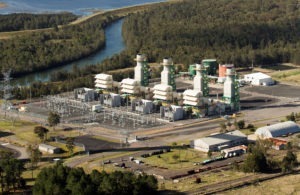
In Collie, within four years, the last of the three remaining coal units owned by the state owned Synergy will be closed, and most likely the struggling privately owned Bluewaters will close too.
That will take more than 1,000 MW of capacity out of the grid – the world’s biggest isolated grid without the ability to export and import from other states or countries – and this will be replaced by the two big Collie batteries, and others that are being built, have been contracted, or have underwriting agreements with the federal government.
AEMO, in its most recent 10-year outlook, noted that these big batteries are flexible and can address multiple issues, including the evenings peaks and the middle of the day troughs caused by the so-called solar duck curve.
“The expected connection of more than 1,000 MW of battery storage by 2026-27 will provide the ability to meet fast increases and decreases in demand and also help address declining minimum demand,” it wrote.
“This battery storage could soak up excess solar output in the middle of the day, potentially avoiding the need to trigger Emergency Solar Management (solar switch off measures). The stored energy could then be discharged during periods of high demand.”

Rystad Energy’s Sally Bogle posted this interesting graph highlighting the changing nature of the energy capacity (not generation) in Western Australia over the last 15 years.
Note how nothing changed for a decade up to 2020, but now rooftop solar and battery storage are shooting ahead, particularly the storage.
“The recent energization of Synergy’s CBESS facility means operational BESS capacity in Western Australia’s main grid has surpassed coal power for the first time,” she writes.
“Big batteries are now the third-largest source of capacity in the Wholesale Electricity Market (WEM) with a 15% share. If all goes to plan, this will rise to 34% by 2030 when BESS capacity could exceed 4 GW/18 GWh.
“The opportunity to time-shift WA’s high and rising rooftop solar output to the evening peak is enabling BESS operators to earn revenue from real-time trading and price arbitrage.”
“It’s also alleviating curtailment at standalone wind and solar farms and helping the ‘duck’ lose a bit of weight.”
An example of this attack on the solar duck was given by AEMO in its recent quarterly update, where it noted the ability of big batteries to offset the fall in the “minimum demand” to levels that AEMO considers risky for the grid.
AEMO says that underlying demand fell to just 449 MW, but 384 MW of battery charging lifted total grid demand to above 830 MW, a level the market operator considers safe.

The impact of big batteries – before the start of the Synergy Collie battery, is highlighted above, with purple showing the increase in battery output, particularly in the morning and evening peaks.
Also of note, in the pink, is the country’s first solar battery hybrid, at Cunderdin, which is also providing regular output in the evening peak. Gas, AEMO notes, is the technology that is being displaced.
If you would like to join more than 27,200 others and get the latest clean energy news delivered straight to your inbox, for free, please click here to subscribe to our free daily newsletter.