Key Takeaways
- ARENA has committed nearly $4 million to support drone-based solar inspection technology developed at UNSW.
- The technology uses Daylight Photoluminescence (DPL) imaging to identify faults in solar panels more accurately than traditional methods.
- Lab 360 Solar, a new start-up founded in 2024, aims to commercialize the DPL technology by integrating it with drones.
The Australian Renewable Energy Agency (ARENA) has committed nearly $4 million to support a drone-based solar inspection technology that has been developed at the University of New South Wales and which could dramatically transform the way in which large-scale solar farms are monitored.
The drone technology is seen as crucial to unlock daytime photoluminescence (DPL) imaging of solar systems being developed by researchers from UNSW’s world-renowned School for Photovoltaic and Renewable Energy Engineering.
Traditional luminescence image data acquisition methods are normally conducted in carefully designed and light-tight enclosures. But this lab-based method is impractical for rapid and cost-effective analysis of large-scale and utility-scale solar farms.
A new UNSW start-up, Lab 360 Solar, which was founded in early 2024 and which has exclusive access to key DPL patents from UNSW, now aims to commercialise the technology by integrating it with commercially available drones.
The DPL imaging helps to identify faults and damage in solar panels that other inspection methods can sometimes miss, providing details right down to individual cells.

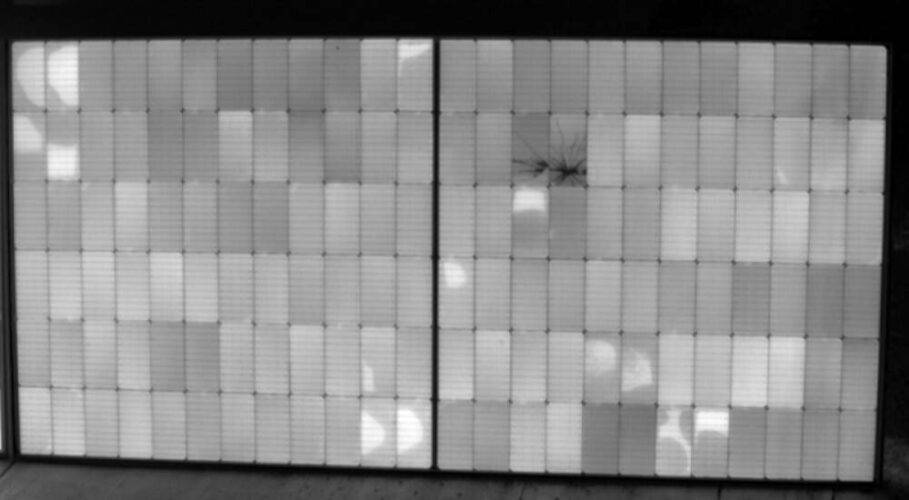

DPL imaging is also more accurate, cheaper, and easier to use than traditional approaches which invariably require more equipment, people, and off-site testing.
“Our drone-based Daylight Photoluminescence technology is a result of more than two decades of systematic research and development into luminescence imaging at UNSW,” said Thorsten Trupke, CEO of Lab 360 Solar.
“Once rolled out commercially, first in Australia and then globally, it will be central to ensuring that photovoltaic panels are a reliable and sustainable cornerstone of the future energy mix, by enabling better monitoring, early fault detection and long-term performance of solar assets.
“Australia, with its world-leading adoption of solar power and its ambitious trajectory towards net zero, is the perfect place to pioneer and commercialise this innovation. We are genuinely excited to play a small part in the incredible energy transition that is currently taking place.”

Image Credit: Lab360
The development of DPL technology at UNSW was backed by previous ARENA-funded projects, and Trupke says that the latest ARENA funding is vital in getting Lab360 off the ground and ensuring its technology can be transitioned from proof-of-concept demonstration into fully operational commercial solutions.
“Australia has world-class solar researchers and start-ups, but too often their technologies struggle to make the leap from lab to market,” said Darren Miller, ARENA CEO.
“Supporting great ideas, like Lab360’s DPL technology, to prove their value and scale as commercial solutions that benefit the whole industry, is exactly why we back innovative R&D and why investing early is key to achieving our Ultra Low-Cost Solar vision.
“This technology has the potential to significantly reduce the cost and complexity of solar farm diagnostics. By spotting issues early and reducing the need for heavy equipment and associated labour, this innovation helps operators get the most out of their solar panels and supports Australia’s clean energy future.”
Want the latest clean energy news delivered straight to your inbox? Join more than 26,000 others and subscribe to our free daily newsletter.