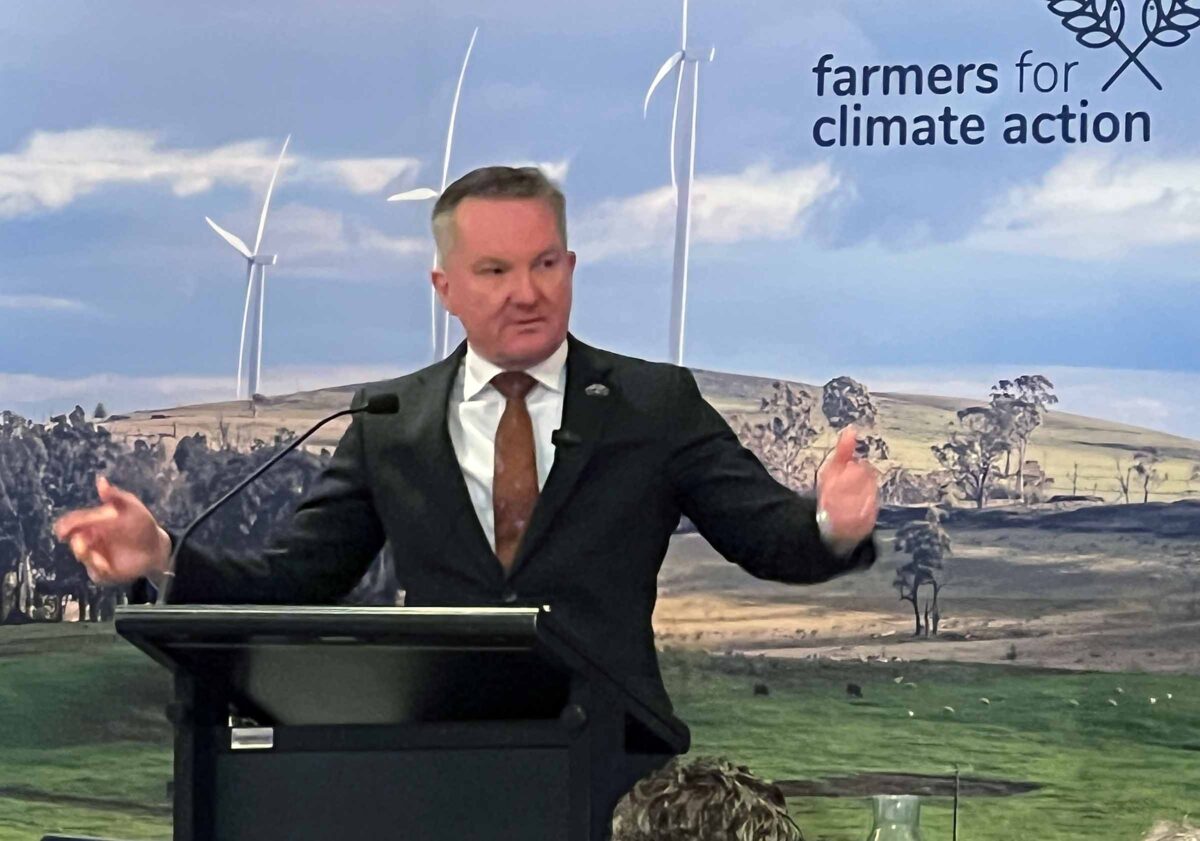

Out of the frying pan of federal parliament and into a farmers’ forum: Federal energy and climate change minister Chris Bowen, left Parliament House on Tuesday morning — where he said he had been listening to “lots of speeches” decrying renewables — to deliver a rallying call to the Farmers for Climate Action summit in Canberra.
Bowen arrived at the tail end of a panel discussion on unlocking fair energy access for regional Australia, where farming representatives had been openly critical of both the renewable energy industry, and the government.
Speakers argued that farmers are too often treated as just another stakeholder to be consulted, rather than recognised as genuine partners who are already leading on emissions reduction.
“It’s more than just listening. I think farmers, and rural communities want to be partners in this,” said Brett Hosking, a grain farmer from Quambatook in Victoria’s Mallee, and president of the Victorian Farmers Federation.
Against that backdrop, Bowen attempted to strike a rallying tone.
“I’ve come to you from Parliament House, where there’s lots of speeches being given that are explaining to Parliament that everyone in the regions is against the transition,” Bowen told the audience. “That it’s a terrible thing.”
The audience of several hundred at the summit is largely pro-renewables, as long as they are built n the right place. And in the light of Hosking’s comment, Bowen admitted that there are real issues that need to be addressed with the rollout of wind, solar and transmission.
“You don’t manage the biggest economic transition in the history of the country without learning things as you go, improving as you go, ensuring that community consultation is improved, benefits are improved, that we take people with us,” Bowen said.
“This is a fundamental choice about whether our economy thrives and prospers, and whether our regions will thrive and prosper, or the country withers.”
Bowen said that despite the speed and scale of disinformation campaigns, the science and economics remained clear.
“We can ignore the problems. We can pretend climate change isn’t real,” Bowen said. “We can pretend the world isn’t warming but that won’t change the science. It won’t change the economics that renewables are the cheapest form of energy and the world is getting hotter every single year and is hotter than the year before.
“You know better than most Australians the impact of climate change because you see farm productivity falling, you see droughts worsening, you see floods worsening.”
2035 target and sector plans
Bowen confirmed that the government will set Australia’s 2035 emissions target in coming weeks.
“It’ll be an ambitious target, but an achievable one,” he said. “[But] I can guarantee you, when we do release the target, it will annoy everyone, because everyone will think it’s either too high or too low.”
He also announced that six sectoral emissions reduction plans will be rolled out, including one for agriculture.
“Dealing with climate change and food security isn’t a choice. It’s fundamentally a comprehensive and complementary challenge,” he said.
Bowen also pointed to the government’s capacity investment scheme, which he said will deliver around $800 million in benefits for communities, and added that “if we get it right … a billion dollars worth of benefits for farmers and hundreds of millions of dollars worth of benefits for communities between now and 2030.”
He also highlighted that the strongest uptake of home batteries under the government’s cheaper battery scheme since its introduction on July1, hasn’t been by “inner city, latte sipping lefties.”
See: “This is not inner-city, latte-sipping lefties:” Bowen hails regions as battery rebate numbers surge
“The electorate in New South Wales with the biggest take up is Gilmore, Nowra and Ulladulla. The biggest in Australia is Mayo in regional South Australia. The biggest in Queensland is Wright.”
Of the renewable energy target, which aims to reach 82 per cent renewables, and a 43 per cent cut in emissions, Bowen said: “We now have 52 months to 2030 — that goes real quick. We wasted a lot of time over the last decade. We don’t have time to waste now. I intend to keep going with it, and getting on with it.
“This is the opportunity for our country. This is the opportunity for all of us. We can ignore the challenge, pretend it’s all too hard, or we can tackle that challenge with all its related difficulties, and we can make it a winner for our country, a winner for our farmers, a winner for our regions.”
But not all farmers in the room were convinced.
“It was very much: we’ve got an agenda, we’re going to push it through — forgetting that pushing it through involves people and communities,” said Hosking.
“We’ve got an energy plan. We don’t have an agriculture plan,” he told RenewEconomy. “If we had an agriculture plan — or a plan for rural communities — we’d be overlaying the energy plan with agriculture and with regional development. Maybe we’d get to a much better outcome if we were doing that.”
His comments highlighted a recurring theme of the summit: that while farmers broadly recognise the opportunities renewables can bring, they want to be genuine partners in shaping the transition — not just recipients of top-down policy.
See also: A tale of two summits: Gina Rinehart’s net-zero siege versus farming’s renewable lifeline