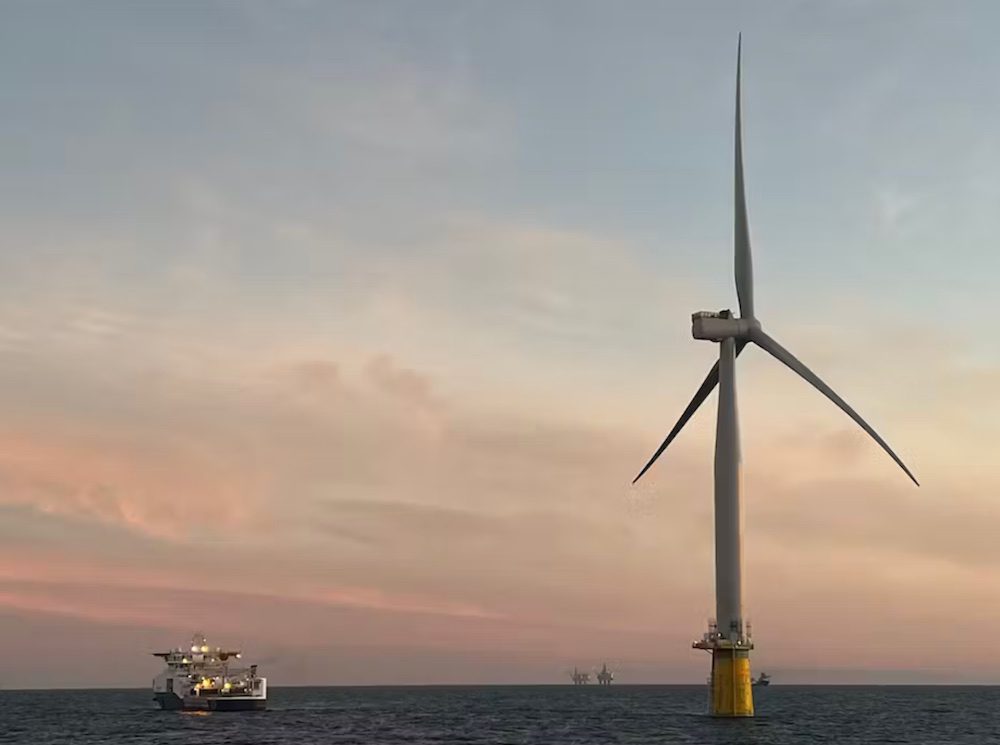
Federal Labor says its offshore wind plans for waters off the coast of the New South Wales Hunter region are not sunk, just on ice, after the pin was officially pulled on the only project in the development zone to be offered a feasibility licence.
The developers behind the Novocastrian Wind project, Norwegian oil giant Equinor and Oceanex Energy, confirmed on Friday that they would not proceed with the feasibility licence offered by the government due to a combination of “global challenges” and “project-specific factors.”
The up to 2GW project was offered the licence in June of last year, in the comparatively small Pacific Ocean zone, which covers an 1,800km2 stretch between Swansea and Port Stephens, and would have been the first in Australia to host floating turbines.
In a joint statement on the project website, Equinor and Oceanex said they continued to view the Hunter region as “well positioned to lead Australia’s energy transition.”
“The Hunter was selected for its strong characteristics for an offshore wind industry, including a legacy of heavy industry and innovation, established infrastructure, regional supply-chain potential, and high quality wind resources.”
The statement also says that Oceanex Energy – founded by Australian offshore wind pioneers Andy Evans and Peter Sgardelis – “remains committed to exploring options for offshore wind to support jobs, investment, energy supply and security, and prosperity for Hunter and NSW.”
But, as Bowen himself noted on Friday, Oceanex is not big enough to go it alone on a project of this scope, let alone in one of the toughest spots to develop offshore wind in Australia, in terms of the degree of technological and financial difficulty.
“They’re too small,” Bowen told ABC Radio Newcastle on Friday morning. “They’re a great company, but they are too small to undertake such a big project alone. They don’t have the access to the capital.
“They are experts in their field ..[but] they would be the first to say this is too big just for them. They need a partner and frankly, an international partner, given there’s no offshore wind being built in Australia yet.
“But their interest and hopes for the Hunter is undiminished.”
Licence to keep trying
To help keep the interest and hopes of Oceanex and other potential developers bubbling along, Bowen on Friday announced the introduction of Research and Demonstration licences to support the development of floating offshore wind.
Federal energy minister Chris Bowen says the licences will allow development and testing of offshore renewables technology in designated development zones by developers, scientists, researchers and other interested parties.
“Today we are releasing new guidance to help … interested parties apply for Research and Demonstration licences … establishing a home for offshore renewables research, as well as commercial generation projects,” Bowen said on Friday.
“While floating offshore wind is nearing commercialisation, there’s still more work to do to support its development.
“The Hunter offshore wind zone remains ripe for investment given their local workforce, experience with heavy industry, and large energy use.”
Bowen says licences might be used to deploy monitoring equipment such as special buoys to assess the feasibility of a region, or to demonstrate projects to investigate viability of new technology before applying for a feasibility licence to progress to a full commercial project.
Research and Demonstration licences are proposed to last for 10 years and will be available across all six declared offshore wind zones. Applications will be assessed for their appropriateness and projects will require community consultation.
“These Research and Demonstration licences are a big green light to domestic and international investors, signalling that Australia wants to be home to the next technological advance when it comes to offshore renewable development,” the minister said on Friday.
“Our first priority for Australia’s offshore renewables areas is to deliver cleaner and cheaper energy, we know there’s a huge reserve of renewable resources on offer if we can develop the technology to harness it.
“Australian waters are the perfect place to research and develop these technologies, demonstrate their viability and work towards turning our clean energy potential into gigawatts of power.”
In the meantime, Bowen says the Hunter offshore wind zone is far from dead and buried, but rather will be “harder and slower than we hoped” to pursue.
“This was never … going to be a this week, this month, this year proposition,” he told ABC Radio. “This was always about the 2030s and I think that remains the case. Maybe a bit later in the 2030s than we originally envisaged, but this is a long-term project.
“This is about ensuring that we have the energy going forward for our growing electricity needs, whether it be for AI data centres or for heavy industry.”
The government is seeking feedback to improve and finalise its Research and Demonstration licence application guidelines, with public consultation open 22 August to 3 October 2025.