Orica’s Hunter Valley Hydrogen Hub has become the second project to receive funds from the federal government’s much-vaunted Hydrogen Headstart program, as the Australian Renewable Energy Agency put another $2 billion on the table for more green hydrogen projects.
Federal energy and climate minister Chris Bowen on Friday said chemicals giant Orica will receive $432 million for its proposed 50 megawatt (MW) green hydrogen electrolyser facility at the Kooragan Island ammonia production facilities near Newcastle.
It is the second major project to receive funding from the headstart program – after the $814 million allocated to Copenhagen Infrastructure Partners’ 1,500 MW Murchison green hydrogen project in Western Australia last year.
However, these will be the only two of the six shortlisted projects to get funding from the first round, which is now wound up.
The federal government had hoped that Stanwell’s promising CQ-H2 green hydrogen project in central Queensland would also get over the line, but this was effectively nixed by the new state LNP government, which is waging its own war against renewable and climate programs.
Three other projects also failed to get across the line – in Kwinana, Tasmania, and another Port of Newcastle project put forward by Japanese giant Kepco.
Arena says it has now opened consultations on a second round that will also offer $2 billion and has launched a new consultation paper.
“While the current costs of producing renewable hydrogen are high and the industry has faced challenges as it navigates the early stages of its scale-up, renewable hydrogen remains an important enabling tool for the decarbonisation of many hard-to-abate sectors and ultimately to achieving net zero,” the agency says.
Bowen was at the Orica hydrogen hub in 2023 to announce a separate $70 million of funding to progress the project, which then involved Origin Energy, but the utility giant has since withdrawn from the project, saying at the time the investment was too risky.
The green hydrogen is destined to replace fossil gas in Orica’s ammonia production process.
“This investment shows we can secure existing industries such as ammonia and fertiliser production by transforming how they’re powered – creating new clean-tech jobs and future-proofing the Hunter’s economic base,” Bowen said in a statement on Friday.
“Regional communities like the Hunter will lead the way in Australia’s transformation into a renewable energy superpower – and this project is a great example of what that looks like in practice.”
Arena CEO Darren Miller says hydrogen still has an important role to play in decarbonising heavy industry, particularly where electrification isn’t possible or where other alternatives are limited or don’t exist. This is despite the failure of numerous potential projects to get across the funding line.
“Renewable hydrogen is an important decarbonisation lever for applications like ammonia production where hydrogen has traditionally been produced with fossil fuels,” he said in a statement.
“Orica’s project is a great example of what’s possible.”
Orica still needs to work with ARENA to satisfy a number of conditions and demonstrate its ability to meet a range of contractual milestones before the funding is released. Funding under this program is paid based on actual production volumes over a 10-year operating period.
The funding was welcomed by the Port of Newcastle, which said it had received strong interest in the technology from potential partners in Germany, Japan and South Korea.
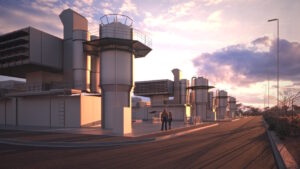
“We are building for the future of our region, city, and port. As the design shows, we can accommodate different forms of clean energy, including ammonia and hydrogen,” Port of Newcastle CEO Craig Carmody said in a statement.
“Port of Newcastle has always said we are agnostic when it comes to the type of clean energy produced at the Port’s Clean Energy Precinct. Our job is to ensure that, when coal finally declines, we still have energy from the Hunter and Newcastle to export to the world. This design proves this goal can be achieved.”
The Clean Energy Council says more than half of the world’s hydrogen is used for the production of ammonia, which is a critical component in fertiliser production, as well as plastics, explosives and textiles.
Almost all of that hydrogen is derived from fossil-based gas, but green hydrogen is made through a process of electrolysis using renewable energy to split water into hydrogen and oxygen.
“Renewable hydrogen projects in Australia are complex and challenging, but remain strategically important given that green hydrogen could be instrumental to domestic green iron processing and clean fuels production for long-haul heavy transport,” Ms Freeman said.
“Substantial public investment will be required to help first mover projects bridge the commercial gap between the cost of production and available market prices, as well as to develop the enabling common infrastructure for these major projects.”
Freeman welcomed the consultation process for the new round of funding, noting that market conditions and the domestic and international policy settings have continued to shift he first phase of the Hydrogen Headstart program was launched in 2023.
Orica’s Managing Director and Chief Executive Officer Sanjeev Gandhi said: “We’re grateful for this crucial support, which brings us closer to realising the Hunter Valley Hydrogen Hub and advancing the decarbonisation of our Kooragang Island facility – a site we’ve proudly operated for over fifty years. We look forward to continuing our collaboration with ARENA and other Federal and State government agencies to support the transition of Orica’s Kooragang Island manufacturing facility and help shape a cleaner, more resilient future for the Hunter region.”
This project follows the announcement of the first recipient of Hydrogen Headstart, with $814 million allocated to Copenhagen Infrastructure Partners’ (CIP) 1,500 MW Murchison Green Hydrogen Project in Western Australia. With both projects now announced, Hydrogen Headstart Round 1 has now concluded.
To date, ARENA has allocated $370 million to 65 renewable hydrogen projects from early-stage research to deployment.
To find out more about Orica’s project, visit: Hunter Valley Hydrogen Project | Home
Consultation for Round 2 of Hydrogen Headstart is now open. For more information, visitRound 2 funding page.